If you’re thinking about trading or investing in stocks, one of the first things that comes to mind is a broker, especially as a beginner, when guidance and a reliable platform are essential.
When it comes to brokers, many platforms offer brokerage services, and one of the most prominent is Zerodha.
Zerodha is India’s largest discount broker by active clients.
The company disrupted the traditional brokerage industry by introducing a flat-fee model instead of the percentage-based charges typically followed by full-service brokers.
Platforms like Zerodha have transformed the Indian brokerage landscape by offering low-cost, technology-driven services that make investing more accessible to retail investors.
However, with convenience comes risk.
While discount brokers provide affordability and ease of access, investors must take greater responsibility for their own decisions.
Therefore, before investing, it is crucial to understand the risks involved, conduct thorough research, and develop a clear financial strategy rather than relying solely on the platform.
Zerodha Unauthorised Trading Complaints
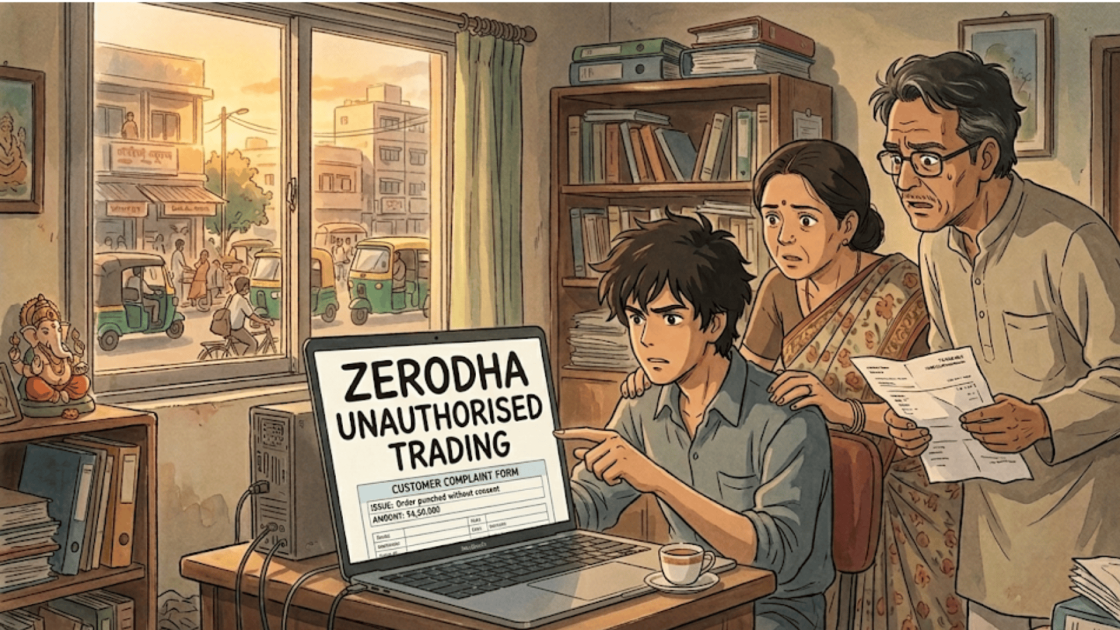
One major risk investors face is unauthorised trading.
Unauthorised trading refers to transactions executed in an investor’s trading or demat account without their explicit knowledge or consent.
In simple terms, if a buy or sell order is placed from your account and you did not approve or initiate it, that is considered unauthorised trading.
As illustrated in the table below, the total number of complaints recorded relates to unauthorised trading cases.
The data highlights the frequency of such incidents and provides an overview of the overall trend observed during the reporting period.
| Year | No. of complaints | No. of complaints for unauthorised trading | Percentage of unauthorised trading |
| 2025-26 | 734 | 89 | 12.12% |
| 2024-25 | 1075 | 129 | 12% |
| 2023-24 | 567 | 43 | 7.5% |
| 2022-23 | 446 | 40 | 8.9% |
Market losses are a normal part of investing. But if trades are executed without proper approval or if risk exposure is increased without a clear understanding, that becomes a serious concern.
The data indicates that while the total number of complaints has fluctuated over the years, the share of complaints related to unauthorised trading has remained notable.
With 2024–25 and 2025–26 showing a higher proportion compared to some earlier years.
This is concerning because unauthorised trading directly affects investor control over their accounts and can lead to unexpected financial exposure or losses.
When Can Action Be Taken Against a Broker?
Action can be taken against a broker when trades are executed without the client’s clear consent or when proper authorisation, such as OTP or TPIN verification, was not obtained before placing the order.
If a broker fails to issue contract notes within the prescribed time or does not maintain proper trade confirmation records, it may amount to regulatory non-compliance.
Serious action may also arise if there is evidence of manipulation, unauthorised use of client funds or securities, or any misuse of trading authority.
Additionally, if a broker fails to respond appropriately to a client’s complaint or ignores a grievance within a reasonable time, the investor has the right to escalate the matter.
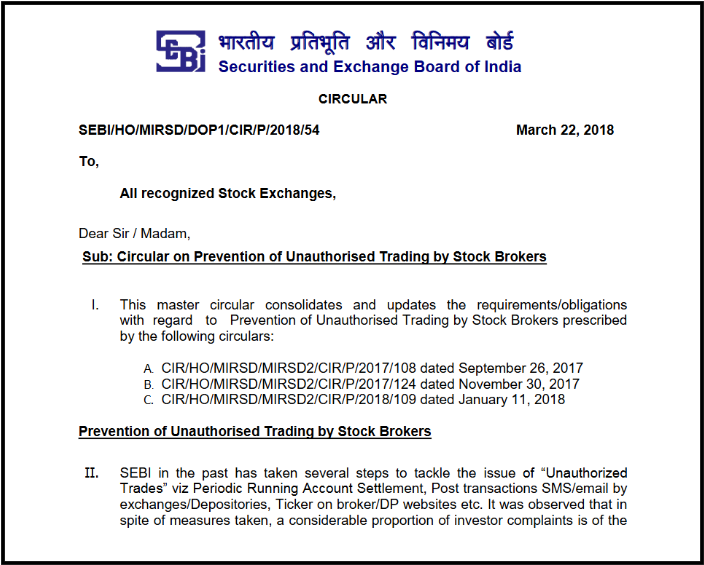
The image above refers to a circular issued by the Securities and Exchange Board of India (SEBI) titled “Circular on Prevention of Unauthorised Trading by Stock Brokers” dated March 22, 2018.
This circular consolidates earlier guidelines and lays down the responsibilities of stock brokers to prevent unauthorised trading in client accounts.
It also clarifies when and how action can be taken.
How to Complain Against a Stock Broker?
If you identify or suspect unauthorised trading activity in your account, it is important to act promptly and follow a structured approach to protect your interests.
The following steps outline the recommended course of action:
Step 1: Gather All Evidence
Begin by collecting all relevant documents and records that can support your case.
This includes account statements, contract notes, transaction records, email communications, SMS alerts, call recordings (if available), and screenshots of your trading account.
Proper documentation is crucial, as it serves as proof when raising a complaint or pursuing further action.
Step 2: Contact Your Broker Immediately
Reach out to your broker or trading member as soon as you notice any unauthorised transactions.
Notify them in writing (preferably via email) and request a formal explanation.
In some cases, the issue may result from a misunderstanding or operational error that can be resolved directly at this stage.
Step 3: File a Complaint in SCORES
If the broker’s response is unsatisfactory or the issue remains unresolved, you can lodge a complaint in the SEBI Complaints Redress System (SCORES) platform.
SCORES is an online grievance redressal mechanism that allows investors to file complaints against listed companies and registered intermediaries.
Ensure that you provide all supporting documents to strengthen your complaint.
Step 4: Escalate the Matter and File for Arbitration
If the complaint is not resolved through SCORES or at the broker level, you may escalate the matter by initiating arbitration in the relevant stock exchange.
If your complaint involves financial loss or negligence and remains unresolved, you may initiate arbitration proceedings by filing a complaint with SMART ODR.
Need Help?
If you believe unauthorised activity has taken place, the first step is to secure your account immediately.
Log in to your trading platform, change your password, and enable all available security features.
Review your recent trades, contract notes, and ledger statements carefully to identify the exact discrepancies.
If you need structured assistance in how to file Zerodha complaint to SEBI then register with us.
We will help you organise your evidence, including contract notes, ledger statements, bank entries, trade confirmations, and email communication, and convert scattered information into a clear, well-drafted, and professionally structured complaint.
We will also monitor the SEBI complaint status for your convenience.
A properly documented case significantly improves your chances of a fair resolution.
Conclusion
Unauthorised trading is a serious issue that can lead to financial losses and unnecessary stress.
However, the good news is that in most cases, it is largely preventable with proper awareness and basic security discipline.
As online trading continues to grow, so do cyber risks and fraud attempts, which makes investor vigilance more important than ever.
Platforms like Zerodha are generally safe, regulated, and equipped with risk management systems.
However, online trading security is a shared responsibility.
While brokers provide the infrastructure and safeguards, investors must follow safe digital practices and stay proactive.
In the world of investing, awareness is your first line of defence.
Stay alert, stay informed, and trade responsibly.