
Quick Summary
We reviewed the NSE arbitration awards involving 5PaisaCapital Limited where the tribunal directed the broker to pay the client. The wins ran from ₹10,000 to ₹15,24,182, and they turned on some strikingly specific failures. One client won because the broker’s app displayed different prices than the actual contract note. Another because a position was squared off while intimations went to an outdated mobile number. A third because a paid subscription was auto-renewed without consent, and the account then liquidated to recover the fee. This page sets out what these clients disputed and how each of them recovered.
What if the complaint 5Paisa rejected could still put money back in your account?
That is exactly what happened in several 5Paisa arbitration cases, where investors recovered ₹10,000, ₹36,000, ₹78,400, and even ₹15.24 lakh. If you think a “no” from customer support or the grievance desk is the end of the road, it isn’t.
These real cases show you when arbitration works, why investors won, and what you can learn before filing your own claim.
Why Arbitration Matters for a 5Paisa Dispute
Here is what most people miss: Arbitration is not another support ticket that vanishes into a queue. It is a neutral tribunal that hears your dispute and passes an award the broker has to honour.
5Paisa built its name on a low-cost, app-first model that brought a huge number of first-time traders into the market. That same model, heavy on technology and light on hand-holding, is where several of these disputes began.
When the app misfired, or a process ran on autopilot, the loss landed on the client, and the grievance desk offered little, turning routine 5Paisa issues into arbitration disputes.
So we looked at the cases that went all the way to an award. What they show is that these losses are recoverable, and the reasons they succeeded are worth understanding before you file.
5Paisa Arbitration Cases: The Wins on Record
Each of these awards directed 5Paisa to pay the client. The table gives the shape; the sections below explain the ones that carry a lesson.
| Year | What went wrong | Awarded |
|---|---|---|
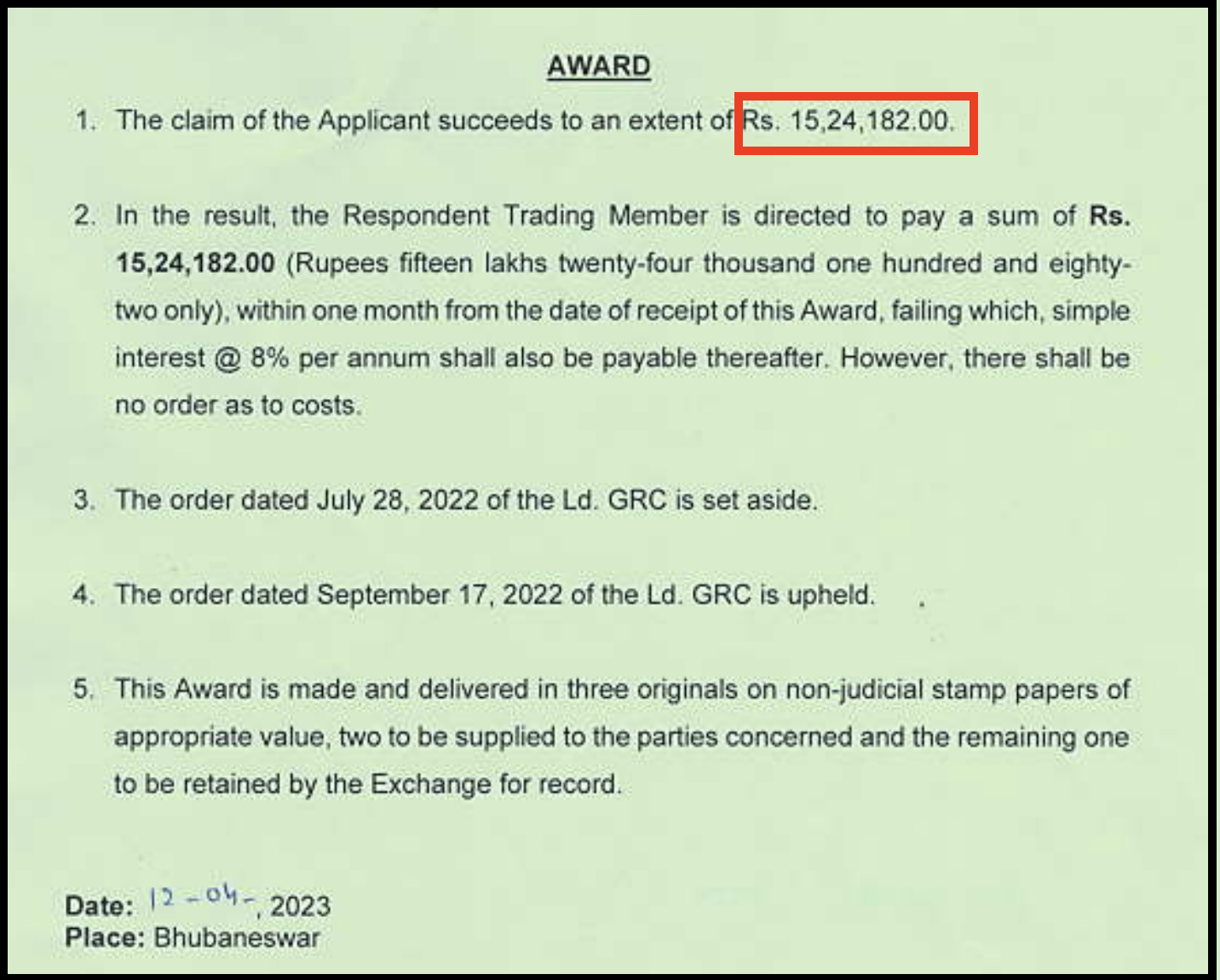
| 2023 | Technical glitch and forced square-off | ₹15,24,182 |
| 2021 | App showed different prices than the contract note | ₹78,400 |
| 2021 | Square-off with intimation sent to old mobile number | ₹36,000 |
| 2021 | Auto-renewed subscription, then liquidation to recover it | ₹10,000 |
Four different failures, four recoveries. The amounts vary widely, but a single thread runs through all of them, and it is worth naming before we look at each.
What Actually Decides These Cases?
Read the four together, and the pattern is clear: 5Paisa was held responsible for what its own systems and processes did to the client.
- An app that showed one price and billed another.
- A square-off notice sent to a number the broker itself had failed to update.
- A subscription that renewed on autopilot and triggered a liquidation.
- A platform that glitched on a high-stakes trading day.
In each, the client did nothing wrong; the broker’s technology or process did.
That is the recurring opening. When the failure traces back to the broker’s own system, the tribunals placed the loss on the broker, not the trader. Each case below shows how that played out.
When the App Shows One Price and the Bill Shows Another
This is the most distinctive of the four, and the most unsettling if you trade on an app.
A client placed 36 buy and sell orders in a single day. After each one, the app’s order screen showed the trade “fully executed” at a particular price. Going by those prices, she should have come out ahead.
Instead, her balance fell. When she compared the app’s screen against the contract note the broker sent the next day, the prices did not match. The app had shown her better prices than the ones she was actually billed at.
The broker’s defence was that the order screen only showed the price at which an order was placed, not the final traded price, and that the real figure sat in a different column and in the contract note.
The tribunal did not accept that a “fully executed” trade could be treated as merely notional. Once the app confirms a trade as done at a stated price, that is the figure the client relies on. Showing one price on the screen and another on the bill defeats the whole purpose of the app.
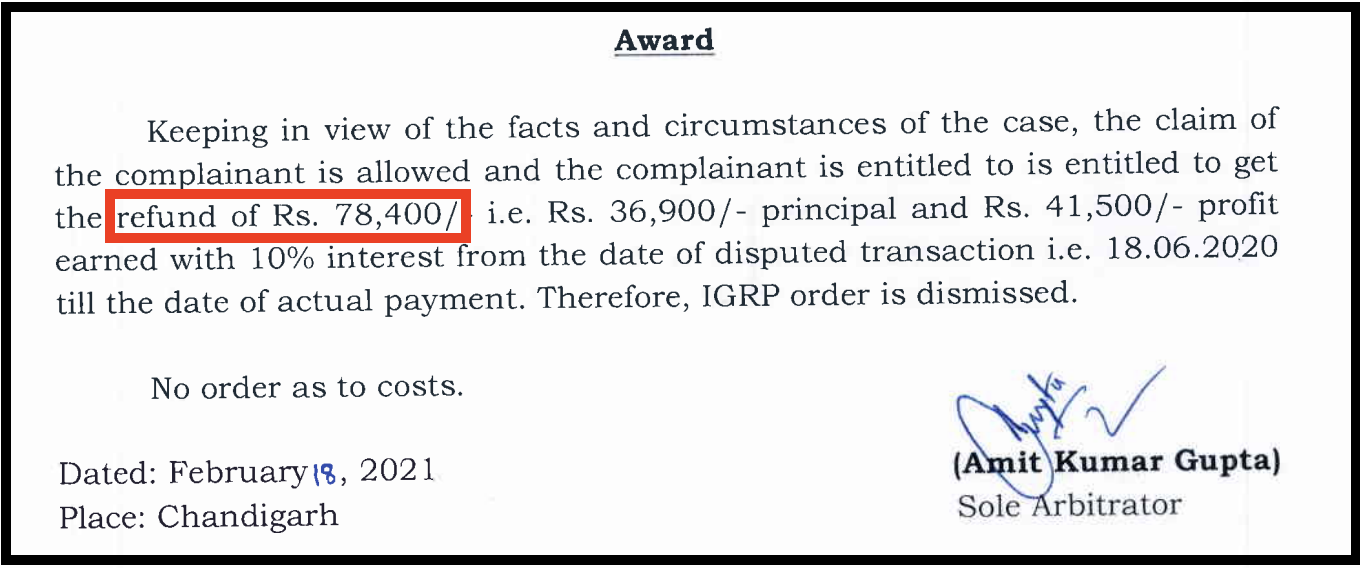
The tribunal held the broker had provided wrong trade figures and ordered a refund of ₹78,400, being the ₹36,900 the client had put in and ₹41,500 in profit she should have seen, with 10% interest.
The takeaway sits right underneath the case, so keep it in mind if your app and your contract note ever disagree.
When the Broker Sends the Notice to the Wrong Number
A broker can square off your position for a margin shortfall. That part is normal. What it cannot do is claim it warned you when it sent the warning somewhere you would never see it.
A client had changed his registered mobile number, and the broker had confirmed the update. Months later, when his account ran short on margin, the broker squared off his stocks and booked him a loss of ₹36,000.
Its defence was that it had sent SMS intimations before liquidating. But it emerged that those trading alerts had gone to his old number, because the broker, by its own admission, had delayed updating the change in its trading system and blamed the pandemic and work-from-home.
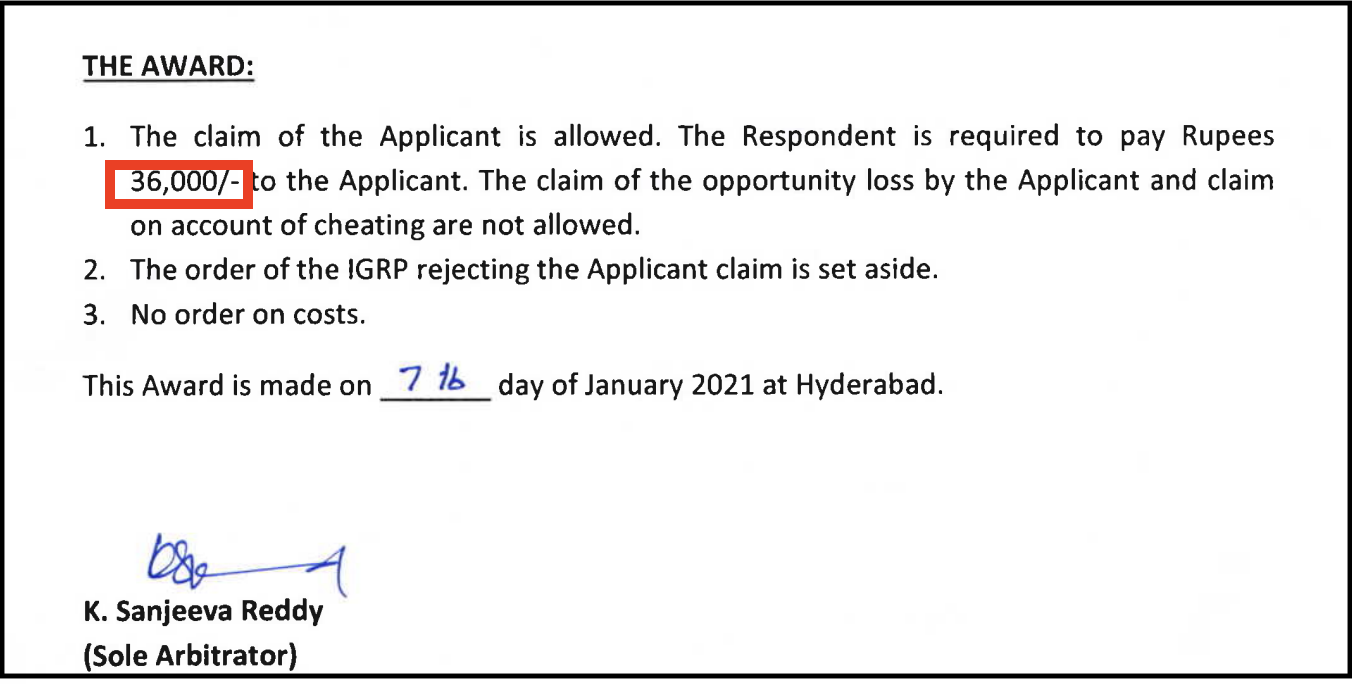
The tribunal held that sending the intimation to a number the broker knew was outdated meant the client was not duly intimated at all. Because he never got the warning, he never got the chance to add funds and save the position. It set aside the grievance committee’s order and awarded him the full ₹36,000.
The principle carries into the next case too: a broker’s right to square off is tied to giving the client a fair, real chance to respond.
When a Subscription Renews Itself and Costs You Your Shares
This one is unusual, and it is a warning for anyone on a paid broking plan.
A client had bought a yearly subscription plan. A year later, the broker auto-renewed it and debited the fee, which pushed his account into a negative balance. To recover that shortfall, the broker then liquidated his shares.
His argument was simple: the renewal was never something he had clearly agreed to, and it should not have been forced on him, let alone by selling his holdings.
The tribunal examined where the auto-renewal term actually lived. The broker pointed to its FAQs. The tribunal held that FAQs are only clarifications and cannot be treated as part of the binding terms and conditions the client had signed.
Auto-renewal, it said, is a facility meant for the investor’s benefit, not a mandatory imposition triggered by the broker’s own interest. Renewing the plan by selling the client’s shares to recover the fee was, in the tribunal’s words, high-handed.
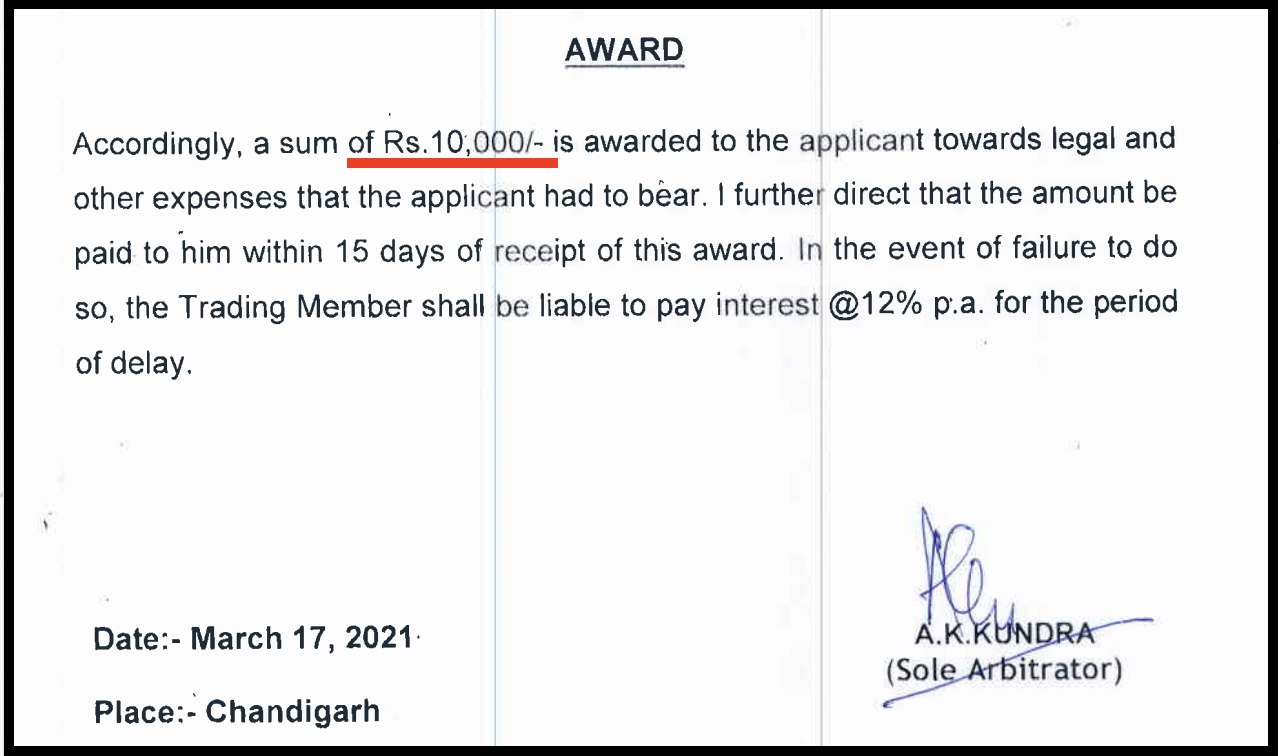
It awarded the client ₹10,000 towards the harassment and expenses he had borne, the disputed fee and notional loss having already been reversed.
The amount is modest, but the point is not, and it connects directly to the largest award in the set.
When the Platform Fails on the Day It Matters Most
The biggest recovery in the 5Paisa set came from a technical glitch, and it shows what these failures can cost when the stakes are high.
The client was trading on 16 June 2022 when she encountered the “5Paisa app not working“ issue. Around the disruption, her holdings were squared off in a way she disputed, and the loss was severe.
The tribunal examined the sequence of the glitch, the margin position, and the broker’s handling of it, and found the broker liable for the way the situation was managed.
It directed 5Paisato to refund ₹15,24,182, with interest.
Across all four, the message to a 5Paisaclient is consistent, and it leads straight to what you can do about it.
What This Means If You Lost Money With 5paisa?
The failures in these cases are common ones, and if any of them sounds like yours, the recovery route is real.
A dismissal at the grievance desk is not the end. Two of these clients were rejected by the grievance committee and won only when a tribunal looked at the facts properly.
What separated the wins was not luck. It was that the loss could be traced to the broker’s own system or process, and the case was built to show it.
That is precisely where most claims fall short. The grievance is genuine, but the app screenshots are not preserved, the mobile-number change is not documented, the subscription debit is not tied to the liquidation that followed.
A claim rarely fails because the case was weak. It fails because the case was half-presented.
Building it properly, on the records that pin the failure on the broker, is the work we do.
Register with us for a free consultation.
If you are still at the early stage, the full escalation route and the common grievance types are covered in our guide to 5paisa complaints. This page picks up where that one ends, at the arbitration stage where an award can actually be made.
What You Must Gather Now
Whatever your dispute, the evidence that wins these cases is specific, and it is perishable, so collect it early.
- For an app or pricing dispute, save timestamped screenshots of the order screen and compare them against your contract notes.
- For a square-off, keep every margin alert with its timestamp and note which number or email it reached. For a subscription or charge dispute, line up the debit against the liquidation that followed it.
- For a glitch, capture the error on screen and preserve your full chat with support. In every case, download your complete ledger and contract notes for the disputed period.
If you want to lodge a complaint, start by gathering these records. They are what turn a real grievance into a provable one.
Conclusion
The 5Paisa awards on record run from ₹10,000 to over ₹15 lakh, and they share a spine: the broker was held answerable for what its own app, its own process, or its own oversight did to the client.
An app that billed a different price than it displayed, a warning sent to a dead number, a subscription that renewed itself and took a client’s shares with it, and a glitch on the day it hurt most.
None of these were the trader’s fault, and in each, the tribunal said so.
If you lost money with 5Paisa and the grievance desk turned you away, arbitration is the stage where that can still become a refund. What decides it is how the claim is built.
Report. Recover. Stay Fraud Free.
Frequently Asked Questions
Yes. In the reviewed awards, tribunals directed 5Paisa to pay clients amounts from ₹10,000 to ₹15,24,182, for issues including a technical glitch, wrong prices shown on the app, and square-offs done without proper intimation. Two of these clients had first been rejected by the grievance committee.
In the reviewed set, the largest was ₹15,24,182 with interest, arising from a technical glitch and a disputed square-off on the trading platform. The amount depends entirely on the facts and the loss proven in each case.
It can be. In one reviewed case, the app showed trades as fully executed at prices that did not match the contract note, and the tribunal held the broker had provided wrong trade figures and ordered a refund of ₹78,400. Save timestamped screenshots of the app screen alongside your contract notes.
Only with proper intimation and a fair chance to respond. In one reviewed case, the broker sent the margin alert to the client's old mobile number, which it had failed to update, and the tribunal held he was not duly intimated and awarded the full loss of ₹36,000.
Possibly. In one reviewed case, the tribunal held that an auto-renewal term buried in FAQs was not part of the binding terms and conditions, and that renewing the plan by liquidating the client's shares to recover the fee was high-handed. It awarded the client ₹10,000 in compensation.



 Add us as a preferred source on Google »

