

Stockifi markets itself as “Investors Ka Dost” and has built a large following across YouTube and social media under Abhijit Chokshi’s name.
The firm holds a valid SEBI Research Analyst registration under INH000008376 and has officially logged zero complaints on SEBI’s SCORES platform from 2018 through 2025.
On paper, that looks like a clean record. But SEBI complaint data and actual subscriber experience are two different things, and the Google Reviews left by paying subscribers tell a story that the official numbers do not.
This page covers what those reviews actually say, what the zero complaint figure really means, and what an honest verdict on trusting Stockifi looks like.
Can You Trust Stockifi in India?
The honest answer sits somewhere between the marketing and the complaints.
Stockifi is a real, registered firm. Abhijit Chokshi is a publicly visible person with a genuine social media following. The registration has been active since 2020.

No SEBI adjudication order exists against the firm.
These are real positives that matter.
At the same time, three specific Google Reviews from paying subscribers describe a consistent pattern. Recommendations arrive pre-market when prices have already moved.
Stocks that generate losses get held with the guidance to “wait.” Stocks that generate profits get highlighted in the firm’s marketing.
One subscriber describes their capital as entirely tied up in two stocks, Cello and Themis, that moved against them with no meaningful guidance on what to do next.
The question of trust, in any advisory relationship, is not just about registration. It is about whether what is delivered matches what was marketed.
The reviews below help answer that specifically.
What Do The Google Reviews Actually Say?
Before reading these accounts, one clarification. These are reviews left by individual subscribers on Google. We are reporting what they wrote on a public platform.
We are not independently verifying each account.
No SEBI order confirming any specific conduct by Stockifi India has been issued as of July 2026.
Review 1: Timing gap between recommendation and market open
According to a review on Google Play, a subscriber describes receiving stock recommendations in the morning before the market opens.
By the time the market opens and the subscriber tries to act on the tip, the stock price has already moved significantly from the recommended entry level due to pre-market activity and gap openings.
The subscriber reports that following the entry at the gap-up price and then watching the stock reverse left them in a loss position.
When they asked for guidance, the response was to hold.
The stock continued to fall.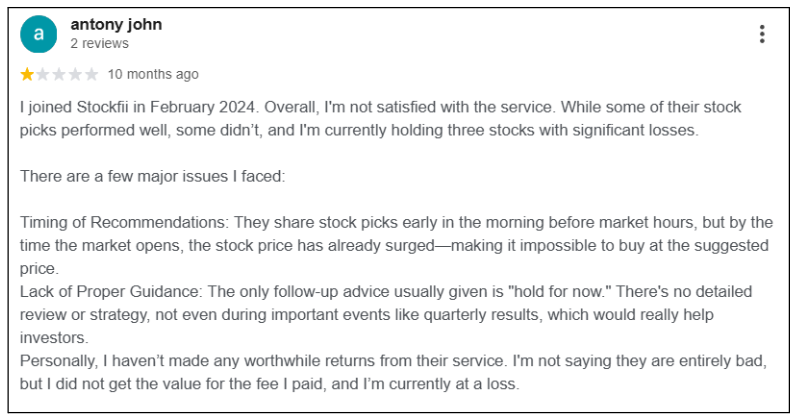
(Source: Google Play Store, Review by Antony John, August 2025)
What this describes is a structural issue with tip-based advisory. A research report with a defined entry range, a target, and a stop-loss is designed to handle this situation.
A morning WhatsApp message or push alert does not.
If the recommendation does not specify what to do when the stock opens above the entry price, the subscriber is left making a judgment call without adequate information.
That gap between what an RA is permitted to deliver and what is practically useful is what this reviewer is describing.
Review 2: Capital blocked in Cello and Themis stocks
According to a review on Google Play from a subscriber who joined in February 2024, after following Stockifi’s recommendations, most of their invested capital was concentrated in two stocks, Cello Packaging and Themis Medicare.
Both moved significantly against the subscriber’s position.
The review states that the subscriber earned zero profits from the engagement and describes their capital as effectively blocked in positions they did not know how to exit, with no clear guidance from the firm on a path forward.
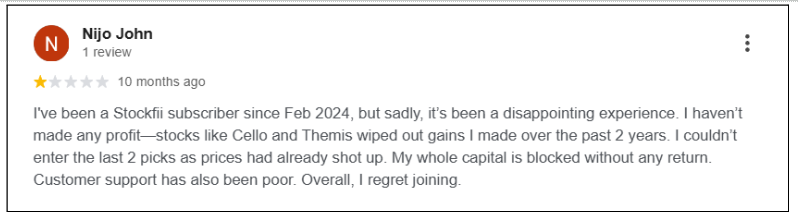
(Source: Google Play Store, Review from the Stockifi App Listing)
Cello Packaging (NSE: CELLO) and Themis Medicare (NSE: THEMISMED) are real listed stocks.
Recommending specific stocks by name is within the permitted scope of a SEBI Research Analyst.
What the RA Regulations also require is that any recommendation include a defined stop-loss level so the subscriber knows at what point to exit a losing position.
If the recommendations for these stocks did not include a defined stop-loss and exit guidance, the research report was incomplete under SEBI’s disclosure norms for research analysts.
We are reporting what this subscriber described on a public platform. The underlying stocks and their price movements are independently verifiable from exchange data.
Review 3: Lack of response after premium subscription payment
According to a review on Google Play, a subscriber named Kiran Kumar describes a highly disappointing experience after purchasing a service plan.
The review states that the platform’s team was active and attentive before the fee was paid.
However, once the premium subscription was successfully processed, the subscriber received absolutely no response to their phone calls or messages.
The subscriber further notes a significant performance gap, stating that only one out of every ten recommendations achieves success, even though the firm presents its results as if nine out of ten are successful.
The subscriber describes this sudden drop in communication and performance gap as characteristic of typical stock market fraud operations.
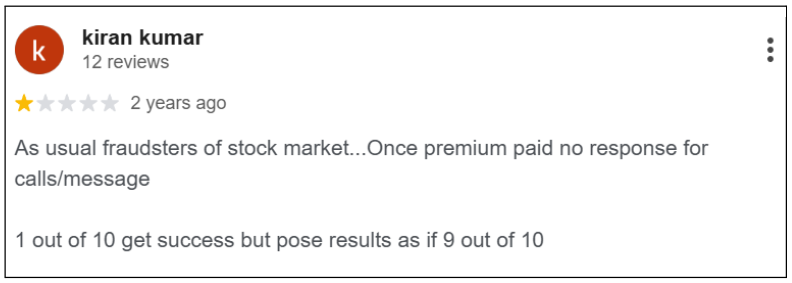
(Source: Google Play Store, Review by Kiran Kumar)
SEBI’s Research Analyst Regulations mandate that registered entities maintain high standards of integrity, professional conduct, and prompt service delivery to clients.
A complete failure to respond to service requests after receiving subscription fees, combined with asymmetric performance disclosures, raises serious service delivery concerns under investor protection norms.
This highlights a practical operational risk for retail investors when support mechanisms and performance tracking fail to function as advertised.
We are reporting what these three subscribers said on Google Play.
Their individual accounts represent their specific experiences and are not formal regulatory findings.
Also Read: Eqwires Research Analyst Complaints, where a SEBI fine of six lakh rupees followed years of unresolved user grievances.
Does “Zero SEBI Complaints” Mean Perfect Service?
Stockifi’s own complaint disclosure, as required by SEBI, shows nil complaints across all financial years from 2018 through 2025.
On the surface, this looks like a strong record.
But zero formal complaints on SEBI SCORES do not mean zero dissatisfied subscribers. It means zero subscribers chose to navigate the formal SEBI complaint process.
There are three common reasons subscribers do not file on SEBI SCORES even when they have a legitimate grievance.
The first is that many investors do not know the SCORES platform exists or that they have the right to file there. The second is that the complaint process feels complicated, and the amount lost seems too small to justify the effort.
The third is that subscribers accept the loss as a market risk outcome rather than recognising it as a potential service delivery failure.
The three Google Reviews above came from real subscribers who clearly had a negative experience.
None of them appear to have filed on SEBI SCORES.
That gap between negative experience and formal complaint is normal. It does not mean the experiences were not real.
Explore More: Can you trust Love Sharma trading advice?
Analyzing Stockifi’s Legitimate Regulatory Track Record
Being fair means including the other side.
Stockifi has been registered with SEBI since July 2020, which is a meaningful period of operation without a formal regulatory order against it.
Abhijit Chokshi maintains an active public presence with verifiable credentials on YouTube, Twitter, and LinkedIn.
The firm delivers stock recommendations with defined targets and stop-loss levels, which is the correct format for a SEBI RA.
The subscription service is a documented, structured product, not an informal or unregistered operation.
None of the three reviews above describes conduct that constitutes a clear regulatory violation on its own.
Selective marketing of winning picks raises a concern, but it does not reach the level of a guaranteed return promise or a live execution call in isolation.
The timing gap issue is a practical limitation of tip-based advisory, not necessarily a rule breach.
The overall picture is a firm that operates within the regulatory framework at a technical level, but may not deliver what some subscribers expected based on the marketing.
That is a different concern from a firm that is making explicit illegal promises.
5 Critical Questions to Ask Before Buying a Stockifi Subscription
Conclusion
Stockifi holds a valid SEBI registration, has operated since 2020 without a formal order, and has logged zero SEBI SCORES complaints. That is the official picture.
The Google Reviews from paying subscribers describe a different experience: morning tips that arrive after prices have moved, capital concentrated in declining positions without clear exit guidance, and a marketing approach that features winning picks while omitting losing ones.
Trust in any advisory relationship is built through consistent delivery that matches what was promised. Whether Stockifi delivers that consistently depends on which subscriber account you read.
The reviews above are from real people on a public platform. Weigh them alongside the registration record and the marketing before deciding.
Frequently Asked Questions
1. Is Stockifi a legitimate company?
Stockifi is a SEBI-registered Research Analyst firm under registration number INH000008376, operating since July 2020. It is a legitimate legal entity.
No SEBI adjudication order has been issued against it as of July 2026.
Legitimate registration does not automatically mean the service delivers what is marketed, which is a separate question covered in the reviews section of this page.
2. Why does Stockifi show zero SEBI complaints if subscribers are unhappy?
Zero SEBI SCORES complaints means zero subscribers formally filed through the official regulatory channel, not that zero subscribers had a negative experience.
Most dissatisfied investors either do not know about the SCORES platform, consider the amount too small to pursue formally, or accept the loss as market risk.
The formal complaint count and the actual subscriber satisfaction level are different measures.
3. Are the Stockifi Google Reviews genuine?
The three reviews described on this page come from Google Play, where reviews are tied to verified Google accounts. We are reporting what these subscribers wrote on a public platform.
We have not independently verified each account.
No SEBI order confirms the specific conduct described in these reviews as of July 2026.
4. What stocks did Stockifi recommend that caused subscriber losses?
According to a Google Play review from a subscriber who joined in February 2024, the stocks mentioned in connection with their loss experience were Cello Packaging and Themis Medicare.
We are reporting this as a subscriber’s account on a public platform, not as a confirmed finding.
The stock names and their historical price movements are independently verifiable from NSE exchange data.
5. Has SEBI taken any action against Stockifi?
No SEBI adjudication order, penalty notice, or formal regulatory action has been publicly recorded against Stockifi or its proprietor, Abhijit Chokshi, as of July 2026.
The firm’s SEBI SCORES complaint data shows nil complaints across all years from 2018 to 2025.
6. What should I do if I subscribed to Stockifi and lost money?
Document your subscription payment, the recommendations you received, the trades you made based on those recommendations, and any communication from the firm’s representatives.
If any guaranteed return promise was made during the sales process, preserve that evidence specifically and file a complaint.





 Add us as a preferred source on Google »

