

Have you ever paid for a stock advisory service and felt something was not right, but did not know where to start or who to tell?
That frustration is more common than you think. Hundreds of traders across India subscribe to research advisory services with genuine hope, only to find themselves misled, pressured, or left with losses they were never warned about.
Supreme Investrade and Research Services is one firm that has found itself at the centre of multiple such complaints.
SEBI action against Supreme Investrade for misleading advisory services has resulted in two separate penalty orders, a client has won an arbitration case against it, and several others have raised concerns through regulatory channels.
But here is the thing: knowing you have been wronged is just the starting point. What matters is knowing what to do next, step by step.
In this blog, we cover the specific violations that can trigger a legitimate complaint, how to report Supreme Investrade’s misleading advisory services, what SEBI has already found in its orders, and how the arbitration route works, including what it can and cannot deliver for you.
Violations by Supreme Investrade
Not every bad experience automatically qualifies as a regulatory violation. But certain specific behaviours cross the line defined by SEBI and can be formally reported.
Here are the situations where you have clear grounds to raise a complaint:
Scenario 1: You Were Shown Other Clients Profit Screenshots to Attract You
If a Supreme Investrade representative sent you screenshots of profits made by other clients to convince you to subscribe, that alone is a violation.
SEBI’s December 2024 adjudication order specifically found that the firm used such screenshots as a form of inducement.
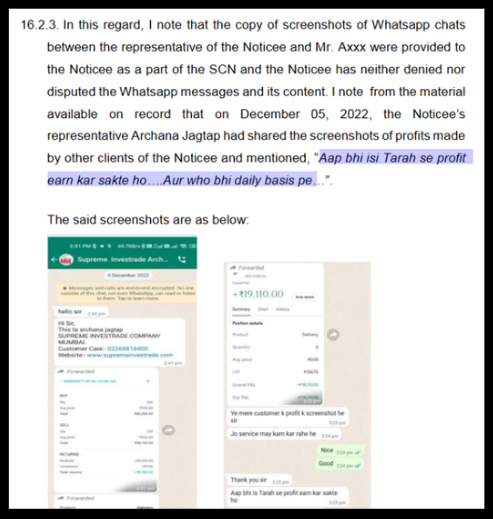
Under SEBI’s Research Analyst regulations, using selective profit data of third-party clients to attract new subscribers is prohibited. It gives a misleading impression of typical outcomes and manufactured social proof.
You can file a complaint if: You were sent screenshots of other people’s profits during the sales pitch and subscribed as a result.
Scenario 2: You Were Promised Daily Profits or Assured Returns
SEBI found documented WhatsApp messages where the firm’s representatives told potential clients they could earn profits on a daily basis.
In the Shikha Sharma arbitration case, a voice recording captured a firm employee saying, until they book you a profit of Rs 1 lakh, you do not need to pay any fees.
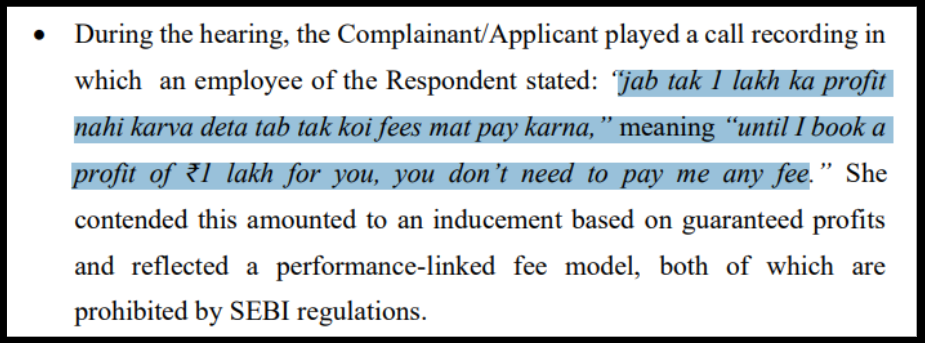
No research analyst in India is legally permitted to promise assured returns or link fees to profit delivery. This is explicitly banned under SEBI regulations.
You can file a complaint if: You were verbally or over WhatsApp told that profits are assured, daily earnings are expected, or that fees are linked to your trading results.
Scenario 3: You Were Pressured to Add More Money After Losses
If you suffered trading losses and the firm’s representative then urged you to deposit additional funds, promising that the next set of calls would recover everything, that is classified as inducement under SEBI’s PFUTP Regulations.

SEBI’s order documented this exact pattern: clients who were already in the red were pushed to arrange more capital for trading, with the implicit or explicit promise of loss recovery.
You can file a complaint if: After incurring losses, a representative contacted you to add more capital and assured you of recovery through upcoming trade calls.
Scenario 4: You Received Real-Time Buy/Sell Instructions, Not Just Research
A research analyst is allowed to share recommendations with targets and stop-loss levels. They are not allowed to message you in real time, saying ‘buy now, buy maximum quantity, do not exit yet.’
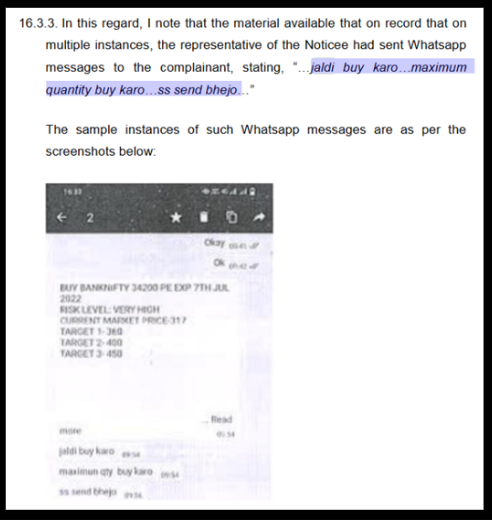
That is active trade execution pressure, not research.
SEBI’s order documented messages where the firm sent urgent real-time commands during live market hours. The arbitration cases also confirmed that voice calls were made, giving specific timing-based trading instructions.
You can file a complaint if: You received live messages or calls telling you exactly when to enter or exit a trade, how much quantity to buy, or advising you not to exit a position when you wanted to.
Scenario 5: You Were Charged More Than the Advertised Package Rate
The Shikha Sharma arbitration case revealed that she was charged Rs 1,97,000 for less than three months of service, while the firm’s own website listed its highest annual package at Rs 1,78,180.
That is more than the full-year price, charged in under 90 days.
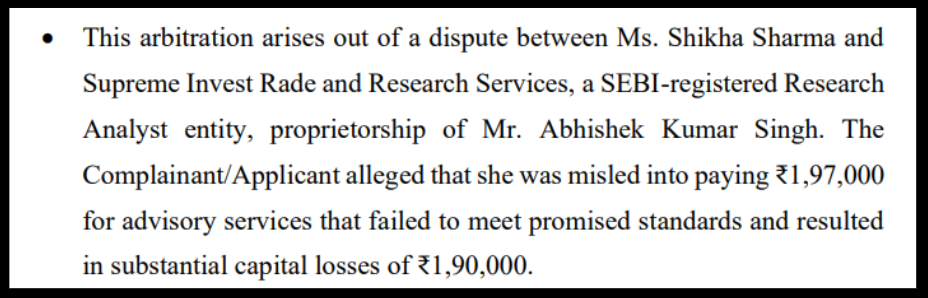
The arbitrator found that the firm retroactively constructed a fictitious package worth Rs 5,66,667 and applied a fake discount to justify the charge. This is a non-transparent fee structure that violates SEBI’s informed consent requirements.
You can file a complaint if: You were not shown a predefined package upfront, were charged incrementally, or ended up paying more than the rates publicly listed on the firm’s website.
Scenario 6: Your SEBI SCORES Complaint Was Closed Without Your Genuine Consent
This is the most serious scenario. SEBI’s 2024 order found that the firm drafted a satisfaction statement on behalf of a complainant and instructed that person to email it to SEBI to close their active grievance.
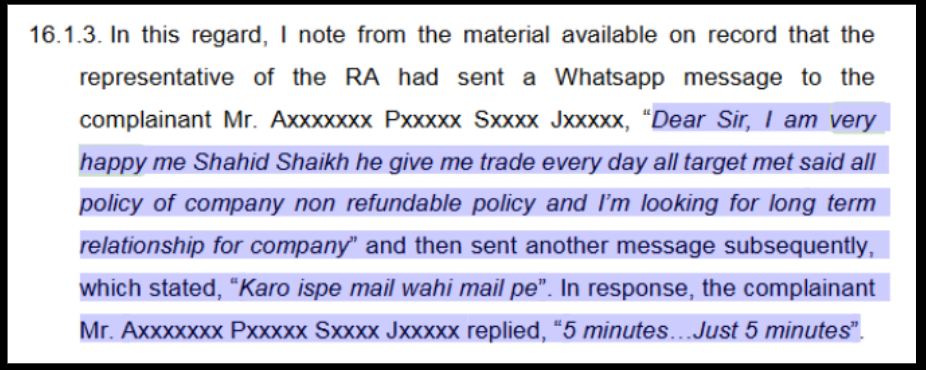
If this has happened to you, if someone from Supreme Investrade sent you a ready-made satisfaction message and asked you to forward it to SEBI, do not do it, and report the attempt immediately.
You can file a complaint if: You were given a pre-written satisfaction statement by the firm to send to SEBI in order to close your complaint.
These findings demonstrate an important point: documented evidence matters.
Penalty Imposed by SEBI:
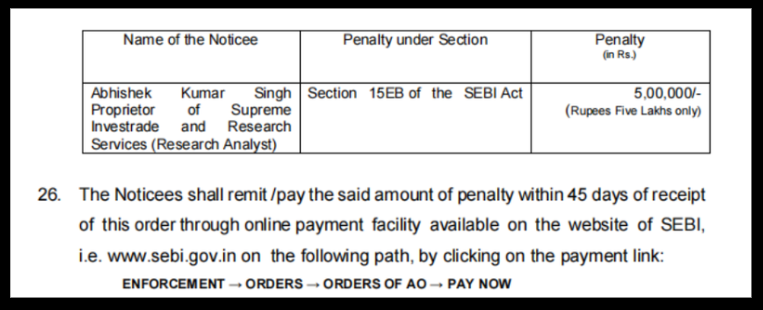
As part of the order, SEBI imposed a monetary penalty of ₹5,00,000 on the entity. The order also included provisions for recovery proceedings in the event of non-payment.
The significance of this order is that it demonstrates how properly documented complaints, especially those supported by WhatsApp chats, call recordings, screenshots, and transaction evidence, can lead to formal regulatory action.
Supreme Investrade Arbitration Case
Apart from the SEBI adjudication proceedings, another important development came through the arbitration matter involving Ms. Shikha Sharma and Supreme Investrade and Research Services.
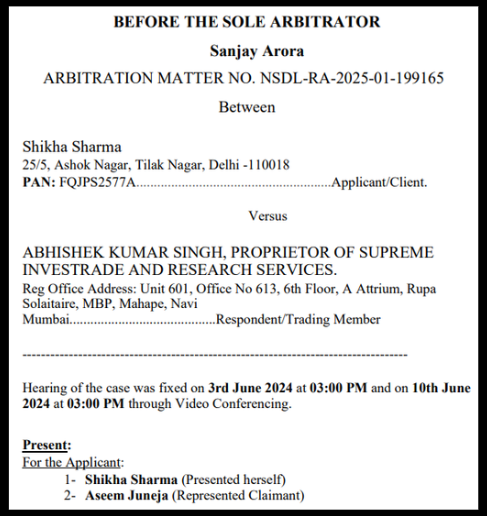
The arbitration proceedings examined allegations relating to verbal profit assurances, fee collection practices, and representations made to the client during the client onboarding and advisory process.
One major issue highlighted in the case was that the complainant was allegedly charged ₹1,97,000 within less than three months, despite the firm’s publicly listed package pricing being significantly lower.
Final Arbitration Award: After reviewing the evidence and submissions, the arbitrator directed Supreme Investrade and Research Services to refund ₹1,97,000 to the complainant, Ms. Shikha Sharma.
Together, the SEBI order and the arbitration proceedings show how regulatory findings, investor evidence, and documented communication records can play a crucial role in disputes involving research advisory services.
How to Report Misleading Stock Advisory Services?
Now that you understand the violations, here is exactly how to move forward if you want to report Supreme Investrade:
Step 1: Preserve Your Evidence First
Before initiating any complaint process, make sure you collect all supporting documents and records.
This should include screenshots of Telegram or WhatsApp conversations, promotional advertisements promising guaranteed returns or profits, payment confirmations, bank transaction statements showing advisory fees paid, signed agreements, if any, and records of trades taken based on the recommendations provided.
Well-documented evidence strengthens your position and improves the credibility of your complaint.
Step 2: Send a Formal Written Complaint to the Firm
SEBI generally expects investors to first attempt to resolve the issue directly with the concerned entity.
Send a formal complaint through email to the company’s official support or grievance email address. Maintain copies of the email, acknowledgements, and any replies received.
If the entity fails to respond within 30 days, or if the resolution offered is unsatisfactory, you may then escalate the matter to SEBI.
Step 3: File a Complaint in SCORES
Visit SEBI SCORES Portal, SEBI’s centralised investor grievance redress platform.
Create an account using your mobile number and email ID. Once registered, log in and select “Lodge Complaint.” Choose the relevant category, such as Investment Adviser, Research Analyst, or Unregistered Entity, then provide complete details of your issue.
Upload all supporting documents and evidence carefully. After submission, you will receive a unique registration number that can be used to monitor the complaint status.
If the complaint reveals significant compliance concerns, SEBI may independently review the matter further.
Step 4: Lodge a Complaint with SMART ODR
If the issue remains unresolved even after the SCORES process, the next option is SMART ODR, SEBI’s Online Dispute Resolution mechanism.
This platform facilitates structured mediation, conciliation, and arbitration between investors and regulated market entities. SEBI-registered entities are required to participate in this process.
In many cases, disputes involving advisory fees or service-related grievances are settled during conciliation itself, helping investors avoid prolonged legal proceedings.
Step 5: Arbitration in Share Market
If earlier resolution mechanisms do not produce a satisfactory outcome, you can initiate formal arbitration proceedings.
Under arbitration, an independent authority reviews the evidence submitted by both parties and issues a legally enforceable decision.
An arbitration award has the same effect as a court decree.
If the adviser fails to comply with the award, SEBI may begin recovery action under Section 28A of the SEBI Act, treating the unpaid amount similarly to government dues recoverable through legal enforcement mechanisms.
Need Help?
If you are uncertain where to begin or feel the process is overwhelming, you do not have to navigate it alone.
Many investors struggle to understand how to report misleading stock advisory services or where to escalate complaints when advisory practices appear deceptive.
Our team specialises in helping investors organise their evidence, file complaints on the right platforms, and pursue arbitration when necessary.
Register with us, and we will guide you through every step.
Conclusion
Filing a complaint against a misleading advisory firm is not complicated, but it does require structure, evidence, and persistence.
Supreme Investrade’s case is particularly well-documented: two SEBI orders, two arbitration proceedings, and multiple established violations across client interactions.
This gives individual complainants a stronger foundation than many other advisory disputes.
The most important things to remember are: preserve every piece of communication before you do anything else, do not send any satisfaction statement to SEBI on behalf of the firm, and understand that regulatory action and individual recovery are two separate things; SEBI’s penalties do not automatically put money back in your account.
Use the channels available to you, SCORES, Smart ODR, and arbitration, in order, with your evidence intact. Each step builds on the last, and each step increases the formal pressure on the firm to address your specific grievance.
You have the right to be heard. The question is whether you are prepared to use it.





 Add us as a preferred source on Google »

