Manish Goel SEBI Order: ₹60 Lakh Penalty and What the Tribunal Upheld?
September 1, 2026
Quick Summary
SEBI’s Adjudicating Officer Soma Majumder passed a 46-page order against Manish Goel on August 11, 2023, imposing a ₹60 lakh penalty across six documented violations, including assured-return promises and missing research records. A separate Enquiry Order suspended his RA certificate for six months. Manish Goel appealed both to the Securities Appellate Tribunal, which largely upheld SEBI’s findings in a judgment dated February 14, 2025. This page covers every violation, the exact penalty breakdown, and the full appeal outcome.
Have you ever joined a WhatsApp or Telegram group for stock tips and thought, “This analyst seems legit, they’re even SEBI-registered”?
You trusted the badge. You followed the calls. But what if that very registration came with a trail of violations the regulator later caught up with?
That’s exactly the story of Manish Goel, a SEBI-registered Research Analyst.
He built a following of hundreds of investors over the years, promising multibagger stock picks and long-term wealth creation.
But when SEBI conducted a formal inspection for the period April 2020 to March 2021, what they found was far from what was being presented to the public.
In this blog, we break down everything: who Manish Goel is, what SEBI found, the exact violations, the penalties imposed, and what this means for you as a retail investor.
SEBI Order Against Manish Goel
SEBI’s routine inspection of Manish Goel Research Analyst operations for the period April 2020 to March 2021 evolved into a detailed investigation into his business practices, public Telegram and WhatsApp communications, fee collection methods, and compliance systems.
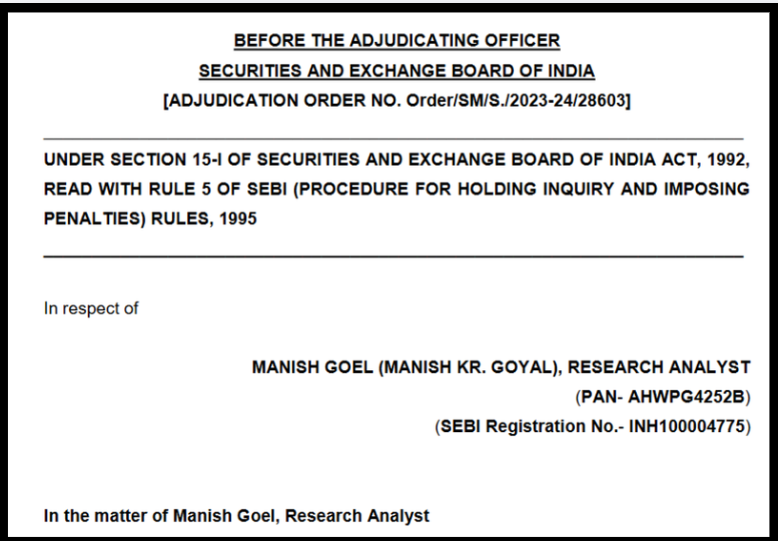
SEBI’s adjudication order against Manish Goel, 2023
During the review, SEBI examined research records, KYC and anti-money laundering procedures, and user-facing communications, identifying multiple compliance concerns.
The findings ultimately resulted in a Show Cause Notice and two separate regulatory orders, including a 46-page adjudication order listing major SEBI violations.
Violation 1: No Research Records, Missing Rationale, Unsigned Reports
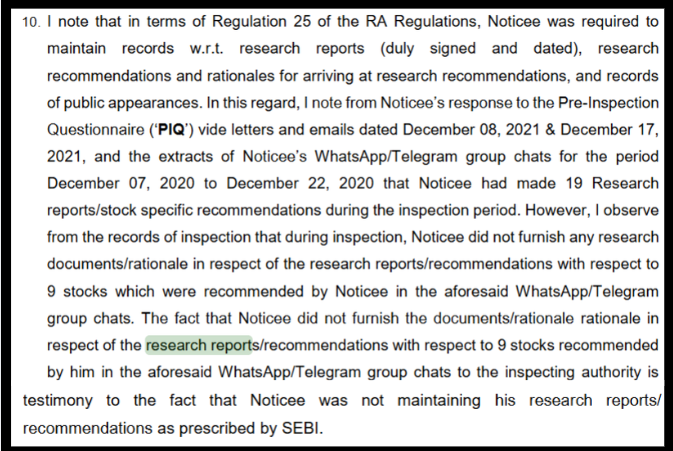
SEBI found that out of 19 stock recommendations Manish Goel made, he could not produce a research rationale for 9 of them at the time of inspection.
SEBI order excerpt on Manish Goel’s record-keeping violation
In 4 other instances, the research reports were unsigned and undated, and these were reportedly signed and dated only after the inspection was announced.
Sharing stock recommendations without documented research is a direct violation of Research Analyst Regulations.
Additionally, SEBI found he was not maintaining records of his “public appearances” as required under Regulation 2(1)(q) of RA Regulations, which includes distributing recommendations on WhatsApp and Telegram.
Penalty: ₹5 lakh under Section 15A(c), for failure to maintain required records and public appearance disclosures.
WhatsApp and Telegram stock tips without proper research documentation are a common but serious compliance failure
Violation 2: Failure to Disclose RA Identity & Credentials
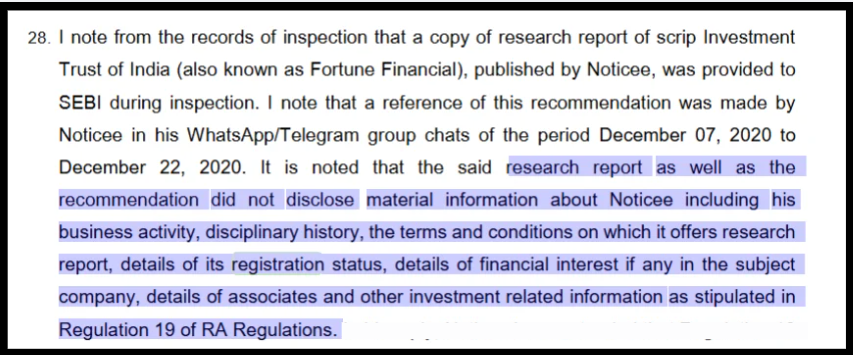
SEBI noted that in his WhatsApp and Telegram communications, Manish Goel never used the term “Research Analyst” when making stock recommendations.
SEBI order excerpt on Manish Goel’s disclosure violations
He also did not disclose his SEBI registration number or credentials to the group members. This is a basic but mandatory disclosure requirement under RA Regulations.
Clients receiving recommendations have a right to know they’re getting advice from a SEBI-registered RA and what that registration entails.
Violation 3: Research Independence Not Maintained
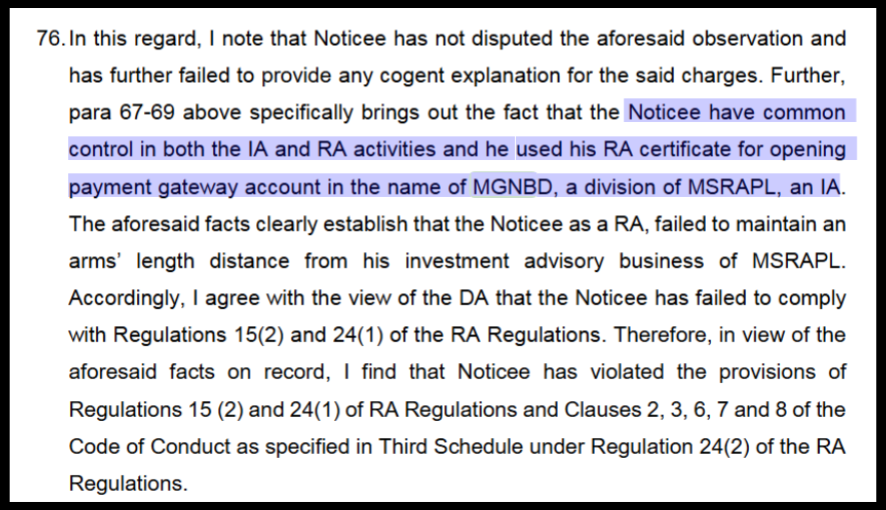
Manish Goel was simultaneously running multiple businesses in his personal capacity, a CA Division, a Spiritual/Vipassana Teaching Division, a News Broadcast Division (MGNBD), and his RA function.
SEBI order noting Manish Goel’s major compliance violations
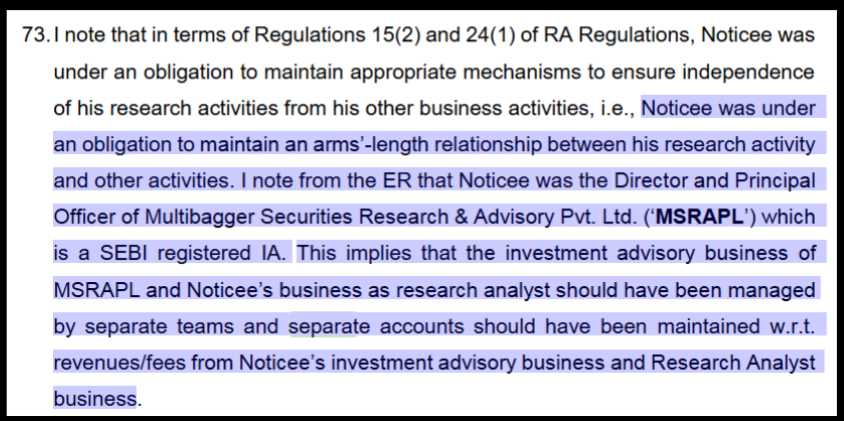
On top of this, he was Promoter and Principal Officer of MSRAPL (an Investment Advisory company). SEBI regulations require that a Research Analyst’s research activities must be kept completely independent from other business activities.
Running an investment advisory firm while also practising as an RA, without maintaining separate teams and accounts, directly compromises that independence.
Research Analysts are restricted from trading in securities they recommend to clients for a specified period, this is to prevent front-running and conflicts of interest.
SEBI found violations related to these trading restrictions.
SEBI order on segregation of Manish Goel’s advisory and research fees
Additionally, SEBI found that revenues from his RA activities and MSRAPL’s advisory business were not maintained in separate accounts, as mandated.
The investment advisory fees collected through MSRAPL and Goel’s own RA fees were mixed, making it impossible to verify what was being charged for what service.
Violation 5: No KYC, No AML Compliance
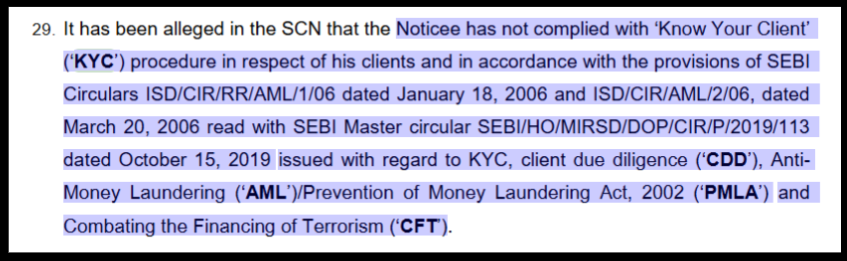
Manish Goel himself admitted during proceedings that he did not maintain records of KYC (Know Your Customer) procedures, client due diligence, or comply with SEBI’s Anti-Money Laundering (AML) circulars for his RA clients.
This admission was significant; it meant SEBI didn’t even need to prove it independently.
SEBI order on Manish Goel’s non-compliance with KYC norms
Collecting ₹4.16 crore from 583 clients without proper KYC is not just a regulatory lapse; it is a serious failure of the basic fiduciary responsibility an RA holds.
“From available records, Mr Goel had collected ₹4.16 crore from 583 clients; he failed to comply with the basic requirements of RA Regulations and also promised assured returns and mis-sold his services”, said SEBI Adjudicating Officer Soma Majumder.
Violation 6: Promising Assured Returns & Misleading Information (PFUTP Violation)
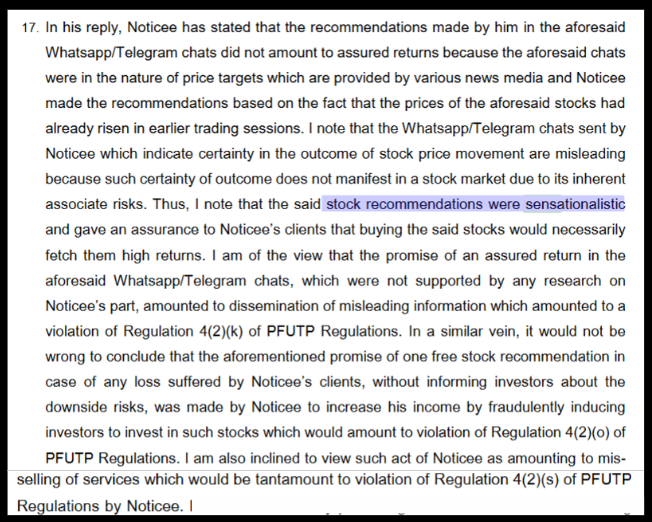
This is the most serious violation. SEBI reviewed Manish Goel’s WhatsApp and Telegram messages and found that while recommending specific stocks, including Swasti Vinayak Synthetics Ltd. and Yash Pakka Ltd., he assured clients that these stocks would definitely rise in price and fetch high returns.
There were no risk disclaimers attached. He also told group members that if any recommendation caused a loss, they would receive one free stock recommendation as compensation.
SEBI order on Manish Goel’s WhatsApp/Telegram recommendation violation
This “offer” itself constitutes an implied promise of returns. SEBI found these to be “sensationalistic” recommendations that disseminated misleading information, directly violating the PFUTP (Prohibition of Fraudulent and Unfair Trade Practices) Regulations.
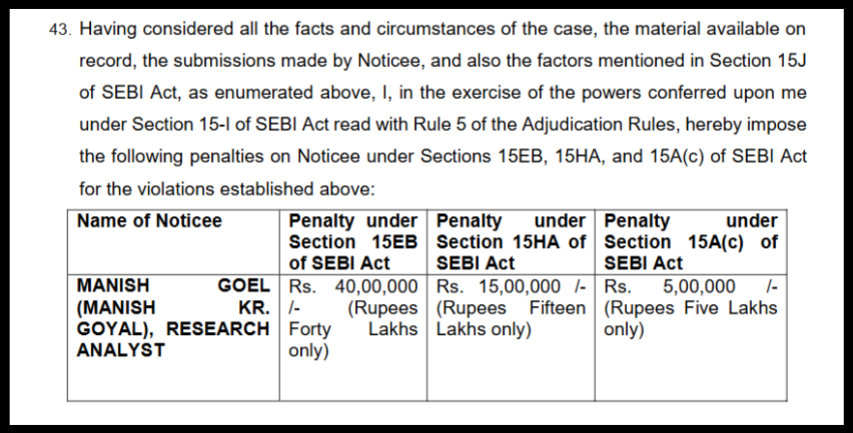
SEBI Penalty:
SEBI order on the monetary penalty imposed on Manish Goel
As a result, SEBI imposed atotal monetary penalty of ₹60,00,000 (Rupees Sixty Lakh) on Manish Goel (Manish Kr. Goyal).
The regulator further noted that such practices could mislead investors and undermine transparency and fairness in the investment advisory ecosystem.
Manish Goel SEBI Enquiry Order
If the financial penalty was the first blow, the enquiry order of October 30, 2023, was the heavier one for Manish Goel’s operations.
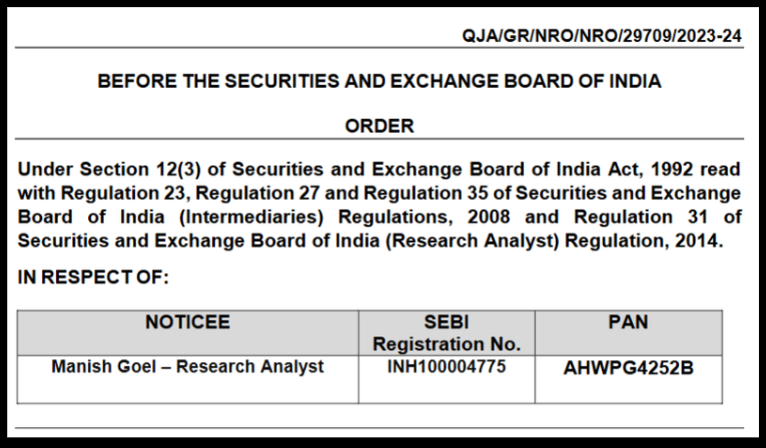
This order came under Section 12(3) of the SEBI Act, read with Regulation 23, 27, and 35 of the SEBI (Intermediaries) Regulations, 2008.
SEBI enquiry order concerning CA Manish Goel
Based on the same inspection findings, SEBI, through a separate quasi-judicial process, concluded that the violations were serious enough to warrant not just a financial penalty but a suspension of his SEBI Research Analyst certificate for six months.
This meant he could not legally operate as a SEBI-registered RA during that period.
The core findings in the enquiry order reinforced what the adjudication order had established: repeated non-compliance with RA regulations, failure to meet the Code of Conduct standards prescribed in the Third Schedule under Regulation 24(2) of RA Regulations, and the gravity of promising assured returns to clients.
When an RA’s certificate gets suspended, it has a direct impact on all registered operations and client services.
Does your own experience with Manish Goel match any of these findings?
This order is exactly the kind of evidence that strengthens a formal complaint. Tell us what happened, and we’ll help you build your case around it.
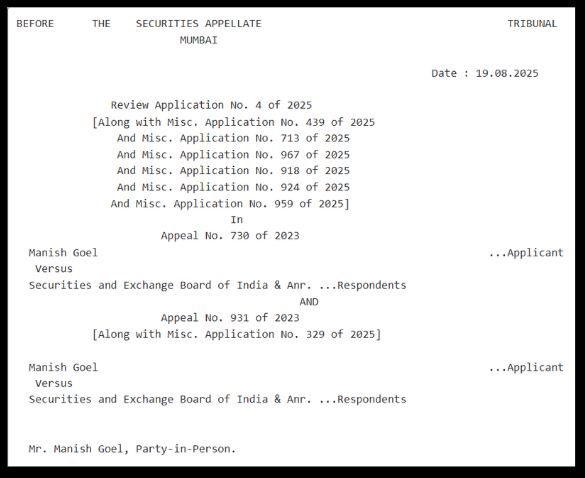
He filed two separate appeals before the Securities Appellate Tribunal (SAT) in Mumbai – Appeal No. 730 of 2023 (against the adjudication order) and Appeal No. 931 of 2023 (against the certificate suspension).
Securities Appellate Tribunal order on Manish Goel’s appeal
He appeared in person before the tribunal.
The SAT bench heard both appeals together since they arose from the same inspection findings.
In its order dated February 14, 2025, the tribunal delivered a mostly unfavourable verdict for Goel:
The ₹5 lakh penalty under Section 15A(c) for failure to maintain records was upheld.
The ₹15 lakh penalty under Section 15HA for PFUTP violations (assured returns) was upheld.
The six-month suspension of the RA certificate was upheld, although it was noted that the period had already elapsed, making the appeal technically infructuous.
Some relief was granted on a few of the specific sub-violations under Section 15EB, though the core findings were maintained
The tribunal specifically noted that publishing recommendations on WhatsApp and Telegram groups falls clearly under the definition of “public appearance” under RA Regulations, and all associated disclosure requirements apply.
What Retail Investors Can Learn From This?
The Manish Goel SEBI case isn’t a story about a fly-by-night operator. It’s a story about a SEBI-registered analyst who built genuine credibility, had real clients, and yet still fell into serious compliance failures.
That’s what makes it so important for every retail investor to understand.
Here are the most critical lessons:
SEBI registration is a starting point, not a guarantee: A registered RA can still violate regulations. Always look beyond the badge.
No one can legally promise returns: If any analyst, registered or not, assures you that a stock will rise or offers to compensate losses with free tips, that itself is a red flag and a regulatory violation.
Ask if the research is documented: A genuine RA will have a written research report with rationale, risk disclosure, and dates. Tips on WhatsApp without any of this don’t qualify as research.
Dual roles create conflicts of interest: When the same person runs both an RA and an investment advisory firm without separation, your best interest may not always be their top priority.
KYC and client agreements matter. If an advisor isn’t asking for your KYC details or having you sign a service agreement, that’s a warning sign about their compliance standards.
For real, individually documented user complaints, and the complete five-step process to file your own complaint, our page on Manish Goel complaintscovers that in full.
Conclusion
The Manish Goel SEBI Order is a reminder that the market regulator takes compliance seriously, regardless of how popular, credible, or well-meaning an analyst might appear.
Collecting ₹4.16 crore from 583 clients while promising “guaranteed” stock returns, skipping basic research documentation, and blurring the lines between RA and advisory businesses is not just a paperwork failure.
It is a fundamental breach of the trust that retail investors place in registered market professionals.
The two SEBI orders, upheld largely by SAT in 2025, establish a clear message: being SEBI-registered is not a free pass. Compliance is an ongoing obligation.
And for investors, it is a reminder to always verify, question, and never let anyone, registered or not. make financial promises that no one in the markets can keep.
Report. Recover. Stay Fraud Free.
Frequently Asked Questions
A total of ₹60 lakh, split across three sections, ₹5 lakh under Section 15A(c), ₹40 lakh under Section 15EB, and ₹15 lakh under Section 15HA.
Yes, for six months, under a separate Enquiry Order dated October 30, 2023.
Yes, to the Securities Appellate Tribunal, which largely upheld SEBI's findings in a judgment dated February 14, 2025, with limited relief on some sub-violations.
Swasti Vinayak Synthetics Ltd. and Yash Pakka Ltd. were specifically named in connection with assured-return promises made in WhatsApp and Telegram groups.
As of the Recovery Certificate and Notice of Demand issued by SEBI, the penalty remained outstanding and subject to formal recovery proceedings.







 Add us as a preferred source on Google »

