

Quick Summary
SEBI passed a formal adjudication order against Abhishek Kumar Singh, proprietor of Supreme Investrade, after examining investor complaints and chat records. The order found the firm promised daily returns of 15-20%, demanded 50-70% profit-sharing as fees, and made misleading claims that induced clients to trade, violations of PFUTP Regulations and the Code of Conduct. SEBI imposed a ₹2,00,000 penalty under Section 15EB, citing repeated conduct and a prior penalty. This page explains each violation and what it means for investors evaluating any advisory service.
The stock market can feel like a maze, especially when advice starts coming from people who claim to have the “right strategy” or “inside understanding” of trades.
The recent SEBI action against Supreme Investrade for misleading advisory services brings attention to how easily investors can be influenced by persuasive communication that looks professional on the surface but raises serious concerns underneath.
In this case, SEBI closely examined the conduct of a registered research analyst and uncovered practices that did not align with regulatory standards.
From client interactions to the way services were offered, the findings reveal why investors need to stay alert and informed.
Let’s break down what actually happened and what it means for you.
What was SEBI’s Action Against Supreme Investrade for Misleading Advisory Services?
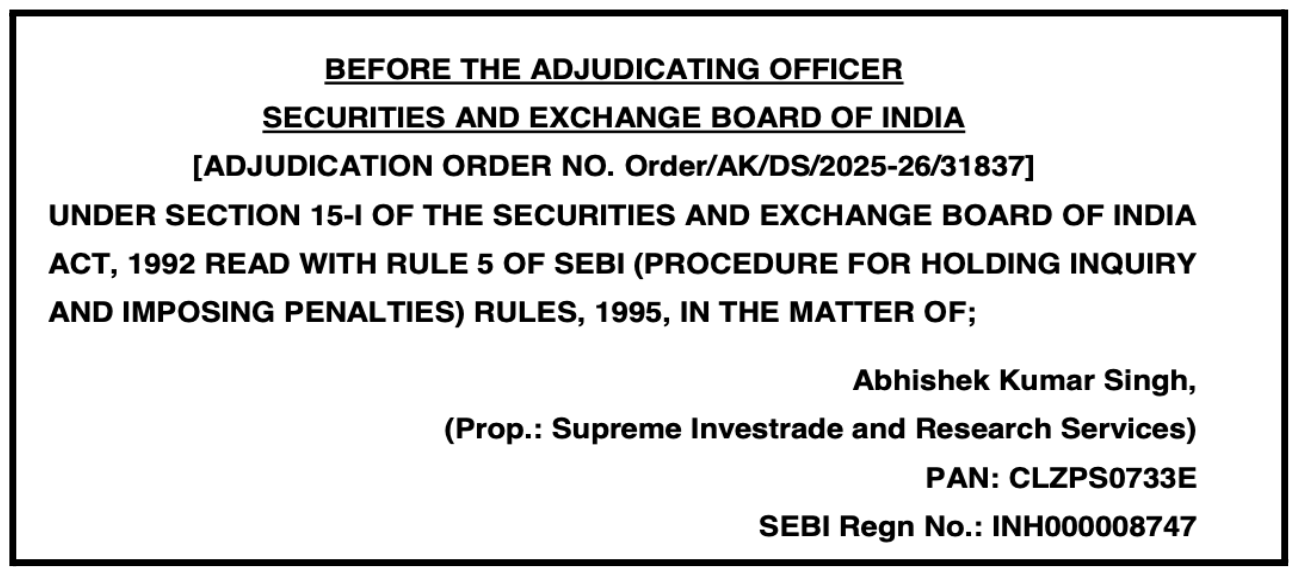
SEBI passed an adjudication order against Abhishek Kumar Singh research analyst, proprietor of Supreme Investrade.
After examining multiple investor complaints, chat records, and submissions, SEBI concluded that the research analyst had violated several provisions of securities laws.
The regulator found that the advisory services were not being provided fairly and transparently.
Instead, certain practices were misleading and against the expected standards of a SEBI-registered research analyst.
Why was the Order Imposed Against Supreme Investrade and Research Services?
Here are the key violations identified by SEBI, explained in simple language:
- Assured returns to clients: The firm promised clients daily returns of 15 to 20 percent. In reality, no one can guarantee such returns in the stock market. SEBI considered this a misleading statement designed to attract investors.
- Profit-sharing demands: The advisor asked clients to share 50 to 70 percent of their profits as fees. This is not allowed for research analysts, as it creates a conflict of interest and pushes advisors to prioritise their own earnings.
- Mis-selling of services: By making exaggerated claims and hiding risks, the firm was effectively mis-selling its services. Investors were influenced to trade based on unrealistic expectations.
- Lack of honesty and good faith: A SEBI-registered analyst must act honestly and with proper diligence. Asking for profit cuts and making false claims clearly violated this principle.
- Violation of PFUTP Regulations: SEBI found that the actions amounted to fraudulent and unfair trade practices, including misleading communication and inducement to trade.
Interestingly, some complaints, such as a lack of stop loss or repeated advice to average positions, were not fully upheld due to insufficient evidence. But the major violations were strong enough to establish wrongdoing.
Supreme Investrade and Research Services SEBI Penalty
After considering all facts, SEBI imposed a penalty of ₹2,00,000 on the noticee under Section 15EB of the SEBI Act.
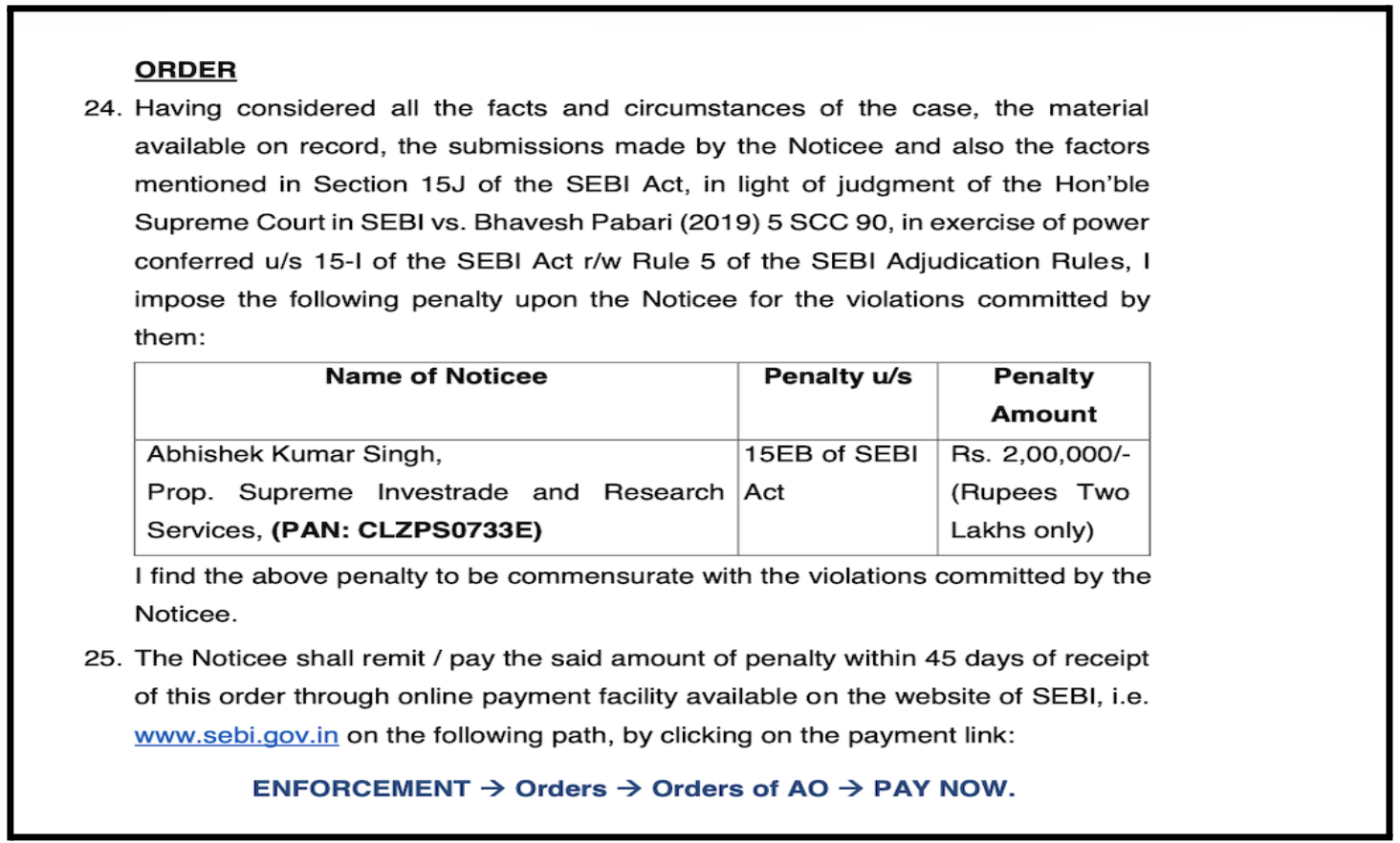
While the amount may seem moderate, SEBI clearly noted that:
- The violations were serious.
- The conduct was repetitive in nature.
- The advisor had been penalised earlier as well.
The penalty was meant to ensure that such practices are discouraged and that intermediaries act responsibly in the future.
Lost money to advice that sounded confident but crossed a real regulatory line?
We will review your evidence, draft a strong complaint, file it on the right platforms, and represent you through SCORES, SMART ODR, and arbitration.
What Can You Learn From This Order?
The case of Supreme Investrade is an acute example of how research analysts in India mislead investors.
It demonstrates why investors must look beyond marketing claims, preserve every communication, and seek professional guidance when something does not feel right.
Here are some key takeaways:
- There is no such thing as guaranteed returns: If someone promises fixed profits in the stock market, it is a red flag. Markets are unpredictable by nature.
- Avoid advisors who ask for profit sharing: Genuine advisors charge fixed fees. Asking for a share in profits often indicates unethical intent.
- Do not trust screenshots or flashy claims: Many advisors use profit screenshots to lure clients. These can be selective or misleading.
- Always check SEBI registration and behaviour: Even if someone is registered, their conduct matters. Registration is not a guarantee of honesty.
How to Report Supreme Investrade Misleading Advisory Services?
If you ever face a situation like this, do not ignore it.
A formal complaint against Supreme Investrade moves through defined stages, each one strengthening your position if the one before it didn’t resolve things.
Start by raising the issue directly with the firm in writing. If that doesn’t work, a SEBI SCORES complaint is the next step, filed with the regulator directly.
If SCORES doesn’t resolve your case, the SMART ODR portal offers structured mediation between you and the firm.
If that also doesn’t resolve the matter, stock market arbitration is the final stage, producing a binding decision an independent arbitrator issues after reviewing both sides.
For the complete walkthrough, exactly what evidence to gather at each stage, and two real cases where investors following this exact process actually recovered their money, our Supreme Investrade refund page covers all of it.
Conclusion
The SEBI action against Supreme Investrade for misleading advisory services sends a clear message. Misleading investors will not go unnoticed.
This case highlights how false promises and unethical practices can harm investors. It also shows that SEBI is actively monitoring and taking action when rules are violated.
For investors, awareness is the best protection. Always question unrealistic claims and verify before trusting any advisor, and if something feels off, it probably is.
And remember, the right action at the right time can save you from bigger losses
Report. Recover. Stay Fraud Free.
Frequently Asked Questions
₹2,00,000, imposed under Section 15EB of the SEBI Act. SEBI noted this followed an earlier penalty against the same advisor, a factor that influenced the amount.
No. Profit-sharing fee structures are prohibited entirely for SEBI-registered Research Analysts, since they create a direct conflict of interest between the advisor's earnings and the client's outcome.
No. Some allegations, including a lack of stop-loss guidance and repeated advice to average positions, were not fully upheld due to insufficient evidence. The core violations, guaranteed returns and profit-sharing demands, were.
A promise of fixed daily returns, 15-20% in this case. No legitimate advisor can guarantee a specific return in the stock market, and any firm claiming otherwise is making a statement SEBI has already found to be misleading.





 Add us as a preferred source on Google »

