
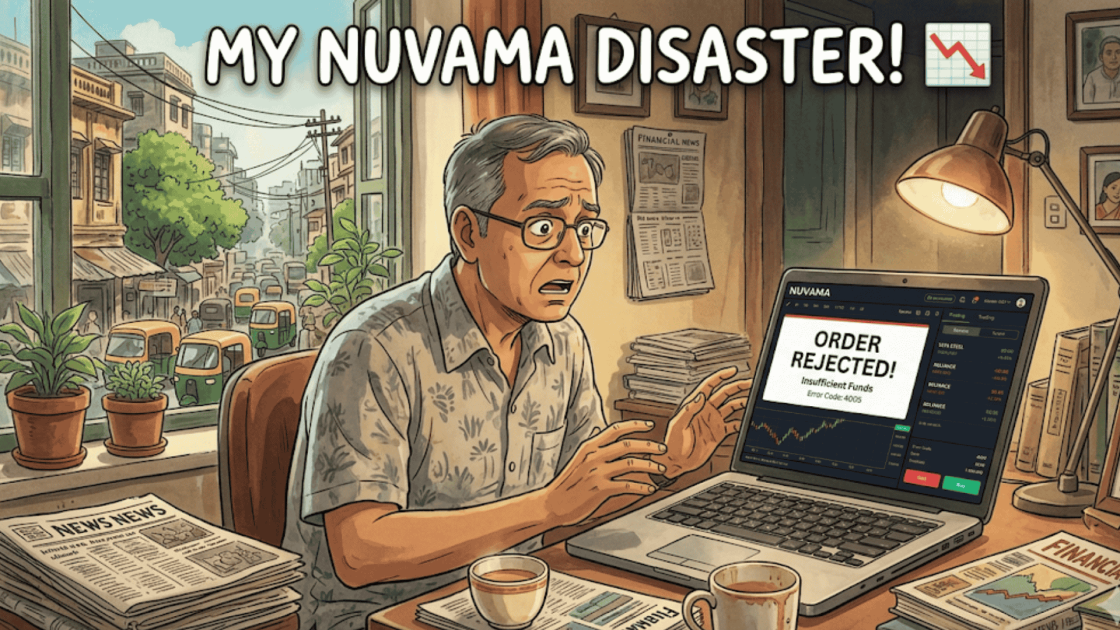
Have you ever been ready to place a trade, clicked confirm, and then seen those two dreaded words, “Order Rejected”, staring back at you from the screen?
If you’ve traded on the Nuvama platform, there’s a decent chance you’ve faced this. And if you haven’t yet, it’s still worth knowing why it happens.
Because an order rejection during a live market move is not just a minor inconvenience.
It can mean a missed entry, a failed exit, or a loss you didn’t plan for. For active traders especially, a few seconds of confusion can turn into a financial hit.
The frustrating part? Most traders don’t actually know why their order got rejected.
Was it a margin issue? A platform glitch? A rule they didn’t know existed?
The rejection message is often vague, and support takes time to respond. So before you sit wondering what went wrong the next time it happens, let’s break it all down clearly.
In this blog, we’ll look at why orders get rejected on Nuvama, what the exchange data and regulatory history say, and what you should do if the problem starts affecting your trading.
Nuvama Wealth and Investment Limited
Nuvama Wealth and Investment Limited is a SEBI-registered stock broker offering trading services across equity, derivatives, currency, and commodity segments.
The company was earlier known as Edelweiss Broking Limited before being rebranded as Nuvama.
Key Nuvama Group SEBI Registrations:
- Broking (NWIL): INZ000005231
- Clearing (NCSL): INZ000177437
- Research Analyst (NWIL): INH000011103
- Asset Management: INP000007207
- Merchant Banker: INM000013004
- Depository Participant: IN-DP-656-2021
- AMFI-registered Mutual Fund Distributor: (ARN – 70892)
It is not a discount broker like Zerodha or Groww.
Nuvama positions itself as a full-service wealth management firm, which means it offers advisory, portfolio management, and relationship-based services alongside regular trading.
Because of this positioning, the expectations from the platform, both in terms of service and technology, are naturally higher.
When something like an order rejection happens repeatedly, it tends to frustrate users more than it would on a basic discount platform.
Why Order Rejected in Nuvama?
Order rejections on Nuvama can occur due to a mix of user-side issues and system-driven checks.
The most frequent reason is insufficient margin, if your account doesn’t meet real-time requirements set by the Risk Management System (RMS), the order is blocked before it reaches the exchange.
Similarly, placing orders outside standard market hours or using incorrect order types during pre/post-market sessions can lead to automatic rejection.
Restrictions on specific stocks or contracts also play a role. Securities under surveillance, in the Trade-to-Trade (T2T) segment, or F&O ban periods cannot be traded freely.
In addition, mismatches in price (beyond circuit limits) or incorrect lot sizes in derivatives often result in failed orders. At times, the issue may not be yours at all, technical glitches, server delays, or platform errors can interrupt order execution, especially during high market activity.
There are also cases where your account gets flagged due to margin shortfalls or existing positions, restricting new trades until resolved.
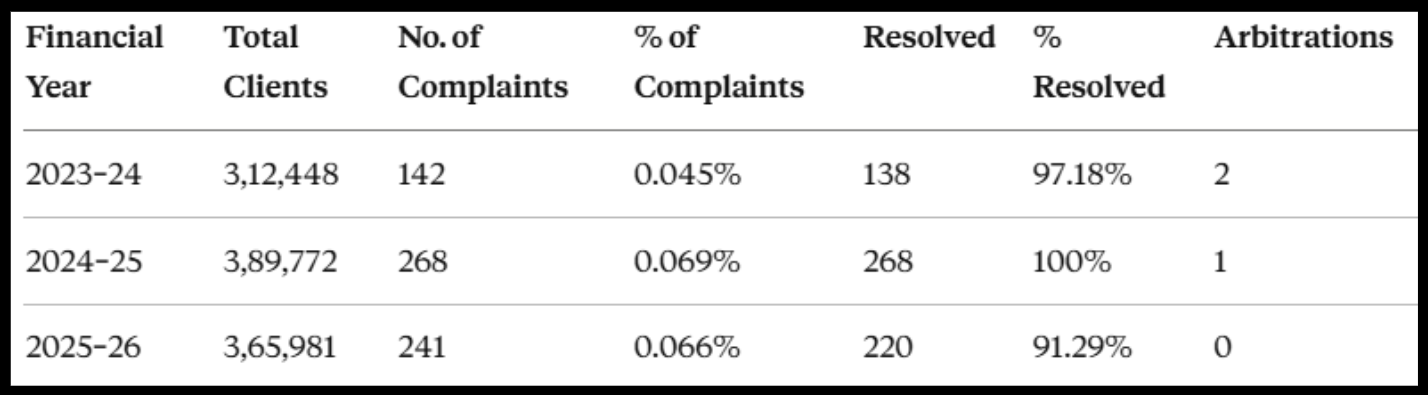
When looking at complaint trends on the National Stock Exchange, Nuvama’s complaint ratio appears low (under 0.07%), but the number of complaints nearly doubled from 142 in 2023-24 to 268 in 2024-25.
Additionally, resolution rates dropped to around 91% in 2025–26, indicating that not all issues are being closed efficiently.
While the overall percentages may seem small, what matters is individual experience, if your order gets rejected or your issue remains unresolved, even a minor system gap can have a significant impact on your trading outcome.
Monitoring the frequency of Nuvama complaints related to order execution can help you determine if the problem is a widespread technical outage or a specific account restriction.
If the standard troubleshooting steps do not work, reaching out to their support desk with your specific rejection code is the best way to ensure your trading remains uninterrupted.
SEBI Order on Nuvama Wealth
Nuvama has been on SEBI’s radar not once but twice. Both cases carry important lessons for traders, particularly around order management, due diligence, and how brokers handle client accounts.
SEBI Order 1: The Edelweiss/Nuvama Suspicious Transactions Case (2023)
This case has its roots going back to 2009–2013, but SEBI’s formal order came on June 20, 2023 (Order No. QJA/AB/MIRSD/MIRSD3/27592/2023-24).
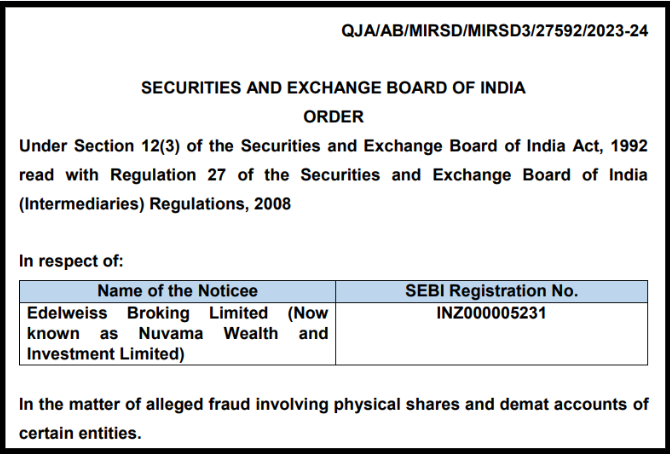
SEBI investigated a fraud involving the dematerialisation and sale of shares from dormant accounts using forged documents.
The investigation involved shares of 14 listed companies allegedly being transferred through 26 bogus entities.
One of those entities’ clients, a person named Mr. Yatin Vasantrai Parekh, had a trading account with Edelweiss Broking Limited (now Nuvama).
The broker was accused of two things. First, that its dealer failed to properly verify the identity of Mr. Parekh when he placed orders telephonically.
Second, and this is the more serious finding, Nuvama failed to report certain transactions to the Financial Intelligence Unit (FIU), even though those transactions were not in line with Mr. Parekh’s declared annual income.
The data showed that on six trading days, Mr. Parekh’s daily trading turnover was nearly equal to or exceeded his declared annual income of ₹10-15 lakhs:
| Trade Date | Daily Trading Turnover (₹) | Declared Annual Income (₹) |
|---|---|---|
| 30/03/2010 | 8,44,971 | 10-15 Lakhs |
| 31/03/2010 | 5,84,800 | 10-15 Lakhs |
| 05/01/2011 | 14,30,951 | 10-15 Lakhs |
| 17/01/2011 | 12,00,000 | 10-15 Lakhs |
| 21/05/2012 | 20,32,440 | 10-15 Lakhs |
| 24/05/2012 | 23,05,670 | 10-15 Lakhs |
SEBI’s Designated Authority recommended suspending Nuvama’s broker registration for three months.
However, after a full hearing and considering the number of instances was relatively small and the trades occurred years ago, the final order from Executive Director Anand R. Baiwar was more measured.
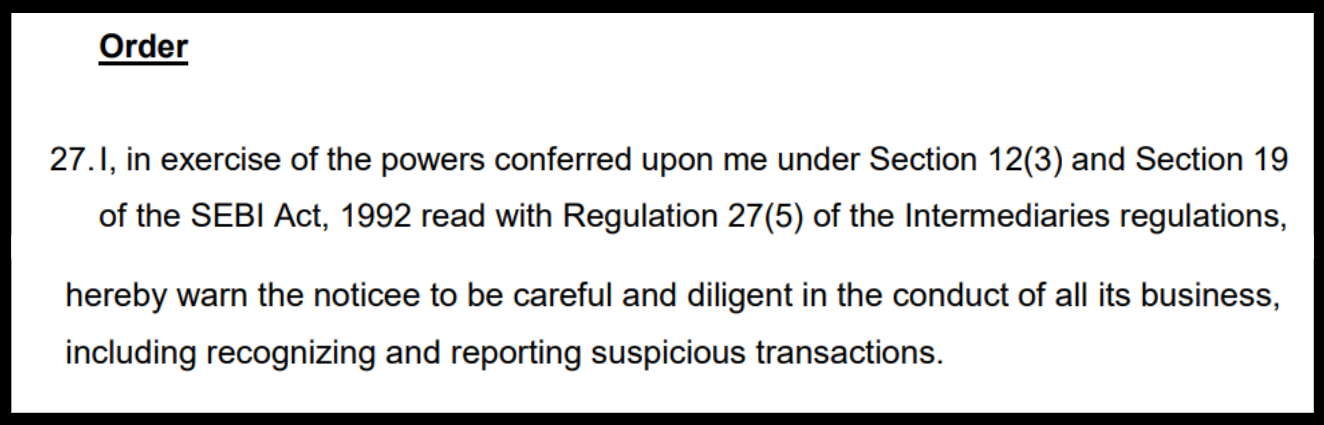
Instead of a suspension, SEBI issued a regulatory censure, a formal warning to the broker to be more careful and diligent, especially in recognising and reporting suspicious transactions.
This case wasn’t about your orders being rejected. But it reveals something important: a broker’s internal due-diligence and monitoring processes directly impact how your account is managed.
When brokers aren’t vigilant about unusual activity, the consequences can trickle down to regular traders through disrupted accounts, compliance blocks, or order restrictions.
SEBI Order 2: The Compliance Violations Case (December 2025)
SEBI conducted a comprehensive inspection of Nuvama Wealth and Investment Limited from August 4 to August 10, 2023, and the adjudication order was passed on December 1, 2025.
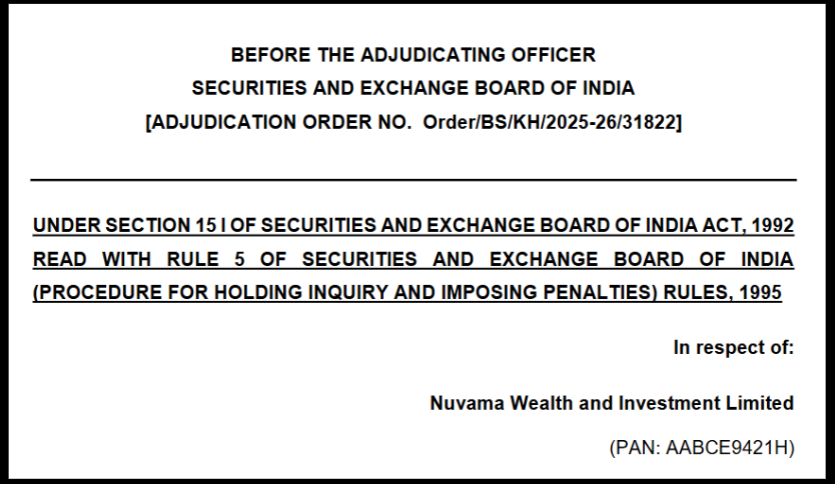
This one hits closer to home for everyday investors, because the violations found were about basic client communication and account management, things that affect whether you even receive correct information about your trades.
What SEBI Found:
a) Contract Notes Not Delivered to 63 Clients
Contract notes are official documents confirming your trades, price, quantity, charges, everything. SEBI found that 63 client codes simply did not receive physical contract notes. Without these, you have no proper proof of your trade details.
b) Electronic Contract Notes Sent to Shared Email IDs
Another 27 client codes had a single email ID mapped to multiple clients who were not family members. This means unrelated individuals may have received each other’s trade information, a clear privacy violation and a failure in basic client management.
c) 322 Email Bounce Instances Not Logged
Nuvama’s ECN system failed to capture email bounces for 322 instances across 63 client codes. So even if an email bounced, there was no corrective action taken. Clients effectively had no way to receive their trade confirmations.
d) Invalid Contact Details in KYC
63 client codes had invalid email IDs in their Unique Client Code (UCC) records. Another 26 shared common contact details without qualifying as relatives under SEBI norms.
e) Trade Exposure Not Matching Declared Income
One client’s (UCC: 50074875) trading exposure was found to be out of line with their declared income — suggesting inadequate risk management checks.
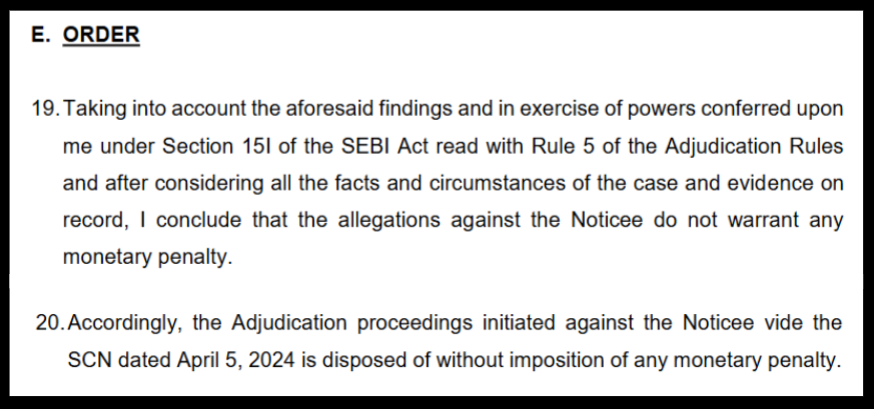
Despite finding multiple violations, Adjudicating Officer Biju S. decided on zero monetary penalty.
The reasoning: there was no fraud, the case arose from inspection rather than investor complaints, and the lapses were not considered serious enough to attract the maximum Section 15HB penalty.
This outcome is a clear signal that regulatory action does not automatically translate into investor protection. SEBI can observe violations and still choose not to penalise.
You cannot rely solely on the regulator to catch every problem in your account. Checking your contract notes, verifying your registered contact details, and reviewing your trade history regularly is something only you can do for yourself.
Nuvama Wealth Unauthorised Trading Arbitration
Order rejections are one level of frustration. But sometimes the problem goes deeper, into unauthorized trading, access misuse, and serious financial loss.
One case stands out.
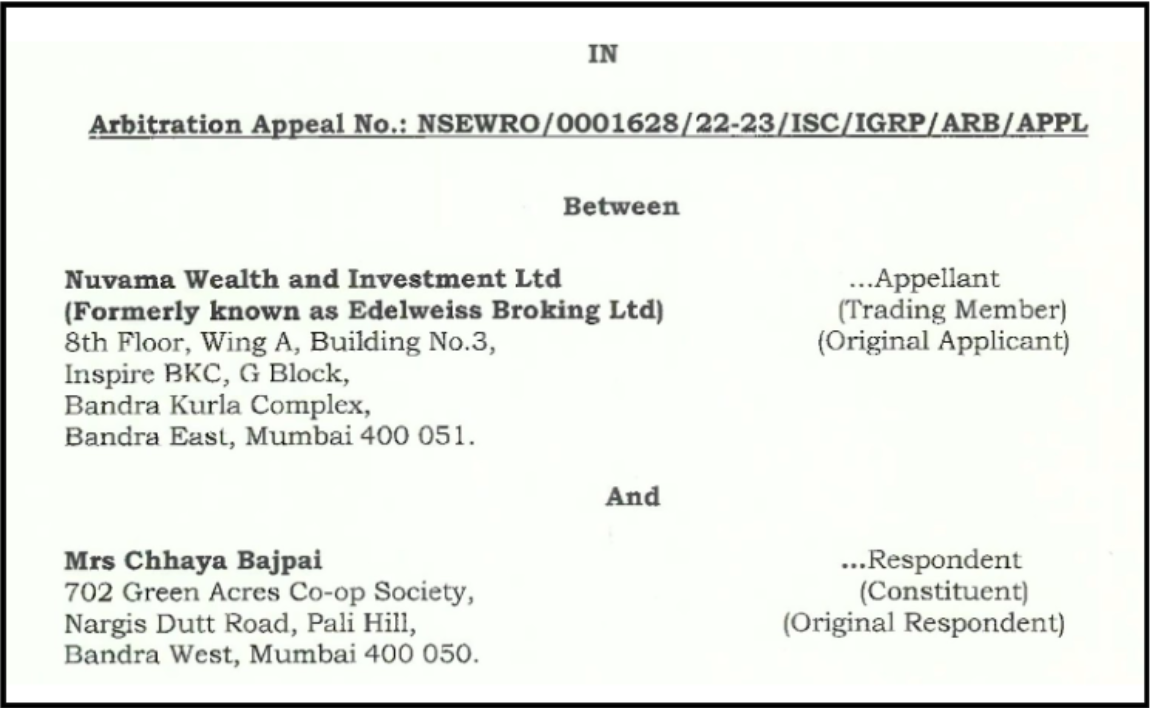
Mrs. Chhaya Bajpai raised concerns about losses of ₹41,66,000 in her Nuvama trading account.
She alleged that two relationship managers at the brokerage had executed trades in her account without her explicit permission, after she had shared her login credentials for what she thought were operational reasons.
The broker’s position was that it couldn’t be held responsible since the client had shared her password.
But the Tribunal noted that the firm had earned considerable brokerage and interest from those trades, and that the broker failed to produce clear evidence of prior client authorisation.
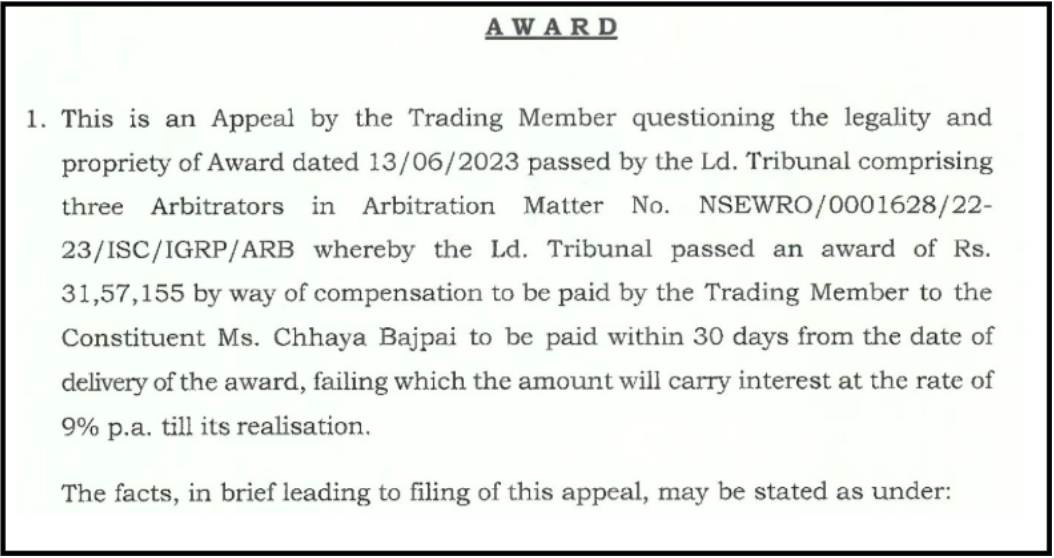
The Appellate Panel dismissed Nuvama’s appeal and directed the firm to pay ₹31,57,155 to the investor, with interest if the payment was delayed.
A brokerage firm can be held responsible for the actions of its employees, even after those employees are dismissed.
Proof of authorisation matters. And sharing your credentials, while inadvisable, does not give anyone the right to execute trades you didn’t approve.
This case is directly relevant to the broader conversation about account handling.
If trades can happen without your knowledge, order rejections are the lesser concern. The real problem is a platform where your account activity may not always reflect your intentions.
How To Complaint Against a Stock Broker?
Here’s a practical approach you can follow:
Step 1: Check the Rejection Reason First
Most platforms show a brief rejection message. Note it down. Common messages include things like “insufficient margin,” “scrip in ban period,” or “order outside price band.”
This will tell you immediately whether the issue is on your end or the platform’s.
Step 2: Check Your Margin and Funds
Log into your account and verify the available margin.
If it’s lower than you expected, check whether there’s a pending debit or a margin revision on your open positions.
Step 3: Raise a Formal Complaint With the Broker
If the rejection happened without a clear reason, raise a written complaint with Nuvama’s customer support. Reference the time, order ID, script, and the rejection message you received.
Keep copies of everything.
Step 4: File a Complaint in SCORES
If the broker’s response is unsatisfactory or delayed, file a complaint on SEBI’s SCORES platform.
This brings the regulator into the picture and forces the broker to respond formally.
Step 5: Lodge a Complaint in SMART ODR
If SCORES doesn’t resolve things, move to SEBI’s SMART ODR mechanism, which is a structured digital dispute resolution system.
Through this system, disputes are first taken up for conciliation, where an independent neutral facilitator helps both parties—the investor and the intermediary (such as a broker), reach a mutually acceptable settlement
Step 6: Initiate Stock Market Arbitration
If conciliation fails, the matter can move to arbitration, where an appointed arbitrator reviews the case, examines evidence like trade records, communications, and account statements, and then issues a binding decision.
For larger disputes, where an order rejection caused a significant financial loss, you can approach stock exchange arbitration.
An independent arbitrator will review both sides of the case and issue a binding decision.
Need Help?
If you’ve faced an order rejection that caused a loss, a support team that isn’t responding, or unexplained charges on your account, you don’t have to figure it out alone.
Register with us, and we can help you:
- Review your trading records and identify whether the rejection was legitimate or a broker error.
- Gather and organise your evidence, order logs, timestamps, contract notes, and communication history.
- Draft a clear, formal complaint for NSE, BSE, SEBI SCORES, or SMART ODR.
- Manage your case from beginning to end, including responses to regulator queries.
- Prepare you for arbitration if the matter needs to be escalated.
You shouldn’t have to fight bureaucracy alone when your money is on the line.
Conclusion
An order rejection in Nuvama can happen for multiple reasons, some technical, some regulatory, and some tied to how the platform manages risk and margin.
Not every rejection is a reason to panic.
But repeated rejections, vague responses from support, or rejections that caused real financial loss are worth taking seriously.
The two SEBI orders on Nuvama are a reminder that compliance failures at a broker can quietly affect regular investors, through missing contract notes, incorrect contract records, or inadequate monitoring.
The arbitration case involving Mrs. Bajpai shows how far things can escalate when orders and account activity go unchecked.
The takeaway is simple: stay aware, keep records, and act quickly when something doesn’t feel right.
Your trading account is your responsibility as much as the broker’s. Don’t wait for a bigger problem to show up before you start asking questions.
If you need help navigating the process, we are here for you. Reach out to us today.


 Add us as a preferred source on Google »

