

Your trading account is not just a number on a screen; instead, it reflects years of savings, disciplined SIPs, and financial goals you have built over time.
You might ask, is SEBI registered broker safe?
Reliance Securities is a SEBI-registered broker, and it has served lakhs of Indian investors across equity, F&O, and depository services.
However, Reliance Securities complaints tell a different story, as they involve alleged unauthorised trades, regulatory penalties, incorrect reporting, and even one investor winning ₹93.47 lakhs through arbitration.
Cases of Reliance Securities unauthorised trading are particularly serious, especially when a stockbroker has done a few unauthorised transactions without the client’s consent.
Furthermore, complaint volumes are rising sharply while resolution rates are declining. Therefore, this broker record demands attention before you invest or ignore an existing problem.
Reliance Securities Overview
Reliance Securities Limited is a SEBI-registered stock broker holding registration number INZ000172433.
It has been renamed to IndusInd Securities Limited after its acquisition by the IndusInd (Hinduja) Group, although it still operates under the “Reliance Smart Money” brand.
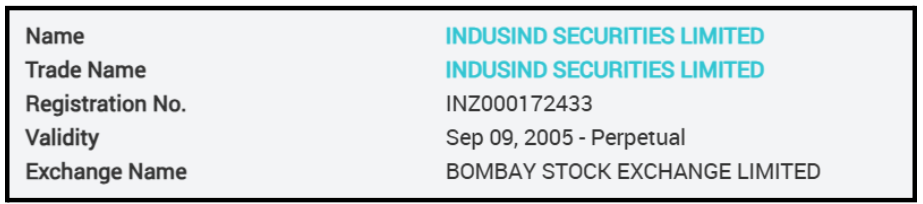
The broker operates under the Reliance Smart Money brand and offers trading services across equity cash, F&O, and currency segments on NSE and BSE.
It also provides depository participant services, enabling clients to hold and manage securities in demat form.
The broker’s parent group, Reliance Capital, has been a major name in Indian finance for decades. Therefore, Reliance Securities complaints carry weight beyond individual grievances.
Reliance Securities Complaints Types
As a registered trading member on both NSE and BSE, Reliance Securities falls under the full jurisdiction of exchange-level investor grievance mechanisms.
| Type | Description of Complaint Type | Count |
| Type I | Non-receipt / delay in payment | 15 |
| Type II | Non-receipt / delay in securities | 6 |
| Type III | Non-receipt of documents | 4 |
| Type IV | Unauthorised trades/misappropriation | 48 |
| Type V | Service related | 122 |
| Type VI | Closing out / squaring up | 2 |
| Type VII | Non-implementation of the arbitration award | 1 |
| Type IX | Others | 77 |
Type V: Service Related has the highest complaints. As a result, users frequently face issues with execution, platform performance, charges, customer support and instances of the Reliance Securities app not working.
These problems directly affect everyday trading and can disrupt timely decisions in the market.
This is a serious red flag, as consistent service failures can lead to missed opportunities, financial losses, and unresolved grievances.
Overall, this reflects weak operational efficiency and poor customer experience management.
Exchange-level mechanisms are only as effective as the investor’s willingness to use them; therefore, delay is the biggest reason claims go unrecovered.
Also Read: PhonePe Wealth Broking reviews, frequent glitches, described directly by an active scalper.
Reliance Securities Exchange Complaints Data
The following data is sourced from Reliance Securities disclosed complaint records on the NSE member complaint data portal:
| Financial Year | Active Clients | Complaints Filed | % of Complaints | Resolved | Unresolved | % Resolved | Arbitration Cases |
| 2025–26 | 49,438 | 95 | 0.192% | 90 | 5 | 94.74% | 1 |
| 2024–25 | 63,418 | 89 | 0.14% | 89 | 0 | 100% | 0 |
| 2023–24 | 72,976 | 72 | 0.09% | 63 | 9 | 87.5% | 1 |
| 2022–23 | 72,976 | 47 | 0.06% | 44 | 3 | 93.6% | 5 |
Complaints Have More Than Doubled in Three Years
From 47 complaints in 2022–23 to 95 in 2025–26, Reliance Securities has seen volumes rise over 100%, while its active client base has fallen from 72,976 to 49,438.
Therefore, the broker is generating more complaints per client, which directly indicates deteriorating service quality.
2023–24 Had the Worst Resolution Record
With 9 complaints left unresolved and a resolution rate of only 87.5%, the 2023–24 financial year represents Reliance Securities’ weakest performance on grievance resolution.
Furthermore, unresolved exchange-level complaints are precisely the cases most likely to involve genuine financial harm because investors who receive a satisfactory explanation usually withdraw their complaints.
Arbitration Cases Signal Serious Disputes
The 5 arbitration cases in 2022–23 and 1 each in 2023–24 and 2025–26 confirm that a subset of Reliance Securities complaints have escalated all the way to formal legal proceedings.
Arbitration is not a first resort; instead, investors reach it only after broker, exchange grievance, and IGRC processes fail to deliver justice.
Meanwhile, as the arbitration section below shows, at least one investor has already won a significant award against this broker.
The Shrinking Client Base Adds Context
Reliance Securities has lost over 23,000 active clients between 2022–23 and 2025–26, a decline of nearly 32%.
A broker losing clients while generating more complaints per client shows the exact pattern that SEBI’s inspection regime is designed to detect and address.
Also Read: Alice Blue reviews, 17 branches, over 1,000 partners, and a genuinely mixed real record.
Reliance Securities SEBI Order
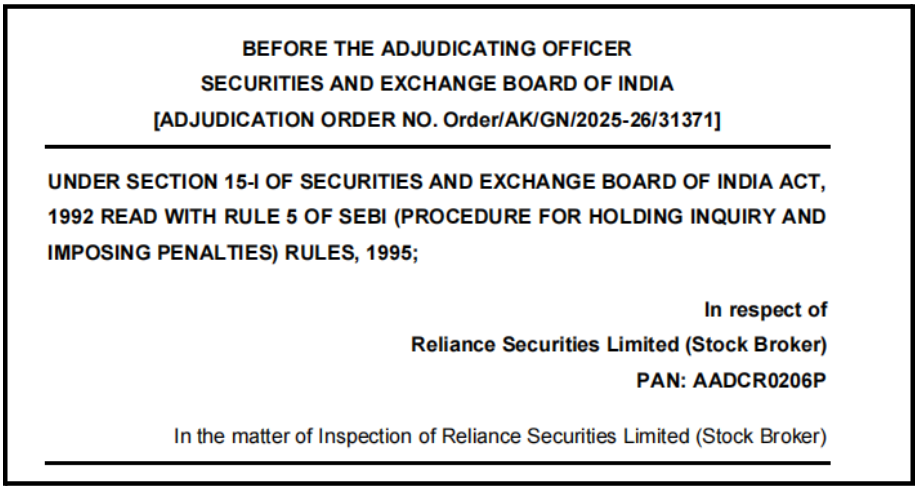
According to the SEBI Adjudication Order dated April 7, 2025, SEBI conducted a comprehensive inspection of Reliance Securities Limited between December 2022 and January 2023, covering the period from April 2021 to November 2022.
Violations By Reliance Securities
The inspection identified alleged violations across 15 separate regulatory areas. Of these, 13 violations were formally established by the Adjudicating Officer.
Violation 1: Non-Settlement of Client Funds
According to the order, Reliance Securities allegedly failed to settle funds belonging to inactive clients with over ₹28 crore remaining unsettled across 10,102 instances.
Failing to return client funds to inactive accounts is one of the most serious regulatory obligations for a stock broker.
Violation 2: False Margin Reporting
According to the order, the broker allegedly reported incorrect margin collection figures to the exchanges, involving a discrepancy of ₹93,262.
While the amount appears small, the act of reporting false margin data to an exchange undermines the fundamental monitoring framework SEBI uses to protect investor funds.
Violation 3: Margin Trading Facility Violations
According to the order, Reliance Securities allegedly exceeded the permissible 50% of net worth plus borrowings limit in 19 instances under the Margin Trading Facility.
These are not clerical errors; instead, they represent repeated overexposure of client positions beyond permitted regulatory limits.
Violation 4: Incorrect Enhanced Supervision and Client Balance Reporting
According to the order, Reliance Securities reported wrong client bank balances, cash equivalents, and margin data to exchanges on multiple dates.
Discrepancies in client balance reporting ranged from ₹1 lakh to ₹54 crore.
Furthermore, the broker allegedly failed to report ₹328 crore of cash collateral under Risk-Based Supervision, reporting only ₹16 crore instead.
Violation 5: Engaging in Other Business Through Loans to Associates
According to the order, the broker allegedly gave loans totalling ₹14 crore to associate companies, including Reliance Unicorn and Reliance Digitech.
Rule 8(3)(f) of the Securities Contracts (Regulation) Rules, 1957 explicitly prohibits stock brokers from engaging in any business other than securities, including extending loans to related entities.
The broker’s defence that these were temporary advances from surplus funds was rejected.
Violation 6: Cybersecurity Non-Compliance
According to the order, Reliance Securities’ off-the-shelf back-office software did not hold the required STQC certification mandated under SEBI’s cybersecurity circular.
The broker claimed its products were custom-developed and therefore exempt; however, SEBI found that no documentary proof was provided and that the broker’s submissions were contradictory.
Final Penalty Imposed
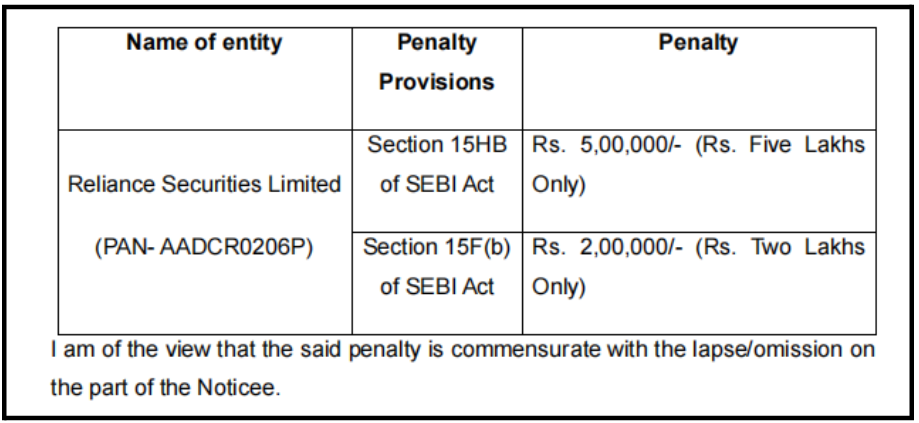
According to the SEBI Adjudication Order dated April 7, 2025, a total monetary penalty of ₹7,00,000 (Rupees Seven Lakhs Only) was imposed on Reliance Securities Limited.
- ₹5,00,000 under Section 15HB of the SEBI Act, 1992 for general regulatory contraventions.
- ₹2,00,000 under Section 15F(b) of the SEBI Act for failure to deliver funds or securities to investors.
What to Learn from This Case?
- Alleged non-settlement of ₹28 crore across 10,102 inactive client instances confirms that fund management failures at Reliance Securities were not isolated events; they were systemic.
- The ₹328 crore underreporting of cash collateral in Risk Based Supervision data is not a rounding error, it suggests the broker’s regulatory reporting cannot be relied upon as an accurate reflection of its true financial position.
- Illegal passing of margin penalties to clients, if it happened to five identified clients, is highly likely to have happened to others whose cases were not part of the inspection sample.
This regulatory record is not just a collection of technical infractions.
It describes a broker with alleged compliance failures across fund management, margin reporting and client protection, confirmed across an 18-month inspection window alone.
Also Read: Nuvama complaints, 142 complaints one year, 268 the very next.
Reliance Securities Arbitration Case
According to the NSE Arbitration Award dated April 18, 2023 (Matter No. NSEHRO/0012219/22-23/ISC/IGRP/ARB), an individual investor filed a complaint against Reliance Securities Limited, then operating as Reliance Smart Money.
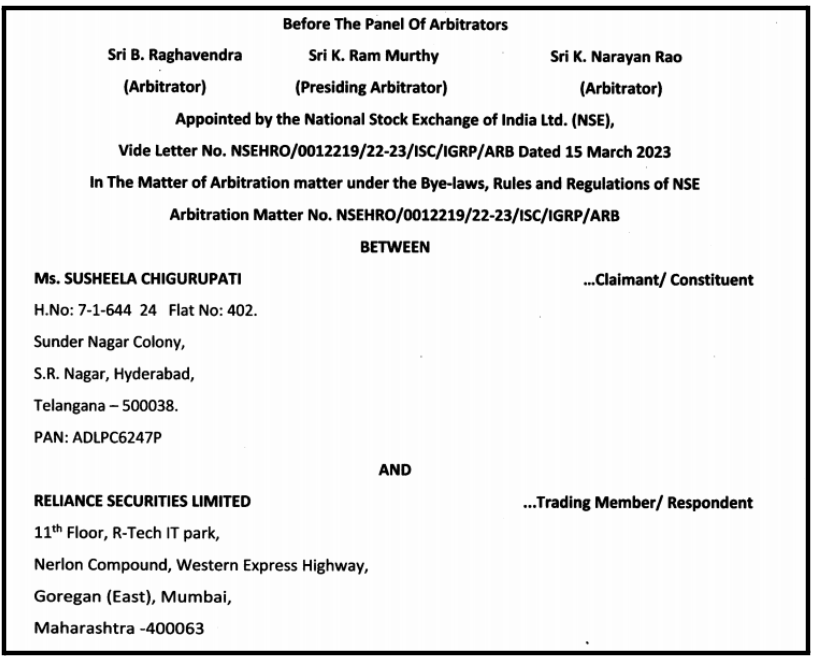
The investor alleged that the broker’s franchise partner executed unauthorised trades in her account over multiple years.
Background of the Case
The investor had opened a trading and demat account with Reliance Securities in July 2017.
According to her claim, the NSE-F&O segment was activated in her account in September 2017 while she was outside India without any request or consent from her.
Furthermore, the claimed trading activity that followed allegedly consumed almost her entire portfolio of blue-chip shares, executed by the broker’s franchise dealer, reportedly to generate brokerage income.
The tribunal held that this admission was sufficient to establish that the trades were unauthorised under Section 58 of the Indian Evidence Act; facts admitted need not be proved.
The Award
According to the arbitration award signed on April 18, 2023, the panel unanimously ordered Reliance Securities to pay the investor ₹93,47,279 (Rupees Ninety-Three Lakhs Forty-Seven Thousand Two Hundred and Seventy-Nine only).
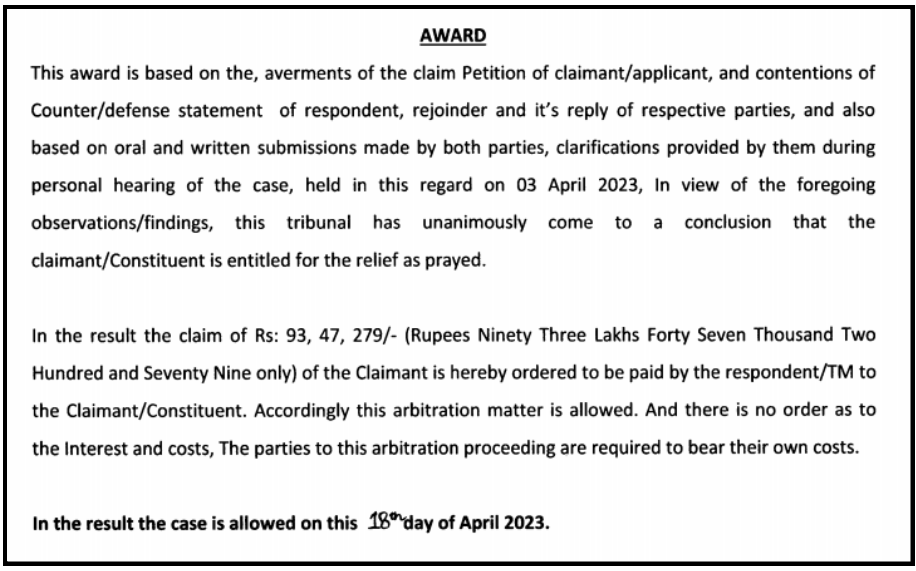
No interest or costs were awarded as none were prayed for by the investor.
When to Take Action Against a Broker?
The difference between recovering your money and losing it permanently often comes down to how quickly you act.
Here are the situations that demand immediate escalation:
- Trades You Did Not Place: If your account shows buy or sell transactions you did not authorise by phone, in writing, or online, do not accept the broker’s explanation at face value.
- F&O Segment Active Without Your Request: If you never applied to trade in futures and options but your account shows F&O activity, your broker may have activated the segment without your knowledge.
- Portfolio Declining Without Your Instructions: If your long-term holdings are being reduced without corresponding trade confirmations you initiated, request your complete ledger and trade log immediately.
- Margin Penalties Charged to Your Account: If you see deductions labelled as margin penalties or exchange penalties like Reliance Securities excess charges, check whether they relate to upfront margin shortfalls.
- Funds Not Returned After Account Closure Request: If you have requested account closure or fund withdrawal and your money has not been returned within the settlement timeline, escalate immediately to the exchange and SEBI SCORES.
- Broker or Franchise Becomes Unreachable: If the authorised person or franchise partner who handled your account stops responding, especially after a period of heavy trading activity.
Every day of delay after discovering a problem reduces your evidence, shortens your effective timeline, and strengthens the broker’s position. Act on the first warning sign.
How Do I File a Complaint Against a Stock Broker?
If you are facing issues, taking timely and structured action is critical to protect your funds.
Therefore, follow the steps below carefully to escalate your complaint through the proper channels.
Step 1: Raise a Complaint With Reliance Securities Directly
Send a written complaint to Reliance Securities’ official grievance email address. Include the exact dates, trade references, amounts involved, and the specific nature of your complaint.
Request a written acknowledgement. Under SEBI regulations, registered brokers must acknowledge complaints and resolve them within 30 days.
Your formal escalation timeline starts from this date, so send the complaint immediately and preserve proof of delivery.
Step 2: File a Complaint in SEBI Against Broker
If Globe Capital does not resolve your complaint within 30 days or if the response provided is inadequate, file a SEBI complaint formally with SCORES.
SEBI SCORES is the central regulatory platform for filing grievances against all SEBI-registered intermediaries, including stockbrokers.
SEBI monitors resolution timelines, and brokers are required to respond within defined regulatory periods.
You can also check your SEBI complaint status online at any time.
Step 3: Escalate to NSE or BSE
Register a complaint in BSE or NSE.
NSE and BSE both operate investor grievance cells specifically designed to handle complaints against their registered trading members.
Submit your complaint with all supporting documents, including contract notes, account ledger extracts, trade confirmations, and your prior written correspondence with the broker.
Step 4: Stock Market Arbitration
If the IGRC process does not produce a satisfactory outcome, you can file for formal arbitration through the Online Dispute Resolution portal.
This portal provides a structured, legally binding process for resolving investor-broker disputes.
Arbitration awards are enforceable under Indian law, and retail investors can initiate the process without requiring legal representation for the initial filing stage.
Need Help?
Navigating a dispute against a large broker like Reliance Securities while simultaneously managing your own finances is genuinely difficult.
The regulatory system works, but only for investors who know how to use it correctly, file on the right platforms, and act within the right timelines.
Many investors miss these steps and walk away from money they were legally entitled to recover.
Register with us if you are facing issues with Reliance Securities or any other broker. We will help you take the right steps at the right time.
Conclusion
Reliance Securities Limited is a SEBI-registered stock broker with NSE and BSE memberships and a long operational history across Indian financial markets.
The SEBI Adjudication Order of April 2025 established 13 regulatory violations, including alleged non-settlement of ₹28 crore across 10,102 inactive client accounts, ₹328 crore in underreported cash collateral, and the illegal passing of margin penalties to clients.
The NSE Arbitration Award of April 2023 ordered the broker to pay ₹93.47 lakhs to an investor for alleged unauthorised trading executed by the broker’s own franchise partner.
Exchange complaint data shows that formal grievances have more than doubled in three years against a client base that has shrunk by nearly a third.
Check your trade history, question every charge, and do not hesitate to escalate formally if something does not add up.
Your capital and your right to control it deserve a broker whose conduct matches its registration.





 Add us as a preferred source on Google »

