
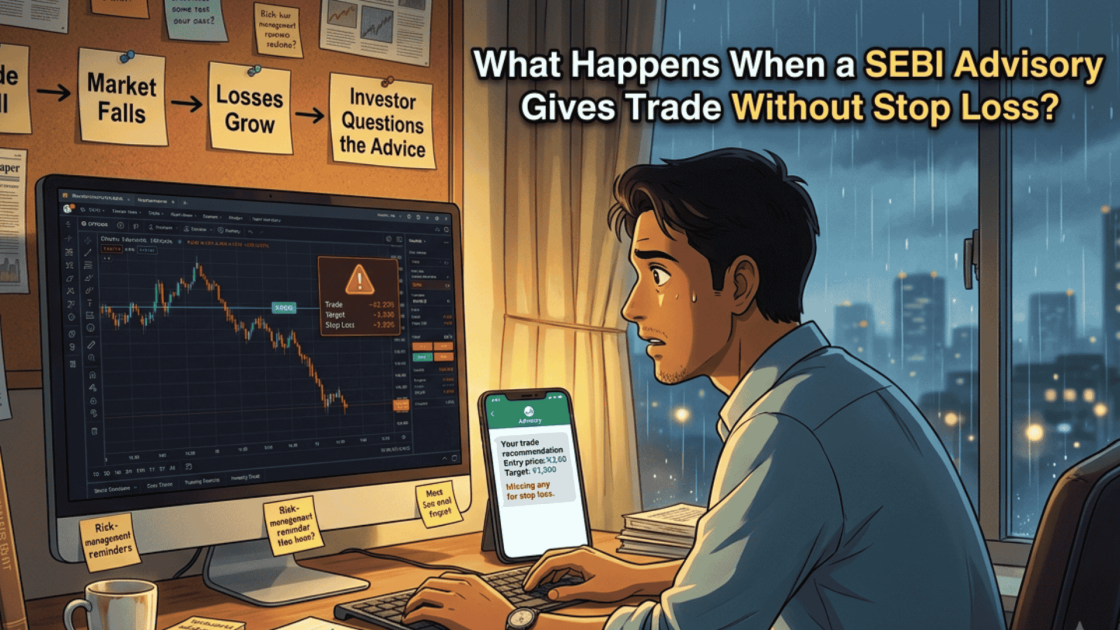
You received the call. You entered the trade. Then the price dropped, and the SEBI advisor had no exit plan for you.
You waited for guidance. Nothing came. Just a losing position, a silent advisor, and a balance that kept shrinking.
This is one of the most widespread violations in India’s advisory space. And most traders who experience it never realise they can fight back.
This blog answers why this happened, what it means under SEBI’s rules, how to recover your money, and what you must do right now.
You Paid for Expert Guidance, But The SEBI Advisor Sent You into Losses with No Way Out
Think about exactly how it unfolded.
The advisory sent you a call. Entry price, clear. Target, clear. Stop-loss, nowhere.
You entered. The price moved against you. You reached out immediately.
Their reply came quickly.
“Thoda patience rakho. Market recover karega.”
That one line kept you in the trade. Each day you held on, the losses grew deeper. They sent no exit. No update. No accountability.
Here is what that line actually was. It was not guidance. It was a trap.
A SEBI-registered Investment Adviser carries a legal obligation to protect your downside. Without a stop-loss, all the risk lands entirely on you.
The advisor faces zero consequences for the outcome. That is precisely why they skip it.
When you held and hoped, you were doing exactly what they needed you to do.
Why Did Your Money Keep Disappearing?
When your advisor gave you a trade without a stop-loss, the problem ran deeper than one bad call.
They violated specific obligations that SEBI put in place to protect you.
Here is what those violations actually look like:
1. They Never Assessed Your Risk Before Advising You
Before any trade recommendation, a registered Investment Adviser must understand your income, financial situation, and how much loss you can absorb.
Did anyone sit with you and ask those questions? If not, every call they gave you started as unsuitable advice, from the very first message.
2. The Call Protected Their Story, Not Your Capital
Complete advice always accounts for what happens when the trade goes wrong.
When they sent a call with only an entry and target, they focused entirely on the upside.
Your downside never made it into the picture. That is a direct breach of their duty to act in your interest.
3. They Made Promises No Registered Advisor Can Legally Make
“Guaranteed profit.” “No loss strategy.” “This will definitely move up.” Every phrase like that violates SEBI’s explicit ban on return assurances.
Saying it confidently does not make it legal. It makes it a violation, full stop.
4. A Stop-Loss Is a Regulatory Requirement, Not a Bonus Feature
SEBI’s framework is unambiguous on this. A complete trade recommendation must include an entry, a target, and a stop-loss. Skipping the stop-loss is not a stylistic choice.
It is a failure of a core obligation they owe every client.
5. Telling You to “Hold” Was Not an Exit Strategy
When you raised your losses, and they said “recovery ho jayegi,” they replaced professional guidance with empty reassurance.
That is not a plan.
That is a deliberate move to avoid accountability for a call that had no protection built into it from day one.
Spotting the Red Flags: What the Advisory Experience Actually Reveals?
This is not a one-off. Advisories across India follow the same playbook: confident calls, no risk management, and silence the moment accountability arrives.
Knowing what to look for protects you going forward.
When things go wrong, many traders begin to wonder: is SEBI registered investment advisor safe? The truth is, safety comes from compliance.
If you find yourself asking, can I trust SEBI registered investment advisor firms at all?, looking closely at their daily operations will give you the answer. Look back at your experience.
You will spot clear violations of core SEBI registered investment advisor guidelines at every stage:
- Trade calls with entry and target, but never a stop-loss: Every single time, without exception.
- Promises of guaranteed or “no loss” profits: Before you paid their fee, and often after you did.
- “Hold karo, recover ho jayega” instead of a proper exit: Always framed as patience. Never as a strategy.
- Pressure to put in more capital after losses mounted: More money from you meant more fee income for them.
- No risk profiling form, no questions about your finances: They never needed to know you. They only needed your subscription.
- Calls sent to large WhatsApp groups, identical message for everyone: No personalisation. No suitability check. No individual accountability.
- Silence or deflection every time you raised a concern: They knew the call lacked protection. They did not want a record of acknowledging it.
- Multiple trades, consistent losses, and a different excuse each time: Losses do not run in one direction without a reason behind them.
Even one of these is enough to file formally. Do not sit on it.
How You Can Get Your Money Back From SEBI Registered Investment Advisor?
Most traders who reach this point never file a complaint. Here is exactly what to do instead.
Below are the steps to file a complaint against investment advisor:
Step 1: Secure Every Piece of Evidence Right Now
Do this before anything else. Screenshot every trade call message. Save every WhatsApp conversation.
Download your complete trading statements and account ledger.
Keep all fee receipts and payment confirmations. Evidence disappears quickly. Save it today.
Step 2: Verify the Advisor’s SEBI Registration
Go to SEBI’s intermediary portal. Search by the advisor’s name or registration number.
Check whether their registration stays active.
An expired or cancelled registration strengthens your case considerably.
Step 3: Send a Formal Written Complaint to the Advisory
Do not call them. Write to them on record. Name every call that lacked a stop-loss.
Include the dates. State the losses. Ask directly for a written explanation.
Keep every reply, and every silence. Both serve as evidence.
Step 4: Register a Complaint with SCORES
If the advisor ignores or dismisses your complaint, go to SEBI’s SCORES portal.
Register your complaint with all supporting documents attached. SEBI mandates a formal response.
The advisor cannot simply walk away from a SCORES complaint.
Step 5: Lodge a Complaint with SMART ODR
If SCORES doesn’t deliver resolution, take the matter to SEBI’s SMART ODR platform.
This gives you structured, time-bound online mediation. Neutral parties review your case.
Most disputes move meaningfully forward within 30 days.
Step 6: Stock Market Arbitration
If everything else falls short, formal arbitration delivers a binding, enforceable outcome.
Evidence of trade calls without stop-loss, combined with documented losses, carries real weight in arbitration proceedings.
This is where cases like yours get a definitive answer.
Recognize the Trap? Don’t Fight It Alone
You know what went wrong. Knowing only matters when you act on it.
Every day you wait, the other side gains time. Evidence grows harder to retrieve, and the complaint feels more distant. Start now, before anything else.
Here’s exactly how we step in for you: We go through your trade calls, losses, and documentation and tell you clearly whether you have a case and what it is worth. No commitment, no upfront cost.
If you have a case, we organise your evidence the way SEBI and arbitration panels expect to see it, not just a folder of screenshots, draft the complaint with specific regulatory violations named, and file through SCORES, SMART ODR, and arbitration if needed.
Advisors who skip stop-losses count on traders not knowing the system. We know it.
Register with us today and let’s find out where you stand.
Conclusion
You asked for guidance. You got a call with no exit. When the losses came, they told you to hold. When accountability came, they went quiet.
That is not a market risk you agreed to carry. That is a regulatory failure. And it can be formally challenged.
The documentation you already have may be enough to start. Do not let this sit any longer.
Disclaimer: This content is for informational and awareness purposes only. It does not constitute legal or financial advice. Recovery outcomes depend on individual case details, evidence quality, and applicable regulations. Past outcomes do not guarantee future results.
Frequently Asked Questions
1. My advisory gave me a trade call with no stop-loss, and I suffered losses. Is that a legal violation?
Yes. SEBI’s regulatory framework requires registered Investment Advisers to include proper risk management in every recommendation.
A stop-loss is not optional; it is part of a complete, compliant trade call. Giving a call without one, especially when it results in losses, is a direct breach of the advisor’s duty toward you.
Document every such call and escalate formally.
2. My advisor kept saying “hold on, the market will recover” every time I raised my losses. Can I use that as part of my complaint?
Absolutely. “Hold karo” in place of a proper exit strategy is a red flag, not professional guidance.
When an advisor repeatedly substitutes reassurance for an actual risk management plan, it demonstrates a pattern of unsuitable advice. Save every such message.
It strengthens your complaint significantly.
3. I was never asked to fill any risk profile form before receiving trade calls. Does that affect my case?
Yes, it matters a great deal. SEBI mandates that every registered Investment Adviser must profile each client’s risk appetite and financial capacity before giving any recommendation.
Skipping that step means every call they gave you was unsuitable advice from the start.
This is an independent violation, separate from the stop-loss issue, and it adds considerable weight to your complaint.
4. I followed trade calls from an unregistered advisory and lost money. Can I still recover it?
Yes. In many ways, an unregistered advisory operating without SEBI authorisation makes your case stronger, not weaker.
SEBI actively acts against unregistered entities. Collect all evidence, payment records, trade call screenshots, chat history, and file on SEBI SCORES.
The absence of registration does not mean absence of accountability.
5. My advisor sent trade calls to a WhatsApp group with hundreds of members. Does that count as personalised advice?
No, and that is actually the violation. SEBI requires registered Investment Advisers to assess each client’s individual risk profile before giving recommendations.
A single call sent to a mass WhatsApp group with no individual suitability check means every recommendation they made was unsuitable advice by definition.
Screenshot the group, your membership in it, and the calls sent. That evidence supports a strong complaint.





 Add us as a preferred source on Google »

