

Selecting a financial advisory or research service involves assessing its regulatory standing, how its offerings are structured, and the level of transparency it maintains.
Investors increasingly seek clear insight into how recommendations are generated and how potential risks are conveyed before making any financial decisions.
Abdullah Zaman, a SEBI-registered Equity Research Analyst (RA) and the owner of Ethica Invest, operates within India’s regulated research ecosystem and positions himself as a provider of data-driven market insights and trading guidance.
In this blog, we examine his professional background, outlined services, and overall role within the financial research space to give readers a well-structured understanding of how his platform functions.
Ethica Invest Review
In recent years, as India’s financial ecosystem continues to expand beyond metro cities, newer research-driven platforms have started gaining attention.
Among them is Ethica Invest, led by Abdullah Zaman, a SEBI-registered Equity Research Analyst (Reg. No. INH000013244).
Unlike many unregulated voices dominating social media, Ethica Invest positions itself as a structured, compliance-focused platform offering research-backed investment insights.
The presence of SEBI registration plays a significant role here. It indicates that the research services provided are expected to follow defined regulatory norms, disclosures, and ethical standards aimed at safeguarding investor interests.
Can we trust SEBI registered RA in India? While registration ensures that the analyst meets minimum qualification and ethical standards, it does not act as a guarantee of profit.
Trust should be built on the transparency of their research reports and their history of regulatory compliance.
At a time when unrealistic return promises and speculative advice are widespread, such registration offers a layer of accountability.
Ethica Invest also emphasizes a community-driven approach, connecting with investors through digital platforms and offering structured research insights rather than informal tips.
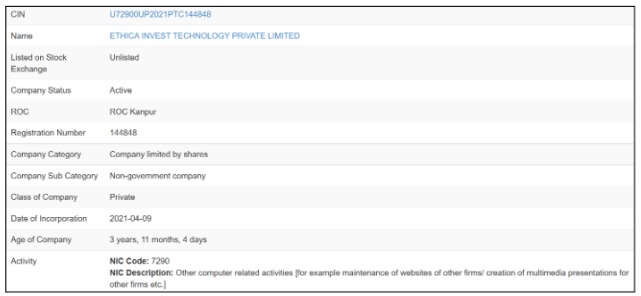
Beyond branding, the company operates through Ethica Invest Technology Private Limited (CIN: U72900UP2021PTC144848), a privately held, non-government entity registered with the Registrar of Companies, Kanpur.
Incorporated in December 2021, the company is classified under “other computer-related activities,” which includes digital platforms and financial research delivery systems.
With an authorized and paid-up capital of ₹23 lakh, and filings updated as per Ministry of Corporate Affairs records, the firm reflects a formally structured operational base.
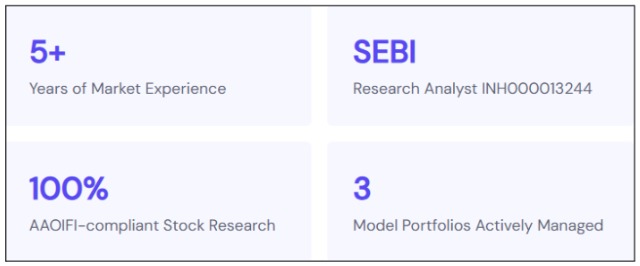
Ethica Invest positions itself as a platform centered around ethical investing, blending financial research with screening frameworks aligned to standards such as AAOIFI.
While this positioning may instill confidence, it is important to recognize that SEBI registration clearly outlines what services are permitted and where strict regulatory limits apply.
For any investor, understanding these boundaries is just as crucial as assessing the firm’s offerings and claims.
At the same time, the Ethica Invest website does not appear to provide publicly accessible information regarding investor complaints.
As per SEBI regulations, Research Analysts (RAs) are required to disclose and regularly update complaint data, making this an important factor investors should take into consideration.
What SEBI Allows a Registered Research Analyst to Do?
As per SEBI guidelines for RA, a registered research analyst is authorised to offer research and advisory-related services within a defined regulatory framework.
They are permitted to:
- Issue Research Reports: An RA can publish detailed reports on listed companies, sectors, or overall market movements. These typically include financial analysis, valuation perspectives, underlying assumptions, and associated risks. All reports must remain objective, data-driven, and include proper disclosure of any potential conflicts of interest.
- Provide Research-Backed Recommendations: They may offer investment suggestions grounded in thorough research. Every recommendation should be supported by documented analysis, clearly outline risks, and must not include any promise or assurance of fixed returns.
- Offer Analytical Views: RAs are allowed to share informed opinions on stocks, sectors, macroeconomic trends, and derivatives. However, these insights must remain analytical in nature and should not extend to direct trade execution or portfolio management.
- Charge Clearly Disclosed Fees: They can levy fees for their services, provided the pricing structure is transparent and in line with regulations. Fees must not be linked to trading outcomes or profit-sharing models, ensuring independence and fairness in advisory services.
What SEBI-Registered Research Analysts Cannot Do?
Before engaging with a research analyst (RA), it is essential to understand the regulatory boundaries he is required to operate within.
SEBI’s framework is designed to safeguard investors by promoting fairness, transparency, and responsible advisory practices.
Being aware of prohibited activities is just as crucial as understanding the services that can be offered.
- No Assured Return Commitments: A registered analyst cannot offer fixed returns, guaranteed profits, or claims of consistent daily earnings. Since markets are inherently unpredictable, such assurances are considered deceptive.
- No Promises of Loss Recovery: It is not permissible to guarantee recovery of previous losses or promote “risk-free” strategies that claim certainty in outcomes.
- No Performance-Based Charging Model: Fees must not be linked directly to profits earned, portfolio size in a profit-sharing manner, or deducted as a percentage of trading gains, as this may lead to biased advice.
- No High-Pressure Sales Tactics: Persistent unsolicited calls, pushy marketing strategies, or creating artificial urgency to secure payments goes against ethical standards.
- Mandatory Transparency & Documentation: Clients should be provided with complete service information, risk disclosures, and formal agreements. Any lack of clarity or omission in communication can attract regulatory scrutiny.
How to Report Against Research Analyst?
If you believe that your research analyst has behaved in a way that seems misleading, non-compliant, or not aligned with expected professional standards, it’s important to approach the situation with clarity and patience.
Investor protection mechanisms are already in place, and following a structured process can help you safeguard your interests and address your concerns effectively.
Here’s how you can proceed:
-
Gather Evidence: Begin by assembling all the necessary documents related to your concern. This may include payment proofs, email exchanges, chat conversations, trade records, and relevant screenshots. Well-organized documentation strengthens your case and adds credibility to your complaint.
-
Contact the Research Analyst: Before escalating the issue, make an effort to connect with the research analyst or the firm directly. Communicate your problem clearly and request a resolution. Often, concerns can be addressed at this stage without needing further action.
-
Register a Complaint in SCORES: If the issue remains unresolved, you can lodge a complaint on the SEBI SCORES platform. This official system enables investors to raise grievances against registered entities. After submission, your complaint is sent to the concerned firm, and you can monitor your SEBI complaint status online.
-
File a Complaint in SMART ODR: If you are still not satisfied, you can proceed to the SMART ODR platform. It offers an online dispute resolution mechanism through mediation and conciliation, ensuring a more streamlined and efficient process.
-
Stock Market Arbitration: As a last resort, you may choose arbitration. This formal legal process involves an independent authority reviewing your case and issuing a binding decision, typically when all other options have been exhausted.
Need Help?
Many individuals feel uncertain when dealing with SEBI-registered entities, as official registration can sometimes give an impression of complete reliability.
When you register with us, we support you at every stage by helping you understand:
- How to accurately check and confirm SEBI registrations
- How to spot potential breaches of rules or unethical practices
- How to prepare well-structured complaints for SEBI and cybercrime authorities
- How to differentiate between mis-selling practices and actual fraud
Our method is centered around clear documentation, following the correct process, and ensuring accountability where it truly belongs.
Conclusion
Abdullah Zaman, a SEBI-registered Equity Research Analyst (RA) offers stock market research, trading insights, and learning resources tailored for participants in the Indian equity market.
If you are planning to opt for his services, it is essential to clearly understand the scope of activities permitted under SEBI regulations, as well as the boundaries that must not be crossed.
Before making any commitment, review his registration credentials, pricing structure, service agreements, and risk-related disclosures in detail.
Ensure that all recommendations are supported by proper research and are not portrayed as assured or risk-free returns.
Additionally, confirm that all terms are well-documented and that communication regarding roles, responsibilities, and expectations is transparent.
Making a well-informed decision after evaluating these aspects can help you set realistic expectations and avoid potential issues later on.





 Add us as a preferred source on Google »

