

You see an investment advisory firm claiming professional research, expert trading calls, and market guidance that can help you grow your money faster. Everything sounds convincing at first glance.
But then you start noticing unresolved complaints, refund disputes, aggressive sales tactics, and even arbitration awards against the company.
That naturally raises one important question: Is Aurostar Investment Advisory safe or not?
Securities and Exchange Board of India-registered advisory firms are expected to follow strict compliance standards designed to protect investors.
However, registration alone does not automatically guarantee ethical conduct or quality service.
In the case of Aurostar Investment Advisory Private Limited, several investor grievances, unresolved complaints, and arbitration findings have raised serious concerns that potential clients should carefully evaluate before investing their money.
This blog takes a detailed look at the company’s complaint history, major red flags, arbitration proceedings, and what investors should know before engaging with the firm.
Is Aurostar Investment Advisory Safe or Not?
Aurostar Investment Advisory Private Limited is SEBI-registered advisory firm offering stock market recommendations, commodity tips, futures and options strategies, and investment planning services.
The company markets its services heavily through online promotions, phone calls, and digital advertising campaigns aimed at retail traders and investors.
However, a closer look at Aurostar Investment Advisory Services reviews and the multiple warning signs that have surfaced over time makes many investors question the safety and reliability of the firm.
Here are some major red flags investors should not ignore:
1. Repeated Appearance in SEBI’s Unresolved Complaint List
One of the strongest warning signs is Aurostar’s repeated appearance in public notices issued through SEBI’s SCORES platform.
The company reportedly appeared continuously from April 2023 to July 2023 for unresolved investor complaints pending beyond the prescribed timeline.
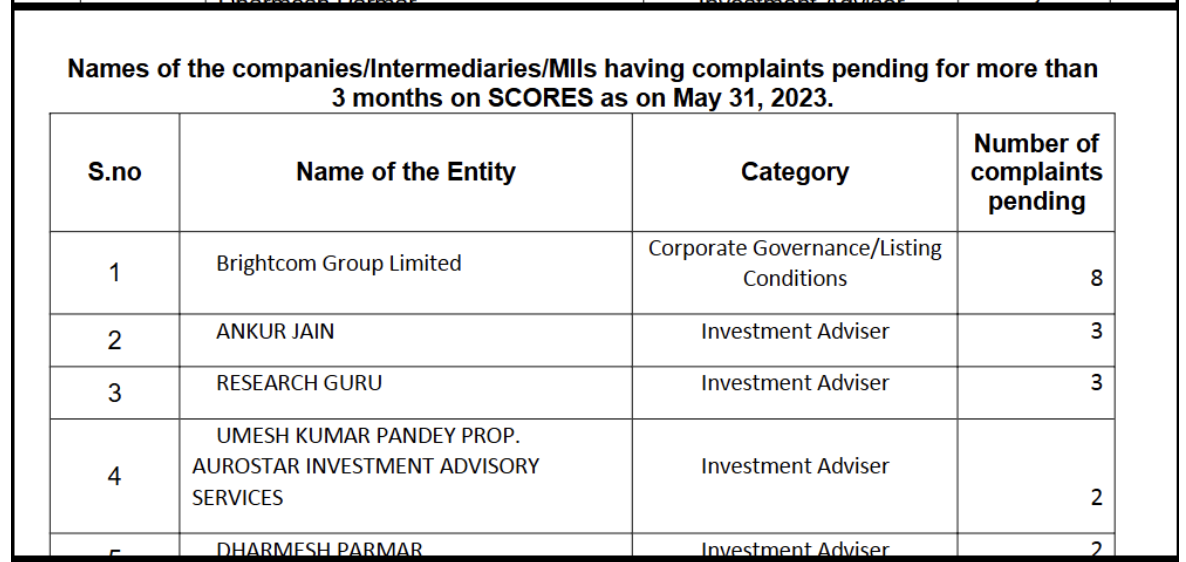
This matters because the SCORES platform exists specifically to help investors resolve disputes when communication with advisory firms breaks down.
When complaints remain unresolved for months, it raises concerns about:
- Responsiveness towards clients
- Complaint handling mechanisms
- Customer support quality
- Overall regulatory compliance culture
A single unresolved complaint can happen with any business. But repeated appearances over consecutive months suggest a larger operational issue.
2. Allegations of Wrong and Reckless Trading Advice
Several investors have alleged that they suffered substantial financial losses after following trading recommendations provided by the firm.
Particularly concerning are allegations involving:
- High-risk options trading
- Aggressive leveraged positions
- Unsuitable trading recommendations
- Advice inconsistent with investor’s risk capacity
In one arbitration matter, it was alleged that despite knowing the investor’s limited financial capacity, the advisory firm still recommended risky weekly options trades that resulted in major losses.
For retail investors, this becomes dangerous because high-risk derivatives trading can wipe out capital very quickly when proper suitability checks are ignored.
3. Promises of High Returns and Profit Expectations
Another major concern involves allegations of unrealistic promises and exaggerated profit expectations.
Under SEBI regulations, investment advisers are prohibited from guaranteeing returns or creating misleading expectations of assured profits.
Yet several complaints and arbitration findings indicate that representatives allegedly:
- Promised high profits
- Claimed consistent winning trades
- Encouraged clients with “loss recovery” assurances
- Used emotionally persuasive sales pitches
Whenever an advisory firm starts sounding more like a “guaranteed profit provider” than a professional risk adviser, investors should become cautious immediately.
No genuine market adviser can guarantee profits in the stock market.
4. Refund and Extra Payment Disputes
Many customer complaints also revolve around payment-related issues.
According to allegations raised in proceedings and public reviews, some clients experienced:
- Difficulty obtaining refunds
- Pressure to upgrade services
- Requests for additional fees after the initial payment
- Continuous demands for more money to recover losses
In one arbitration case, it was alleged that after charging the contractual advisory fee, the firm demanded additional cash payments beyond the agreed structure.
Such practices raise serious concerns about transparency and ethical conduct.
A legitimate advisory relationship should always have:
- Clearly defined fees
- Written agreements
- Transparent billing
- No hidden or unofficial payment demands
5. Aggressive Sales and Communication Practices
Another common concern involves aggressive marketing and communication methods.
Several users have reported:
- Persistent unsolicited calls
- Pressure-selling tactics
- Repeated follow-ups despite refusal
- Emotional manipulation during losses
- WhatsApp-based trading instructions instead of formal communication channels
In the arbitration proceedings, it was also observed that although official documents stated advice would only be provided through SMS, much of the communication allegedly happened through calls and WhatsApp.
This inconsistency creates accountability issues and makes dispute resolution harder later.
So, is Aurostar Investment Advisory safe?
While the company operates as a registered advisory entity, the volume of complaints, repeated unresolved grievance notices, allegations of unethical conduct, and arbitration findings create significant caution signals for investors.
Registration with SEBI should never be the only factor investors rely on.
Before trusting any advisory firm, investors should always examine the important sections carefully, and when multiple warning signs appear together, it is wise to proceed very carefully.
Aurostar Investment Advisory Arbitration Case
One of the most significant developments involving profit sharing violation by Aurostar Investment Advisory was filed by investor Md Tousif Uddin.
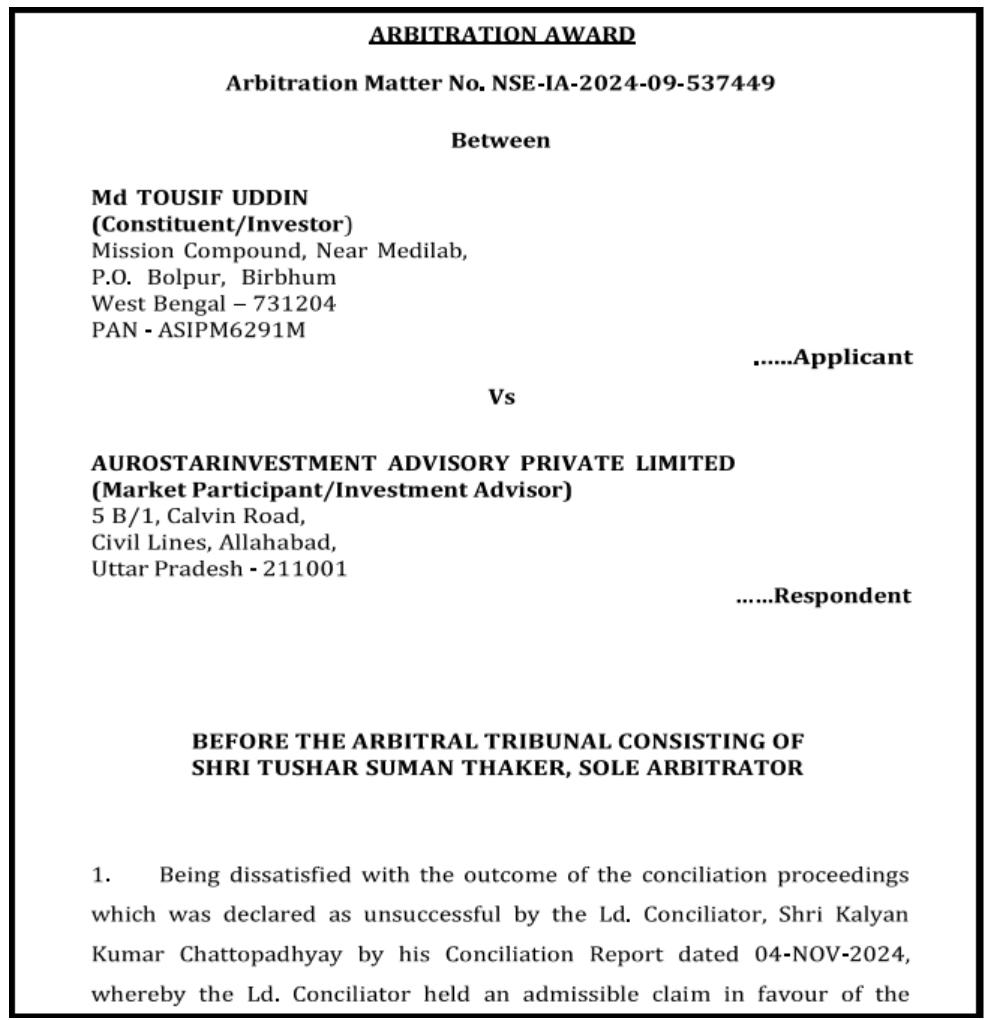
This case provides deeper insight into the nature of allegations raised against the firm and how the dispute was formally evaluated.
The investor approached arbitration after allegedly suffering major financial losses linked to advisory recommendations provided by the firm.
1. Why Was the Arbitration Filed?
The arbitration was initiated because the investor alleged that Aurostar:
- Failed to conduct proper risk profiling
- Recommended highly risky options trades
- Provided unsuitable investment advice
- Promised profits and assured returns
- Pressured the client into additional payments
- Encouraged risky averaging strategies during losses
- Used misleading communication methods
According to the findings discussed in the proceedings, the investor allegedly incurred losses of approximately ₹14.1 lakh after following the recommendations.
The arbitrator reportedly observed that the advice provided was reckless and unsuitable considering the investor’s financial profile.
2. Penalty Imposed on Aurostar
The arbitration award was passed entirely in favour of the investor. Aurostar was directed to pay approximately ₹15.57 lakh, including:
- ₹14.10 lakh towards trading loss compensation
- ₹1.47 lakh as refund of advisory fees
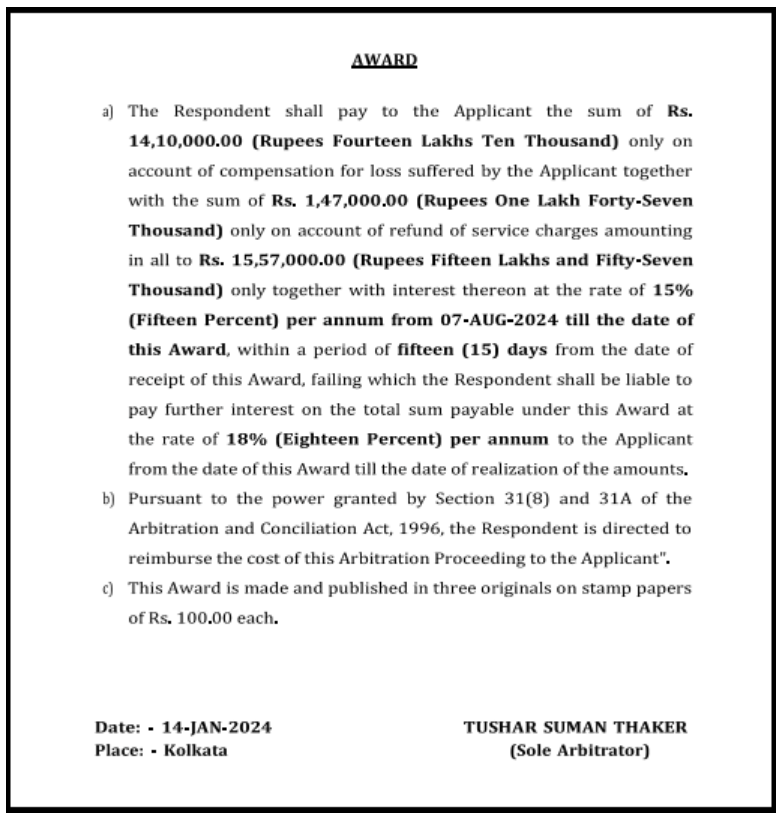
Additional directions reportedly included:
- Interest at 15% per annum from August 7, 2024
- Increased interest at 18% per annum in case of delayed payment
- Reimbursement of arbitration-related expenses
The case became notable because it highlighted multiple alleged violations of advisory regulations and investor protection norms.
3. Key Learnings for Investors
This arbitration case offers several important lessons for retail traders:
- Never Trust Guaranteed Return Claims: If an adviser promises assured profits, consider it a serious warning sign.
- Understand Your Risk Before Trading: Many retail investors enter high-risk F&O trades without fully understanding potential losses.
- Always Demand Written Communication: Official communication channels help create accountability and protect investors during disputes.
- Check Complaint History Before Investing: Reviewing SEBI notices and public grievance records can reveal patterns that advertisements never show.
- Avoid Advisers Who Push Constant Upgrades: Repeated pressure for additional payments or “premium recovery services” should raise immediate concern.
How To Complaint Against Aurostar Investment Advisory Pvt Ltd?
If you are facing issues with Aurostar Investment Advisory or any other advisory firm, it is important to take timely action and follow the proper complaint process.
Here is how to file complaint against RIA:
Step 1: File a Complaint with the Company
Start by raising your grievance directly with the company through its official email address or customer support channels.
In your complaint, clearly explain your client’s details, the nature of the issue, the financial loss or inconvenience suffered, and the specific resolution, refund, or corrective action you are seeking.
It is also important to preserve proof of complaint submission, such as acknowledgement emails, ticket numbers, screenshots, or chat records, as these may become useful if the matter needs to be escalated further.
Step 2: Collect All Supporting Documents
Step 3: File a Complaint in SCORES
Step 4: Lodge the Complaint in SMART ODR
Need Help?
Investment advisory disputes can often feel confusing and overwhelming, especially when significant money is involved.
If you are seeking a recovery from Aurostar Investment Advisor or need assistance navigating the legal process, you can register with us.
Our team helps investors with:
- Drafting and documenting complaints
- Filing complaints on SEBI SCORES
- Organising supporting evidence
- Navigating SMART ODR procedures
- Arbitration assistance and representation
- End-to-end support throughout the process
We stand beside investors at every stage and help ensure their concerns are properly represented.
Conclusion
The question “Is Aurostar Investment Advisory safe?” cannot be answered with a simple yes or no.
While the company operates as a registered advisory entity, several factors raise caution for investors.
Repeated unresolved complaints, allegations of unsuitable advice, aggressive sales tactics, refund disputes, and arbitration findings all point toward the need for careful due diligence.
Retail investors must remember that registration alone does not guarantee ethical practices.
The stock market already carries enough risk on its own, and working with the wrong adviser can increase that risk significantly.
Before paying any advisory firm, always verify complaint history, read agreements carefully, and avoid anyone promising unrealistic profits.
In investing, protecting your capital is often more important than chasing quick returns.





 Add us as a preferred source on Google »

