
You’ve probably seen the ads.
A ₹9 workshop. AI-powered trading. Financial freedom.
The promise sounds almost too simple: let artificial intelligence handle the market while you sit back and watch your portfolio grow.
SpringPad AI has been everywhere lately: Instagram reels, YouTube pre-rolls, LinkedIn posts, and Google ads.
And with that kind of visibility comes a lot of questions. People are searching for answers. Is this platform genuine?
What are other users saying? And if something went wrong, how do you formally raise a complaint?
This blog is for anyone who has attended a SpringPad workshop, purchased a course, and feels like things didn’t go the way they were promised.
It walks through the facts, what’s documented, what’s verifiable, and what your options are if you want to take things forward.
SpringPad AI Review
Let’s start with the basics here, such as the regulatory status. This is the first thing most people check, and it does matter.
Is Springpad AI SEBI registered?
Yes. SpringPad AI operates under the registered company name SpringPad Wealth Solutions Private Limited.
The company is registered with the Securities and Exchange Board of India (SEBI) as a Research Analyst under Registration No. INH000022950.
This can be independently verified on the SEBI website.
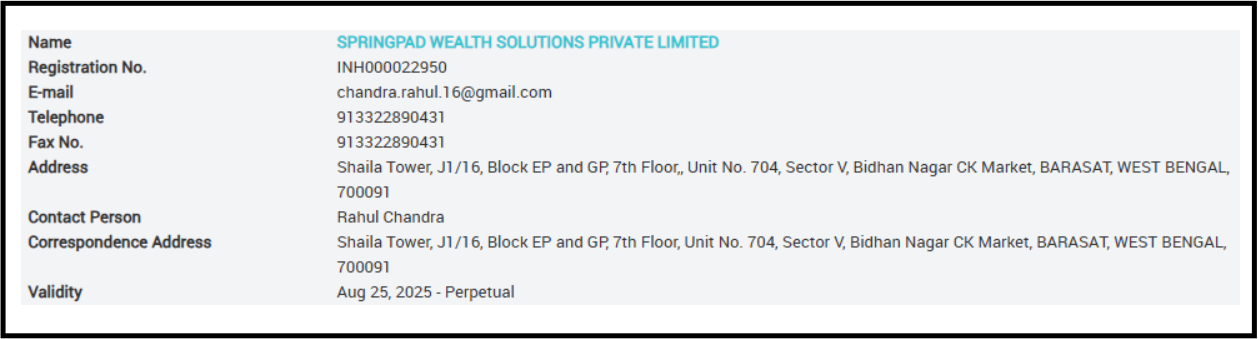
The platform was founded by Rahul Chandra, who holds CFA, FRM, and CAIA credentials, and co-founded by Pratik Chakraborty, who claims over a decade of experience in global trading.
The company is based in Kolkata and operates primarily through online workshops and training programmes.
It does not automatically guarantee the quality of services, the fairness of sales practices, or whether every claim made in marketing materials is fully compliant with SEBI guidelines for RA.
Additionally, SpringPad promotes an algo trading tool called Bulls AI as part of its workshops.
However, there is also a need to verify a company’s legitimacy.
On the surface, SpringPad has real credentials.
A functioning website at springpad.in, a verifiable SEBI registration, a corporate LinkedIn presence with over 3,000 followers, and active YouTube marketing.
At the same time, several aspects of the platform’s operations have attracted criticism from independent sources.
To be clear: no official SEBI order or formal regulatory action against SpringPad has been documented.
The platform operates as a registered entity. But the gap between what is marketed and what users report receiving is a consistent thread across multiple independent platforms.
Is SpringPad Safe?
Safety, in the context of a financial education platform, means a few different things.
From a legal standpoint, SpringPad is a registered entity operating under regulatory oversight. It is not an anonymous or unregistered operation. Payments made to the platform are deposited into a verifiable corporate account.
The absence of official Facebook and Instagram pages is worth noting.

A consumer-facing EdTech brand claiming to serve thousands of students across India, but with no verified presence on the two most widely used social media platforms in the country, removes a layer of accountability that most legitimate platforms maintain for customer communication and public feedback.
The ₹9 entry cost carries minimal financial risk.
The premium Springpad AI courses, priced in the range of tens of thousands to over one lakh rupees, carry significantly more.

Before committing to any higher-value purchase, it is worth carefully reading the refund terms, saving all promotional material and written communication, and understanding exactly what the course delivers versus what was marketed.
SpringPad AI User Complaints
The user feedback documented across platforms points to several recurring themes.
1. Pre-Recorded Sessions Presented as Live
On Reddit, multiple threads discuss SpringPad in critical terms.
One recurring complaint from users is that some SpringPad AI sessions allegedly presented as live were actually pre-recorded.
A user accused the platform of using “limited seats” and “limited offer” tactics to create urgency while claiming that the initial sessions were recordings rather than real, live workshops.
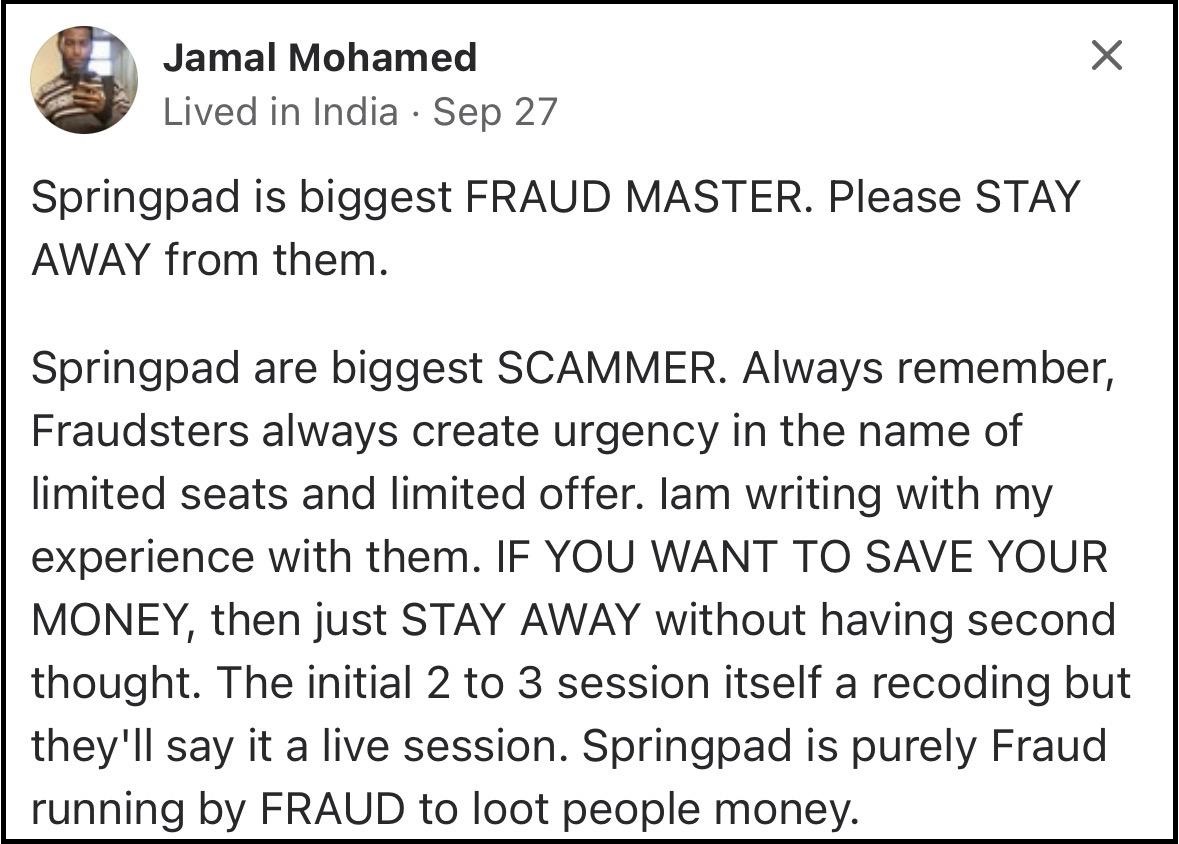
The reviewer described the experience as misleading and warned others against making rushed payment decisions under sales pressure.
2. Persistent Unsolicited Calling After a Clear Refusal
Persistent unsolicited calling is another complaint from a user on Google.
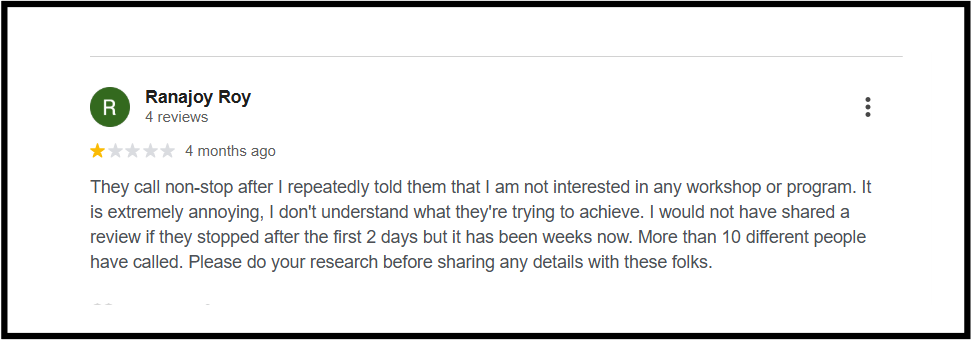
The user left a 1-star Google review describing a pattern many others have echoed. After registering interest and then clearly communicating that he did not want to proceed, the calls did not stop.
He mentioned that more than ten different team members called over a period of weeks, well after he had declined multiple times.
This kind of repeated outreach, after an explicit refusal, goes beyond routine follow-up and crosses into territory that many consumers would reasonably find distressing.
3. Financial Pressure Tactics on Vulnerable Users
In another review, the complaints can be measured in tone but direct in their concern.
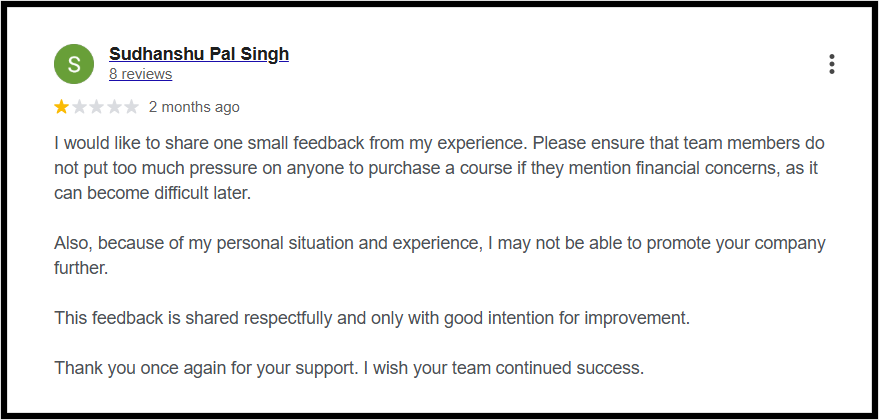
He specifically called out the practice of pushing course purchases onto people who have already mentioned financial difficulties.
His feedback requests that team members refrain from applying pressure when a potential customer has raised money concerns, noting that it can create problems for people later.
4. Opaque Cancellation Policy and Refund Denial
One of the most detailed and serious complaints comes from a user who describes an experience that touches multiple layers of the platform’s conduct.
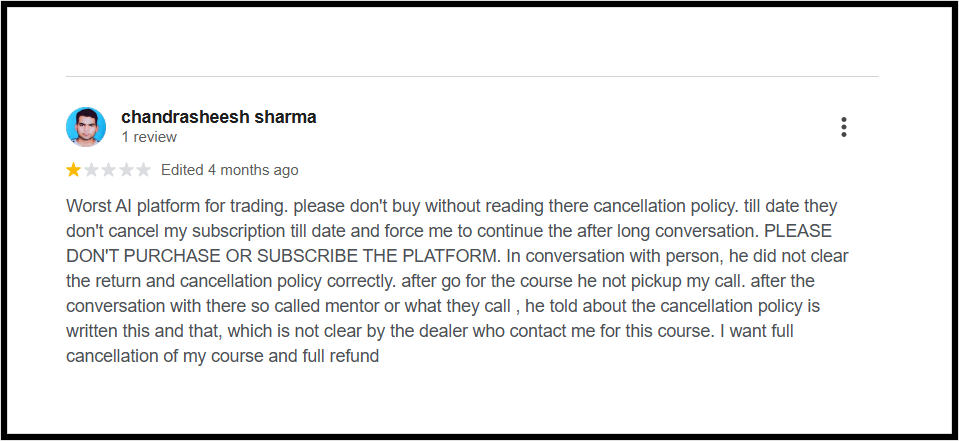
He describes SpringPad as the worst AI trading platform he has encountered and issues a direct warning: do not purchase or subscribe without reading the cancellation policy first.
His account reveals a sequence of failures. During the initial sales conversation, the cancellation and refund terms were not clearly explained to him.
What this complaint makes clear is not simply a dissatisfied customer, but a failure at multiple points in the process. The policy was not disclosed properly before the sale.
Communication broke down after the payment. And when the user sought resolution, he was met with policy language that contradicted what he had been told.
Taken together, these reviews point to three distinct but connected issues: unsolicited and persistent contact after a refusal, pressure applied on users who have expressed financial constraints, and a refund and cancellation process that users describe as unclear before purchase and difficult to access after.
These are the kinds of concerns that, when they cannot be resolved directly with the platform, warrant formal escalation through the channels described below.
How to Report Against a Research Analyst?
If you are a participant who feels they were misled, subjected to unfair sales practices, or unable to obtain a refund that was promised, here is how to formally escalate the matter.
Step 1: Preserve Everything
Before anything else, gather and save all documentation of your experience.
This includes screenshots of advertisements and promotional claims, payment receipts, email or WhatsApp conversations with the platform, recordings of any sessions where specific promises were made, and records of any refund requests and the responses received. Strong documentation is the foundation of any formal grievance.
Step 2: Write Directly to the RA
Send a formal written complaint by email to SpringPad’s registered contact, clearly stating your grievance, the resolution you are seeking (refund, clarification, or correction), and attaching all supporting documentation.
Keep a record of when you sent it and whether you received a response.
Step 3: File a Complaint in SCORES
SCORES is the official online portal for filing complaints against SEBI-registered entities.
It is accessible at scores.sebi.gov.in. When you file through SCORES, the complaint is formally routed to the concerned entity, which is required to respond within a specified timeframe.
This creates a regulatory record and applies formal pressure for resolution.
Step 4: Report in SMART ODR
If the issue is still not resolved, you can escalate it through the SMART ODR (Online Dispute Resolution) platform introduced for securities market disputes.
The platform is designed to help investors raise complaints digitally and attempt resolution through mediation and structured dispute handling.
Step 4: Stock Market Arbitration
If the process does not result in a satisfactory resolution, you can escalate further through the arbitration mechanism available via stock exchanges.
This formal process allows for a more structured examination of the dispute and can be a route toward recovering losses in appropriate circumstances.
Need Help?
Navigating a complaint against an SEBI-registered entity can feel confusing, particularly because the registration itself creates an impression of trust.
Many people hesitate to escalate because they assume that if a firm is registered, the problem must be on their end. That is not how the regulatory framework works.
Register with us. If you need structured support through this process, professional assistance is available.
Conclusion
SpringPad AI is associated with a SEBI-registered research analyst entity and operates through a visible business structure.
That gives it a level of regulatory visibility not commonly seen among many online trading educators.
At the same time, registration alone does not settle questions around satisfaction, pricing value, workshop expectations, or customer experience.
Public feedback appears mixed.
Some participants report useful learning experiences.
Others raise concerns around workshop structure, upselling, refunds, or communication gaps.
For anyone dissatisfied with SpringPad services, the most practical next step is not speculation—but documentation and formal complaint escalation where needed.
In financial services, clarity matters more than assumptions.
Before joining any paid trading or AI investing program, reviewing documentation, refund policies, and grievance options can help reduce unnecessary risk.





 Add us as a preferred source on Google »

