
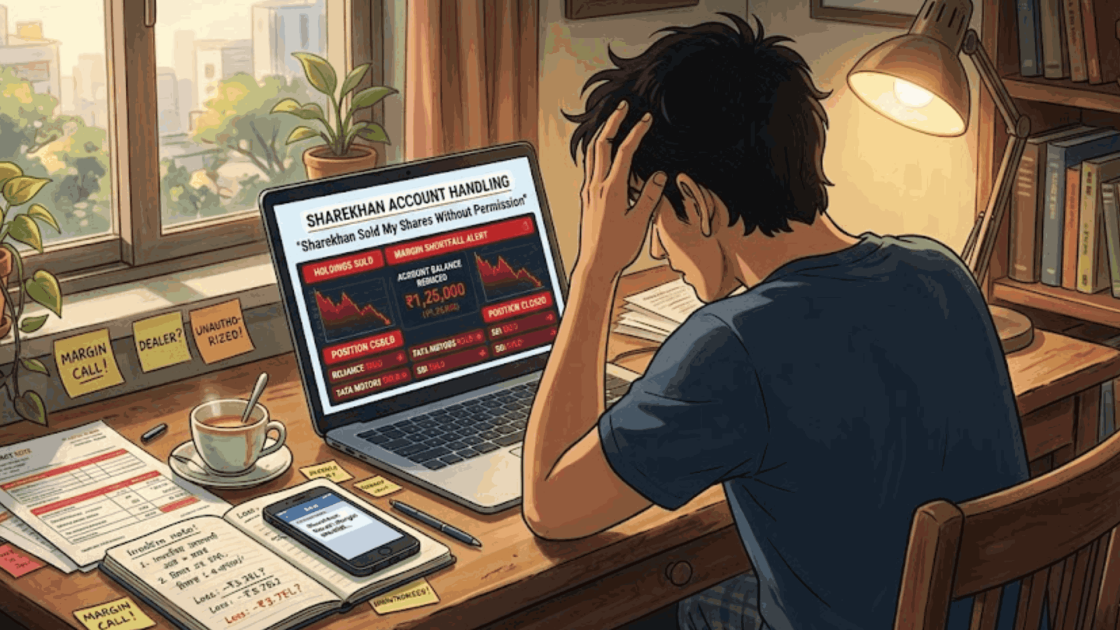
Imagine checking your portfolio one morning and finding that several of your holdings, shares you had held for months, have been sold.
No call, no SMS you could act on, no chance to arrange funds. Just a lower balance and a contract note you never approved.
This is the kind of experience investors describe when they raise Sharekhan account handling concerns, and it is more common than most people realise.
Margin shortfalls, dealer-driven trades, and forced liquidations have appeared across Sharekhan complaints, regulatory filings, and public forums involving the platform.
If you have experienced something similar, or if you currently rely on a dealer to manage your trades, this blog is written for you.
Sharekhan Account Handling Issues
Most investors open a trading account with confidence.
They trust the platform, they trust the relationship manager, and they assume that if something critical is about to happen to their holdings, someone will call.
That assumption is where many account handling disputes begin.
One publicly documented investor complaint involving Sharekhan describes exactly this: multiple share holdings were reportedly sold due to a margin shortfall, at prices significantly below their purchase value, with the investor claiming they were not given adequate notice or the opportunity to arrange additional funds before the liquidation took place.
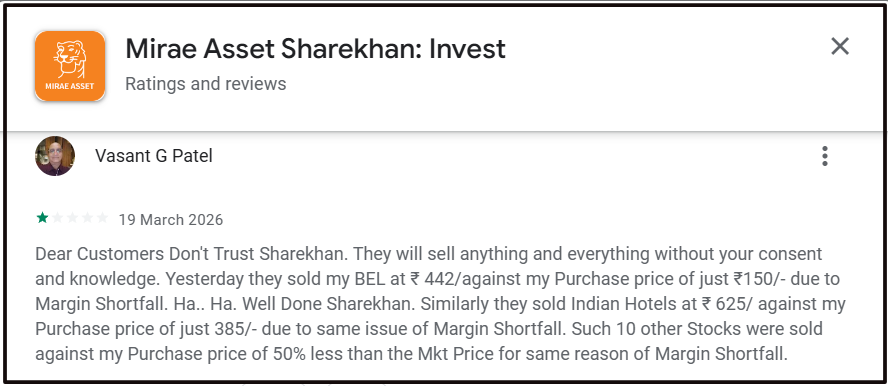
The investor alleged the trades happened without their knowledge or genuine consent.
This is not an isolated complaint pattern.
Across broking industry forums and regulatory filings, instances of Sharekhan unauthorised trading frequently come to light.
Investors routinely describe variations of the same troubling experience:
- Holdings were sold suddenly due to a margin shortfall, without clear prior warning.
- Dealer-assisted trades placed without documented pre-trade confirmation.
- Account activity that increased in volume or risk beyond what the investor understood they had agreed to.
- Margin obligations that were never clearly explained until a call was triggered.
- Sudden Sharekhan login issues during high-volatility market hours cut off your ability to manage positions.
- Communication gaps during volatile market periods, exactly when clear communication matters most.
These concerns don’t mean every broker is acting improperly.
Margin trading carries real risk, and brokers do have contractual rights to act during shortfalls.
But the question that matters in most disputes is not whether the broker had the right to act; it is whether they followed the regulatory process before doing so.
Can a Broker Legally Handle Your Account?
This is a question most investors wish someone had explained to them before they signed the account opening documents.
When you open a trading account with Sharekhan, you sign a Client-Broker Agreement and, in many cases, a Power of Attorney.
These documents authorise specific actions, but they do not give the broker unlimited control over your account.
Here is what the regulatory framework actually says:
-
Margin shortfall and forced liquidation
If your account falls short of the required margin, your broker does have the contractual and regulatory right to square off positions to recover the shortfall.
This is sometimes called a “margin call” situation.
But here is the part brokers are less likely to explain upfront: SEBI’s guidelines and most client agreements require the broker to notify you before or during this process.
Whether that notification was adequate, whether you were genuinely given a chance to act, is precisely what becomes the core dispute in most margin-related complaints.
If your holdings were liquidated and you are unsure whether adequate notice was provided, reviewing your account records early may help clarify what happened and what options remain available.
-
The dealer-assisted trading question
Many investors, particularly older or less tech-savvy ones, rely on relationship managers or dealers to place trades on their behalf.
This informal arrangement is common but legally grey.
The investor is ultimately responsible for trades in their account, but the broker also carries regulatory obligations about how such arrangements are conducted and documented.
A dealer who places trades without your explicit instruction is not in a protected legal position, regardless of what verbal discussions took place.
-
Pre-trade confirmation requirement
For discretionary trades, i.e. trades not placed by the client themselves, SEBI Circular SEBI/HO/MIRSD/DOPI/CIR/P/2018/54 dated 22.03.2018 mandates that brokers obtain pre-trade confirmation before executing transactions.
If a trade is being placed on your behalf without your instruction, this circular is directly relevant.
The existence of this regulation means that “the dealer always called me” or “you had online access” is not a sufficient defence.
Documented, trade-level confirmation is the standard.
Warning Signs That Should Make Any Investor Stop and Act
Account handling disputes rarely begin with a single catastrophic event.
They build, slowly, across weeks or months, through patterns that feel manageable until they suddenly aren’t.
Recognising these patterns early is the difference between a recoverable situation and a severe loss.
Watch carefully if you are experiencing any of the following:
- Frequent High-Volume Trading You Didn’t Initiate.
- Margin Exposure That Keeps Expanding.
- Trades You Cannot Explain When You Look at Your Contract Notes.
- Sudden Liquidation of Holdings Without Prior Warning.
- Communication That Went Silent at the Wrong Moment.
If any of these resonate with your current situation, the next section explains exactly what formal options are available to you.
How To File A Complaint Against Account Handling?
If you are wondering how can I raise my complaint in Sharekhan, knowing that a regulatory path exists is the first step.
Follow these structured steps to ensure your dispute is formally recorded and addressed:
Step 1: Collect and Organise All Evidence
Preserve all evidence from day one.
Keep contract notes, margin statements, SMS alerts, WhatsApp messages with your relationship manager, account login records, and any written communication.
This documentation forms the backbone of any formal claim.
Step 2: Contact Sharekhan Officially
Write to Sharekhan’s grievance team.
Every SEBI-registered broker must have a designated grievance redressal mechanism.
Send a written complaint, clearly describing the issue, the dates involved, and what resolution you are seeking.
Note the date you sent it and any reference number you receive.
Step 3: File a Complaint Through SCORES
File a SEBI SCORES complaint if unresolved.
If you don’t receive a satisfactory response within 30 days, file your complaint at SCORES.
SCORES is SEBI’s official online complaint portal for grievances against registered market intermediaries like stockbrokers.
Step 4: Lodge a Complaint in SMART ODR
SEBI has also introduced an Online Dispute Resolution platform for securities market disputes.
This is a newer, faster alternative route that may be available depending on the nature of your complaint.
Step 5: Arbitration in Share Market
Request arbitration under exchange rules.
This is a binding process under exchange byelaws.
An Arbitral Tribunal will hear both sides and issue an award.
Need Help?
If your Sharekhan account has shown trades you don’t fully recognise, margin activity you didn’t authorise, or shares that were liquidated without adequate warning, your situation deserves more than a phone call to your dealer.
Our team helps investors:
- Identify what their records actually show versus what they were told.
- Organise account statements, contract notes, and communication into a structured timeline.
- Prepare formal complaints for SEBI SCORES and SMART ODR.
- Understand whether exchange arbitration is a viable option based on their specific documents.
If you are struggling to understand unusual trades, margin-related share sales, dealer-assisted activity, or account losses, our team can help you review records, organise evidence, and understand the available complaint process.
If you want clarity about your situation, you may register with us, share the details for review, and we will get back to you within the next 48 hours.
Conclusion
The regulatory framework is clear: SEBI Circular SEBI/HO/MIRSD/DOPI/CIR/P/2018/54 dated 22 March 2018 mandates pre-trade confirmation before any transaction executed on a client’s behalf.
Brokers are required to notify clients before or during margin-related liquidations.
Dealer-assisted trading arrangements that operate without documented, trade-level authorisation do not meet the regulatory standard, regardless of what verbal conversations took place.
These are not aspirational guidelines. They are enforceable obligations, and they form the basis of formal complaints. The Sharekhan arbitration awards are proof that investors have received decisions in their favour.
The investor who found their shares sold without warning had grounds to ask formal questions. So do you, if your account activity does not match your instructions.
Frequently Asked Questions
1. Sharekhan sold my shares due to a margin shortfall. Can I find out when the warning was sent?
Yes. You can review SMS alerts, emails, app notifications, and account communications relating to the margin call. These records may help establish whether you were notified and whether you had an opportunity to arrange funds before the liquidation occurred.
2. Can a Sharekhan dealer place trades if I only gave general approval and not trade-specific instructions?
General discussions about the market are different from trade-specific authorisation. If trades were placed on your behalf, the existence of proper instructions and pre-trade confirmation may become relevant when reviewing the account activity.
3. How can I check whether Sharekhan obtained pre-trade confirmation before dealer-assisted trades?
You can request records relating to trade authorisation, including call recordings, emails, WhatsApp communications, or other documentation that allegedly authorised the transactions.


 Add us as a preferred source on Google »

