

Have you ever received a phone call promising ₹10,000–₹15,000 daily profits from the stock market if only you sign up for a premium package?
If yes, you are not alone.
Every day, thousands of Indian traders and investors receive such calls, and many end up paying large fees in the hope of financial freedom.
But what really happens after the fee is paid?
That is the question this blog tries to answer, specifically about Absolute Finserve, a SEBI-registered investment advisory firm that has been receiving a flood of negative reviews from its own clients.
Whether you are considering their services or have already had a troubled experience with them, this blog breaks down everything you need to know, from who they are to what their clients are actually saying, to what you can do about it.
In this blog, we look at real client reviews, recurring complaint patterns, red flags traders should know, and most importantly, a step-by-step guide on how to file a formal complaint against an investment advisor through SEBI.
Absolute Finserve Details
Absolute Finserve positions itself as a stock market investment advisory firm based in India, founded and operated under the name of Manu Chhabra.
The firm claims to offer services across equity, commodities, Nifty, and intraday segments, targeting both retail investors and active traders.
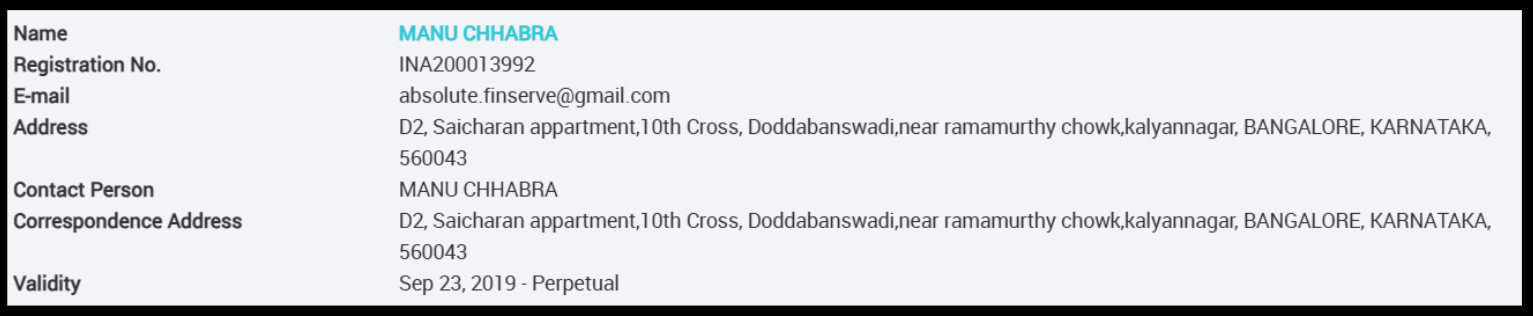
On paper, the company markets itself as a full-service advisory built on portfolio intelligence, risk management, and analyst-driven calls.
Their website describes a team of “brilliant analysts” and promises to help investors across bull and bear market conditions alike.
However, before you pay any fees, you must check SEBI registered investment advisor details on the official portal to verify their current status.
Even then, being registered does not automatically mean a firm acts in your best interest.
SEBI registration simply means the firm has met certain regulatory eligibility requirements; it does not guarantee quality advice or ethical conduct.
This leads many to ask: can I trust SEBI registered investment advisor firms blindly?
This distinction matters a lot when you start reading what actual clients have experienced.
With that context established, let’s look at what the firm’s own clients have to say, and the patterns that emerge across their reviews.
Also Read: Winway Research, a firm with two SEBI orders roughly a year apart.
Absolute Finserve Reviews
The reviews shared below are drawn from Google and other public review platforms. While individual experiences can vary, what stands out here is not just the volume of negative reviews; it is the striking similarity in the complaints.
Multiple unconnected clients, at different points in time, describe nearly identical patterns: promises made before payment, follow-up gone missing after payment, trades going wrong, and pressure to upgrade to bigger packages.
Let us walk through each review one by one:
1. Broken Promises & Vanishing Support
This review captures one of the most common patterns seen with advisory complaints across the industry: aggressive pre-sale communication followed by radio silence once fees are collected.
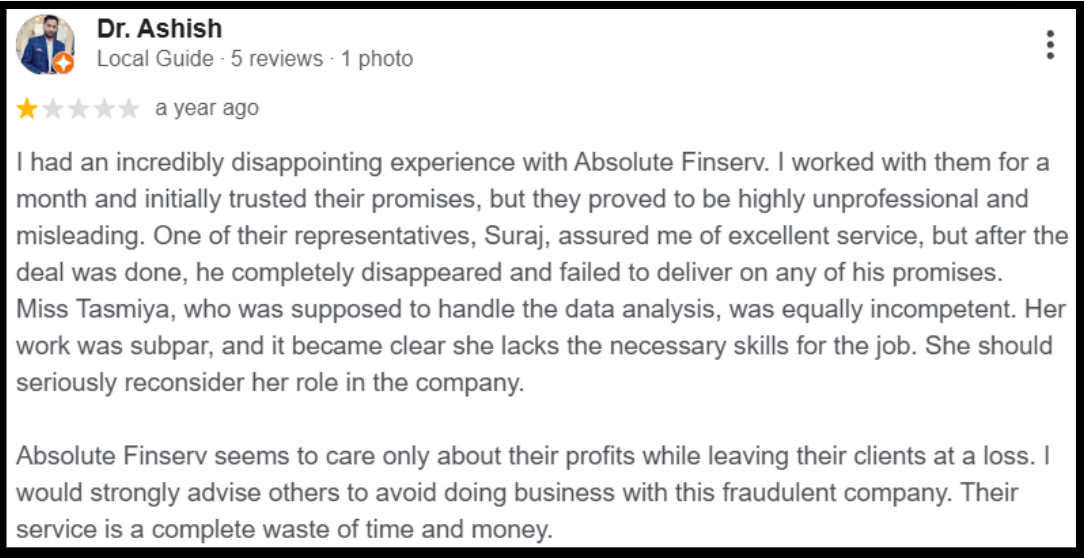
The client, a verified client with a documented review history, describes a month-long experience where the representative who sold the package simply became unreachable after payment.
What makes this review particularly noteworthy is the mention of a dedicated analyst, suggesting the client paid for a personalised service tier, and still found the experience to be below basic professional standards.
When someone pays a premium for personalised advisory and receives no meaningful support, that is a serious service failure.
2. Membership Trap & Heavy Losses
This review describes what is commonly referred to as a “membership escalation trap.”
The client was first sold a basic package for ₹16,500, then offered a single demo trade, which reportedly earned him money, and immediately pitched an upgrade to a ₹1,00,000 membership with promises of earning up to ₹7,00,000.
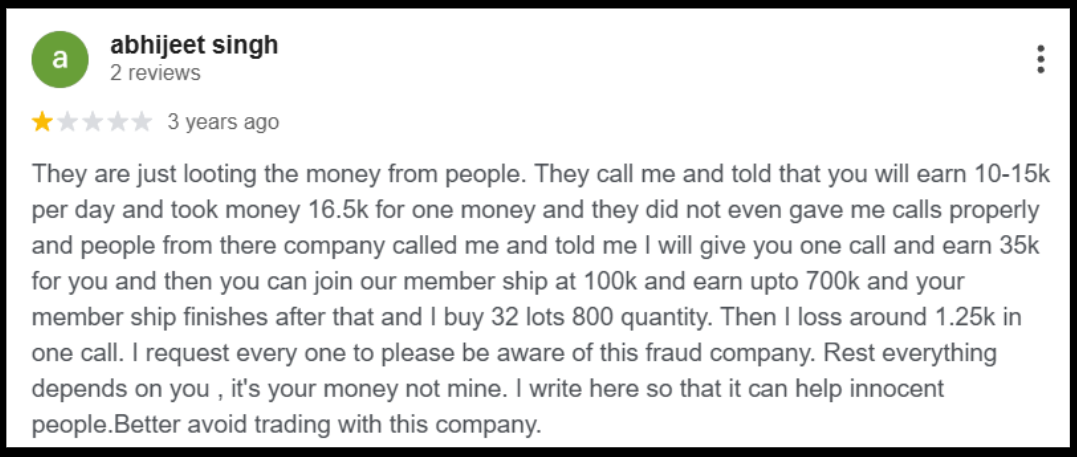
When the client followed the advice, he ended up losing ₹1.25 lakh in a single call.
The pattern of one profitable demo call followed by a high-value upsell is a documented advisory scam strategy. It creates the illusion of reliability and pushes the investor to commit more money, after which the calls begin to fail.
3. Stop Loss Ignored
This is an alarming account. The client paid ₹36,000, expecting 2–3 advisory calls daily, but received only one call in an entire week.
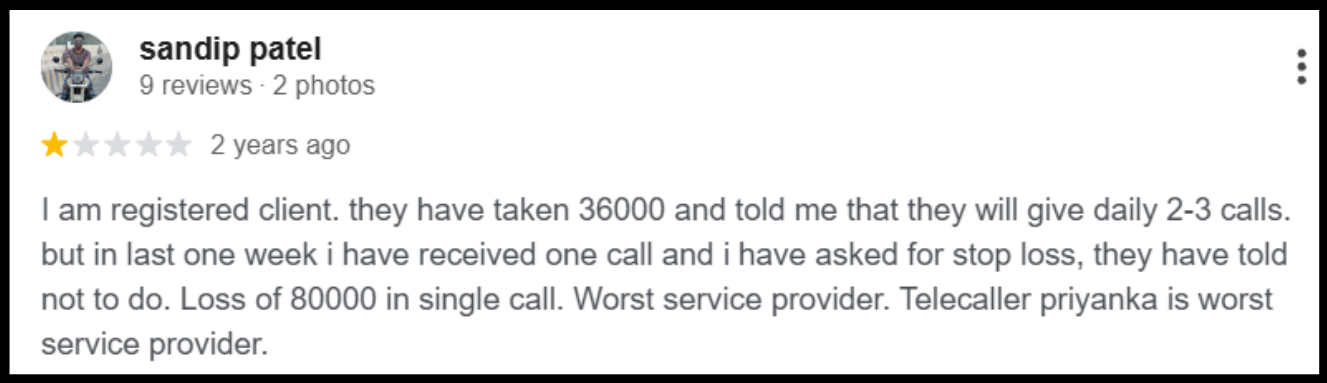
More critically, when the client requested a stop loss, a standard risk management mechanism that limits downside on any trade, the company’s representative allegedly advised against it.
This raises serious ethical and regulatory questions. Advising a client not to use stop loss while executing a high-risk trade is not just bad practice; it directly contradicts the fiduciary responsibility that every SEBI-registered investment advisor is legally obligated to uphold.
The client ended up losing ₹80,000 in a single call.
4. Coercion for Bigger Packages & Mental Harassment
This review introduces something that goes well beyond poor advisory quality; the client explicitly alleges that the company’s representatives used the threat of service withdrawal as leverage to push clients into buying even more expensive packages.
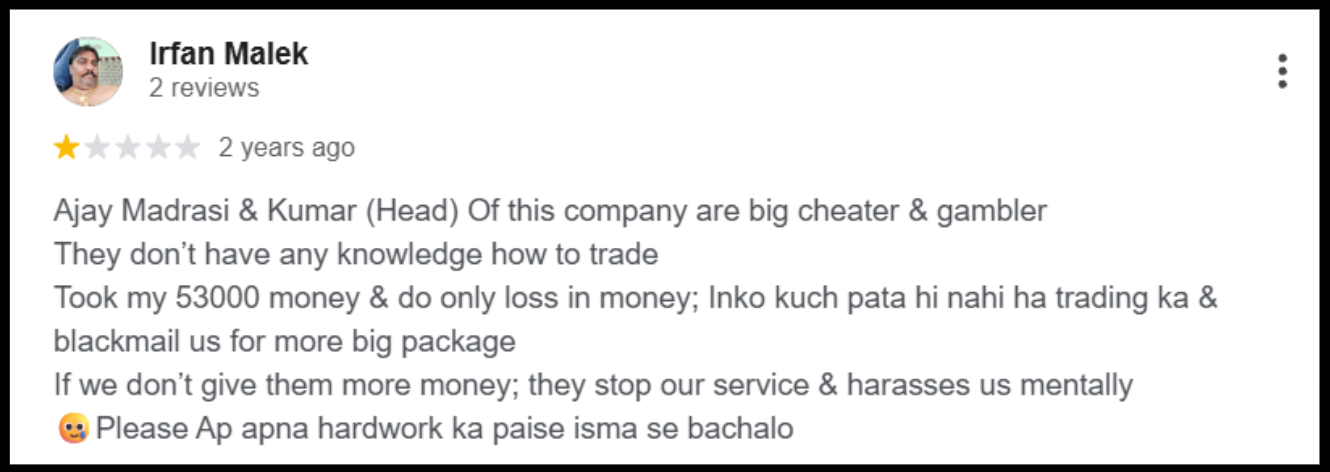
After paying ₹53,000 and suffering losses, the client claims to have been pressured further with psychological intimidation.
If accurate, this would constitute a serious violation of consumer rights and potentially SEBI’s investor protection guidelines.
Investment advisors are required to act in the best interest of their clients and are strictly prohibited from any form of coercive or manipulative conduct.
5. The Demo Call Strategy
This is perhaps the most insightful review of the lot. The client lays out what appears to be a deliberate and calculated cycle.
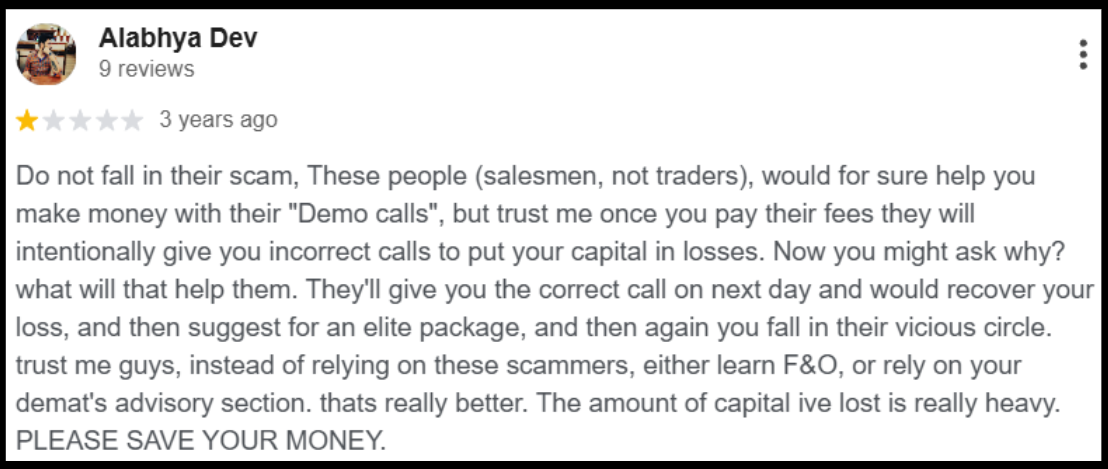
First, accurate demo calls to build trust and close the sale; then, after payment, incorrect calls that result in losses; followed by correct calls to “recover” the loss; and finally, a pitch for an elite or higher-value package.
This cyclical pattern, if repeated, creates a dependency loop where the client is always chasing a recovery and therefore always vulnerable to the next upsell.
Experienced traders will recognise this as a carefully designed conversion funnel rather than a genuine advisory service.
6. Coached Positive Reviews
This reviewer from Delhi raises a critically important point that changes how we should interpret any positive reviews a firm might display.
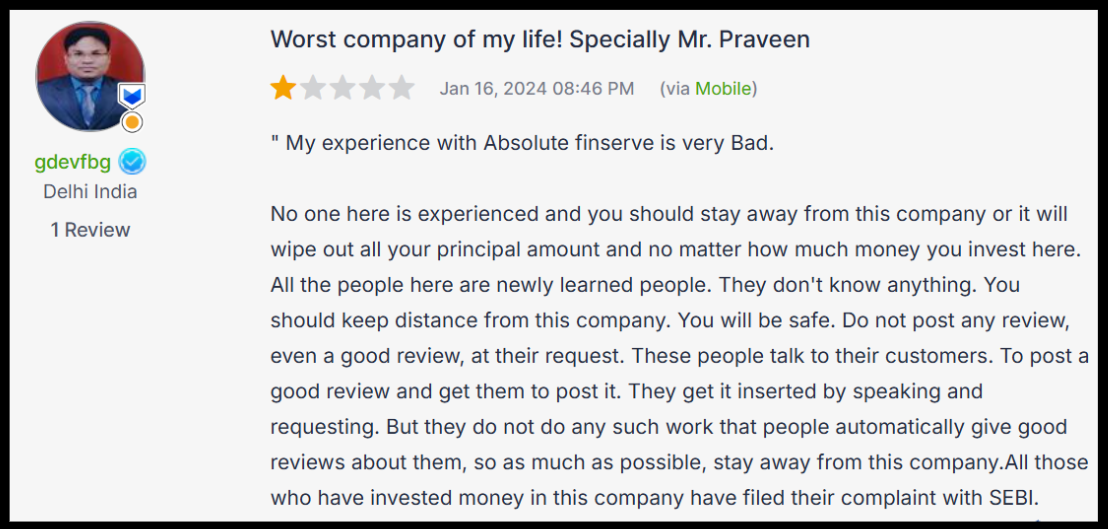
If the company actively solicits and coaches clients to post good reviews, even when the underlying service experience has been poor, then the public rating becomes deeply unreliable as a decision-making tool.
This practice, while not illegal in itself, creates a distorted picture that can mislead new investors into making decisions based on false social proof.
Also Read: AlphaGrep Advisors Private Limited, with no Investor Charter published anywhere on its site.
Also Read: The Equal Research Investment Advisor. Find out who operates the firm and what its investment advisory services include.
Where to File A Complaint Against SEBI Registered Investment Advisor?
If you have had a similar experience with Absolute Finserve or any SEBI-registered investment advisor, you do not have to just accept the loss.
For those seeking clarity on how to recover money from a SEBI registered investment advisor, India has a structured grievance mechanism specifically for these situations.
Here is how to use it:
Step 1: Approach the firm first
Before escalating, write a formal complaint email to the company’s compliance officer.
In the case of Absolute Finserve, their compliance contact is listed as [email protected]. Keep a record of this communication.
Step 2: File a Complaint in SCORES
If you do not receive a satisfactory response within a reasonable time, visit scores.sebi.gov.in, SEBI’s centralised online complaint portal.
Register, log your complaint, and track its status.
The firm is required to file an Action Taken Report within 30 days.
Step 3: Report in SMART ODR
If your issue is not resolved through SCORES, escalate it to SMART ODR (Online Dispute Resolution).
This platform allows structured online mediation and conciliation, offering a faster and more efficient alternative to traditional legal proceedings.
Step 4: Share Market Arbitration
If the dispute still remains unresolved, you can file a SEBI complaint against advisory company through arbitration in stock exchanges like NSE or BSE.
This is a formal legal process where an independent arbitrator reviews your case, evidence, and responses from the firm before issuing a binding decision.
Ensure you submit all supporting documents, including complaint records, payment proofs, and communication history, to strengthen your case.
Your money deserves protection. Your concerns deserve to be heard.
By moving forward with your complaint, you’re not only holding the responsible party accountable for your losses but also contributing to a more transparent and trustworthy financial ecosystem.
Don’t let complicated procedures hold you back. Register with us today to initiate your case and allow our experienced team to guide you toward a clear path of resolution and accountability.
Conclusion
The experiences highlighted in this blog underline an important truth: in the stock market, the biggest risk is not just price movement, but who you choose to trust.
While firms like Absolute Finserve may operate within a registered framework, real client feedback shows that registration alone does not guarantee quality advice or ethical conduct.
For traders and investors, the key takeaway is to stay alert, question every claim, and never rely solely on sales pitches or online reviews.
Always evaluate risk management practices, transparency, and post-sale support before committing your money.
And if things do go wrong, remember, you have clear legal channels to seek resolution.
Acting early, documenting everything, and using SEBI’s complaint systems can make a meaningful difference in protecting your financial interests.





 Add us as a preferred source on Google »

