
Quick Summary
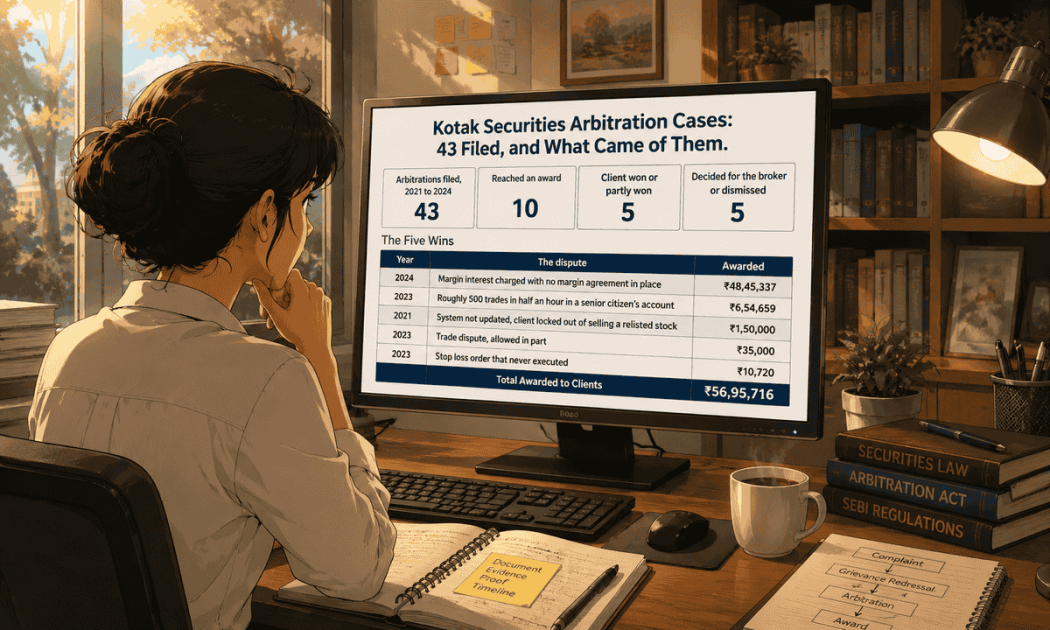
Between 2021 and 2024, investors filed 43 arbitrations against Kotak Securities Limited. Ten reached an award. In five, the tribunal told Kotak to pay the client, ranging from ₹10,720 to ₹48,45,337. What makes this set unusual is not the money. It is that three separate tribunals escalated Kotak beyond the dispute in front of them, twice asking the exchange to take action against the broker, and once imposing a penalty payable to the Investor Protection Fund. This page goes through the numbers, the escalations, and what the winning cases had in common.
You trust a broker with money you spent years building up carefully. When something goes wrong, you expect answers, not silence.
That frustration is exactly why Kotak Securities arbitration cases deserve a closer look right now.
Forty-three investors went the distance, and their outcomes reveal something worth knowing before you decide your next step.
What Kotak Securities Arbitration Cases Actually Reveal
A win rate on its own tells you almost nothing useful.
Five wins in forty-three filings sounds poor until you look at what the other thirty-three actually were. Most disputes never reach an award at all. They settle, they get resolved at the grievance committee stage, or the investor gives up somewhere along the way.
Of the ten that did produce an award here, half went to the client.
The more useful question is what the five winners did that the rest did not, and on that the awards are remarkably consistent. Every one of them turned on a document Kotak was required to hold and could not produce when a tribunal finally asked for it.
Here is what those disputes were worth.
The Filing Numbers Behind These Awards
| Count | |
|---|---|
| Arbitrations filed, 2021 to 2024 | 43 |
| Reached an award | 10 |
| Client won or partly won | 5 |
| Decided for the broker or dismissed | 5 |
Year by year, the filings were 9 in 2021, 8 in 2022, 19 in 2023 and 7 in 2024. The spike in 2023 is worth noting on its own merits.
The five wins:
| Year | The dispute | Awarded |
|---|---|---|
| 2024 | Margin interest charged with no margin agreement in place | ₹48,45,337 |
| 2023 | Roughly 500 trades in half an hour in a senior citizen’s account | ₹6,54,659 |
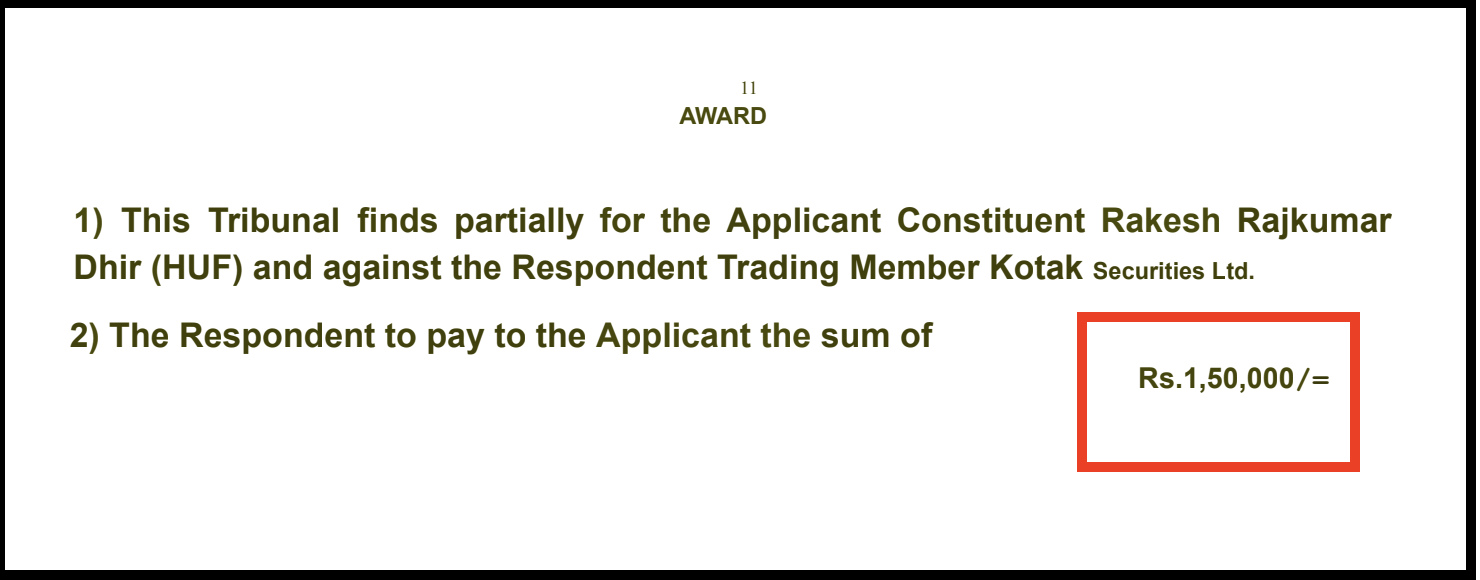
| 2021 | System not updated, client locked out of selling a relisted stock | ₹1,50,000 |
| 2023 | Trade dispute, allowed in part | ₹35,000 |
| 2023 | Stop loss order that never executed | ₹10,720 |
One award accounts for almost 85 percent of the total recovered across all five. That case deserves a closer look, because the reason it grew so large has nothing to do with how badly the client traded.
The Paperwork Gap That Moved ₹48 Lakh
Most investors who dispute a broker’s conduct focus on the trades. Was this one authorised, did I ask for that one, who actually placed the order?
The largest Kotak award came from a completely different question: What gave the broker the right to charge me in the first place?
A client had been funded on margin for close to two years, carrying a debit balance that reached ₹1.3 crore at one point, with interest running at 24 percent. When the tribunal asked Kotak to produce the margin trading agreement, the document SEBI requires before any margin facility can be provided, it simply could not.
Kotak answered that the client’s recorded consent to individual trades proved the agreement existed somewhere. The tribunal rejected that, holding that agreeing to trades is not evidence of a written agreement, whether primary or secondary.
Without the agreement, there was no lawful basis for the interest charged. The case was not really about trading at all. It was about Kotak Securities excess charges levied without the paperwork that should have justified them.
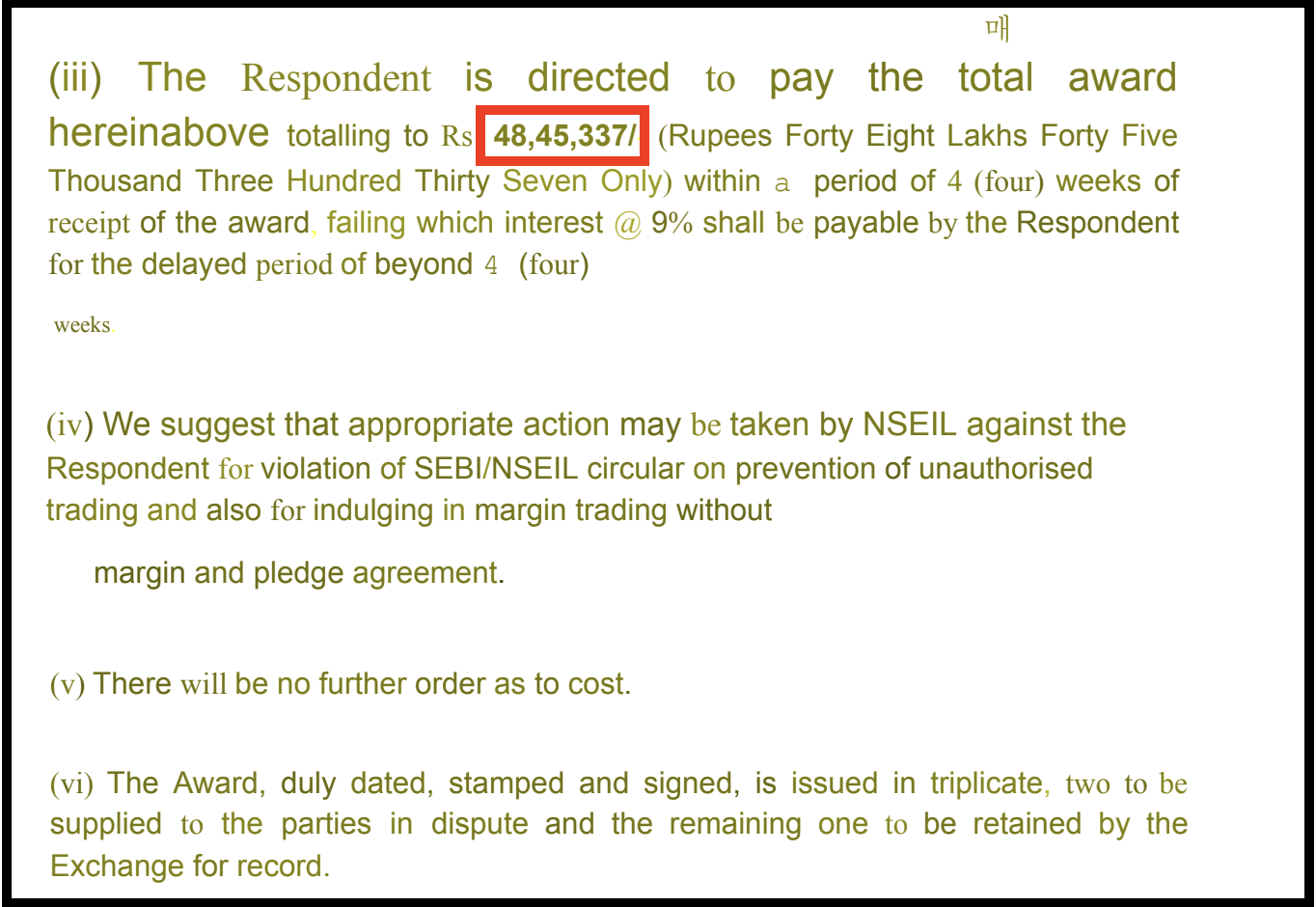
The tribunal calculated every rupee Kotak had taken as margin interest and ordered it returned, then added interest on that sum, then interest on the award itself. That is how a paperwork gap became ₹48,45,337.
The full breakdown of that case, and a second unauthorised trading award, sits on our page covering Kotak Securities unauthorised trading arbitration.
When Tribunals Escalated Straight to the Regulator
This is the part of the Kotak record that sets it apart, and it happened three separate times.
In the ₹48.45 lakh case, the tribunal did not stop at ordering repayment. It suggested that the exchange take appropriate action against Kotak for violating the circulars on preventing unauthorised trading, and for running margin trading without either a margin agreement or a pledge agreement.
In a 2021 case about a stock returning to trading after suspension, the tribunal went considerably further. It instructed the exchange’s legal department to bring the award to the immediate notice of the highest levels of the exchange and SEBI, and to do so forthwith, suggesting stern remedial and preventive action. It also recorded its own frustration that arbitral tribunals have no power to impose punitive costs in a case like that one.
And in a 2022 appeal, a tribunal examining a client’s short sale found that Kotak’s mobile app had been showing shares she had already transferred out. Like many Kotak Neo not working complaints, the dispute centred on a trading platform that failed to display accurate information.
It held that providing a glitch-free and sound trading application was the broker’s bounden duty, and ordered Kotak to pay ₹1,00,000 into the Investor Protection Fund.
if you want to read the whole arbitration in detail, you can refer to our Kotak Securities technical glitch arbitration awards blog and examines these wins in detail.
The client herself lost that dispute on other grounds. The penalty stood anyway.
Three tribunals, three referrals that went well beyond the money in dispute. For a broker of this size, that is not a normal pattern, and it is a fair thing to weigh if you are deciding whether to pursue a claim of your own.
Why Some Claims Against Kotak Fail?
It would be misleading to write only about the wins, so here is the other half, honestly.
The claims that failed mostly failed for one of two reasons:
1. The loss was notional. In the 2021 stock relisting case, the client claimed over ₹36 lakh, being what he would have made had he been able to sell 2,29,000 shares at the morning price. The tribunal rejected that outright, because there was no guarantee those shares would have found buyers at that price. He recovered ₹1,50,000 in costs and nothing more.
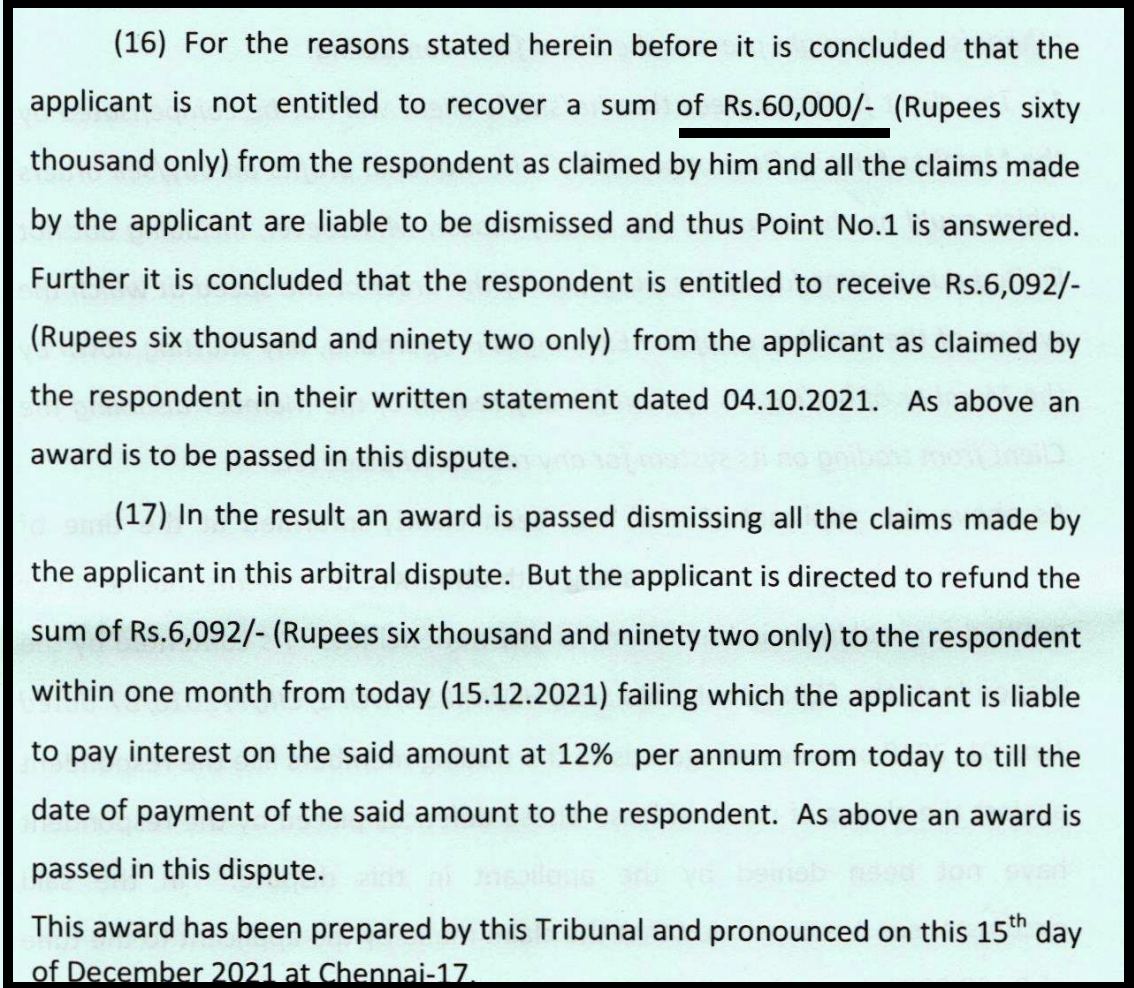
2. In another case, a client claimed ₹60,000 for a day he could not trade, and the tribunal found he had produced nothing showing he had actually attempted to trade at all. The client could not evidence the claim properly. Tribunals repeatedly noted claims raised weeks after the event, amounts that changed between forums, and calculations that were never produced despite clear directions to file them.
The pattern is clear enough once you see it:
- Kotak lost when it could not produce a document.
- Clients lost when they could not produce a number.
Most claims fail not because the grievance is weak, but because it cannot be proved.
The key is demanding the right records, placing the burden of proof where it belongs, and clearly quantifying the loss.
Register with us for a free consultation.
Filing Late Is Not Always Fatal
One finding from the largest award deserves separate mention, because it changes the calculation for anyone sitting on an old dispute.
That client’s first disputed trade was in November 2018. She filed for arbitration in October 2023, nearly five years later, well past the three-year limitation period.
She had not been idle through those years but had gone to a commercial court in Alipore, obtained an injunction, and later faced proceedings before the Calcutta High Court. Only after being referred to arbitration and subsequently approaching the Bombay High Court did she finally reach the correct forum.
The tribunal excluded the two years and ten months she had spent in those proceedings, applying the Limitation Act provision that covers time spent pursuing a matter in good faith in the wrong forum. Within that adjusted calculation, her filing was in time.
If you have been pushing your complaint through the wrong channels for years, that time may not be counted against you at all.
The route from a first complaint to arbitration is set out in our guide to filing a complaint against Kotak Securities.
Conclusion
Forty-three arbitrations, ten awards, five clients paid, and the largest of them decided not on a trade but on a missing agreement.
If there is one thing to take from the Kotak record, it is that the strongest questions are often the administrative ones. Not what did the market do, but what document allowed you to charge me, and can you produce it?
Three tribunals thought the answers troubling enough to send the matter back to the regulator. That is a signal worth acting on if you have a live dispute.
Report. Recover. Stay Fraud Free.
Of 43 arbitrations filed between 2021 and 2024, ten reached an award, and in five of those the tribunal directed Kotak Securities to pay the client. The remaining five were decided in the broker's favour or dismissed. ₹48,45,337, decided in February 2024. The tribunal found Kotak had charged margin interest for close to two years without the margin trading agreement SEBI requires, and ordered the entire interest returned along with interest on that amount. Yes, in three separate matters. Two tribunals recommended the exchange take action against the broker, one of them directing that the award be placed before the highest levels of the exchange and SEBI. A third imposed a ₹1,00,000 penalty payable to the Investor Protection Fund over a defective mobile application. Possibly. In the largest reviewed win, the client filed almost five years after the disputed trade, and the tribunal excluded nearly three years she had spent pursuing the matter in courts before being directed to arbitration. Time spent genuinely pursuing a remedy elsewhere can be excluded from the limitation period.Frequently Asked Questions

 Add us as a preferred source on Google »

