
Quick Summary
Every account opening kit contains a clause saying the broker is not liable for losses caused by system failure. Read plainly, it seems to end any claim before it starts. Three tribunals have found otherwise in Kotak Securities matters. One awarded a client the difference caused by a stop loss that never triggered. One awarded ₹1,50,000 in costs where the broker had not updated its system for a stock returning to trading. One imposed a ₹1,00,000 penalty payable to the Investor Protection Fund over an app showing shares that were no longer there. This page explains where that clause runs out, because it is narrower than most people assume.
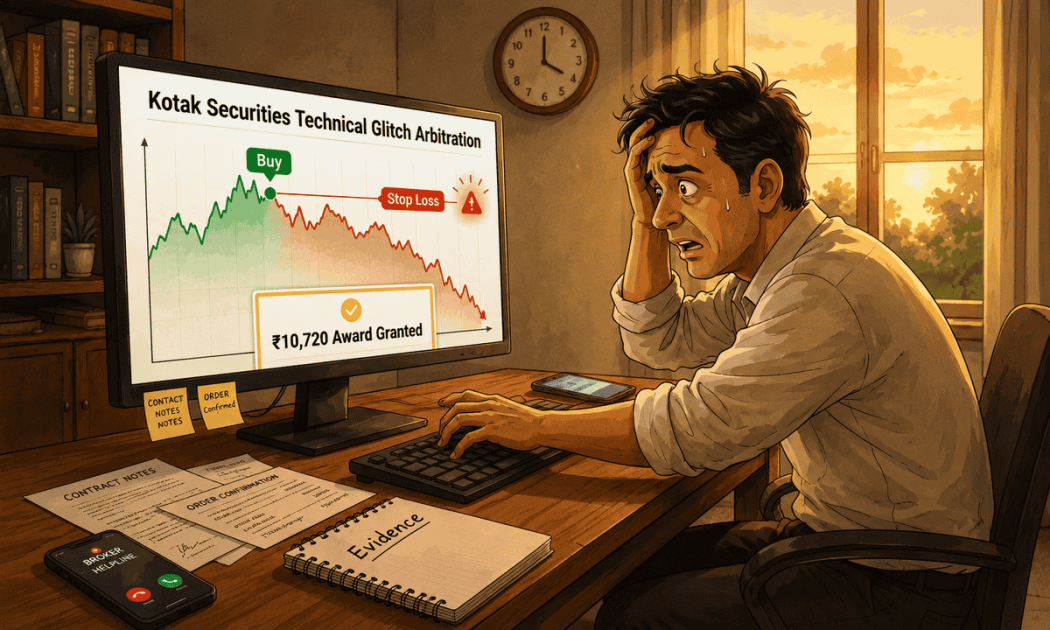
Imagine watching your stop loss sit there uselessly while your losses climb every single minute.
That helpless feeling is exactly why the Kotak Securities technical-glitch arbitration matters to anyone who trades online today.
Before we get into the cases, it helps to know that most Kotak Securities complaints about platform failures fail for one simple, avoidable reason.
Kotak Securities Technical Glitch Arbitration: Two Situations, One Clause
It appears in the voluntary terms and conditions, and it is long. The substance is that the client indemnifies the broker against losses caused by link failure, system failure, equipment failure, communication line failure, security failure on the internet, and technological problems generally.
A second clause usually follows, saying the client will not be compensated for lost opportunity, meaning notional profits on orders that could not be executed.
Together they look comprehensive. In practice, they carve out two very different situations, and confusing them is why most glitch claims fail before they begin.
What the clause does cover:
- A genuine platform outage or crash
- Connection or link failure on the broker’s end
- Exchange-level technical issues beyond the broker’s control
- Notional profits you might have made had an order gone through
What the clause does not cover:
- An order that was accepted by the system and then simply failed to execute
- A stop loss or trigger order that sat unexecuted despite conditions being met
- A known issue the broker had advance notice of and failed to fix
That distinction is not academic. It decided the clearest of the Kotak cases, and it is the first thing worth checking before you assume a glitch clause has already ended your claim.
A Stop Loss That Just Sat There
A client placed a trailing stop loss on a futures contract. The buy leg went through. The market then fell to the price at which the stop loss should have sold him out.
Nothing happened. The position stayed open regardless.
He called the helpline. Then called again. He emailed the same afternoon. Nobody resolved it, and nobody told him he could simply place a fresh sell order himself.
He worked that out on his own the following day. By then the loss had grown to ₹11,100. Had the stop loss done its job, he would have lost only ₹400.
Why the Clause Did Not Save the Broker
The tribunal read the exemption clause against what actually happened, and found a mismatch immediately.
This was not equipment failure, link failure or an outage of any kind. The order had been accepted by the system. The second leg then failed to execute when its trigger condition was met.
The tribunal cited a Delhi High Court judgment holding that where client orders are not executed because of a system issue, the broker is responsible for the loss. A client trading on a broker’s platform has no visibility into it, and providing a safe environment is the broker’s duty alone.
The award was calculated as the gap between the intended outcome and the actual one, coming to ₹10,720 with 10 percent interest attached.
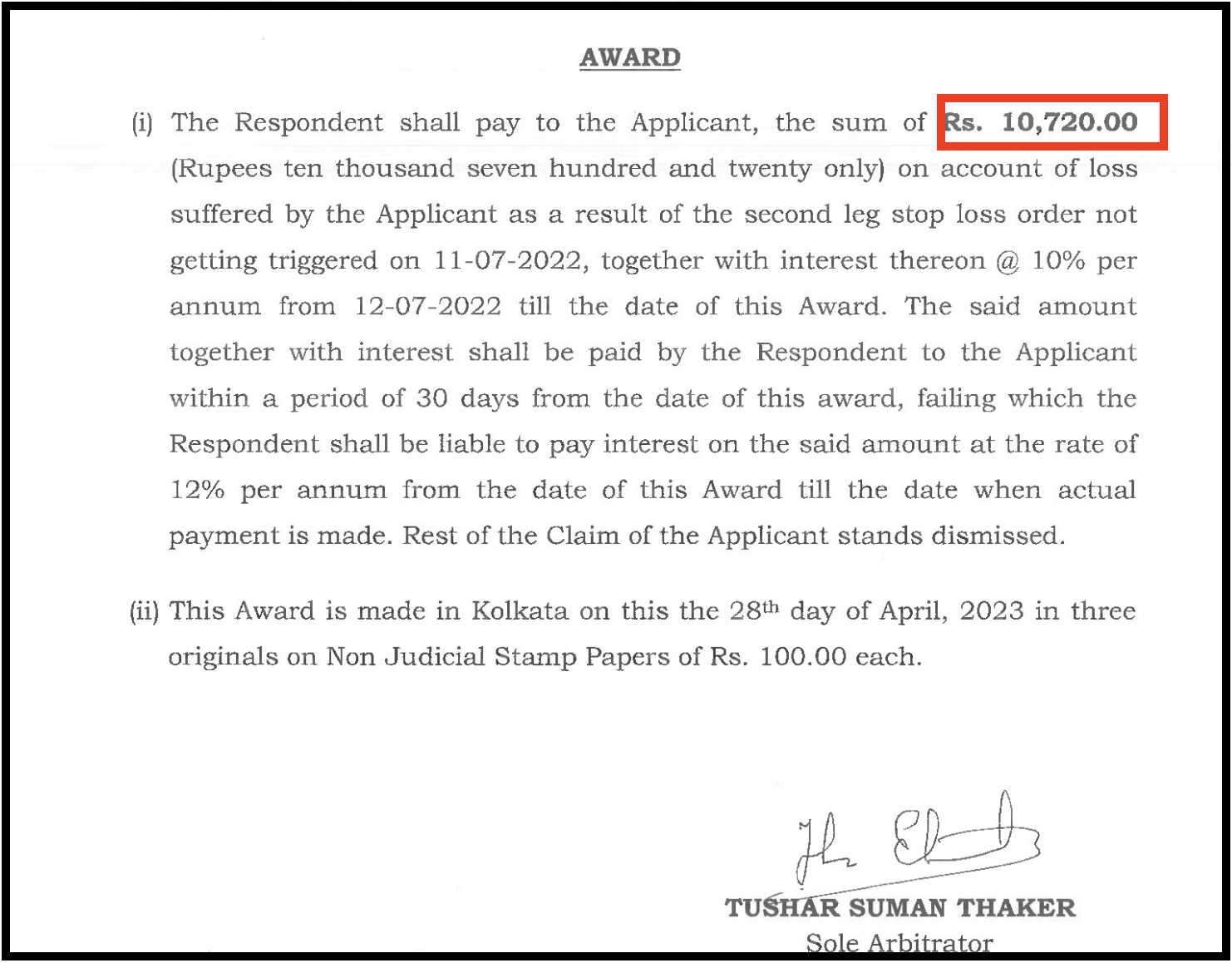
Among the Kotak securities arbitration awards we reviewed, this one shows how a small, precise number can still carry a much larger principle behind it.
When the Failure Was Not a Glitch at All
The second case is not about technology misbehaving. It is about a broker that had two days’ notice and did nothing about it.
A suspended stock was returning to trading. The exchange issued a circular on 17 February announcing dealings would resume on 19 February. Kotak received that circular immediately. Its system was not updated in time.
On the morning of the 19th, a client told the dealer to sell 2,29,000 shares. He was told the system would not accept it. He called back repeatedly for an hour and heard the same excuse. A reduced order finally went through at 10:24, after the stock had already hit the lower circuit.
Meanwhile, over seventeen lakh shares of that same stock changed hands elsewhere on the exchange that day.
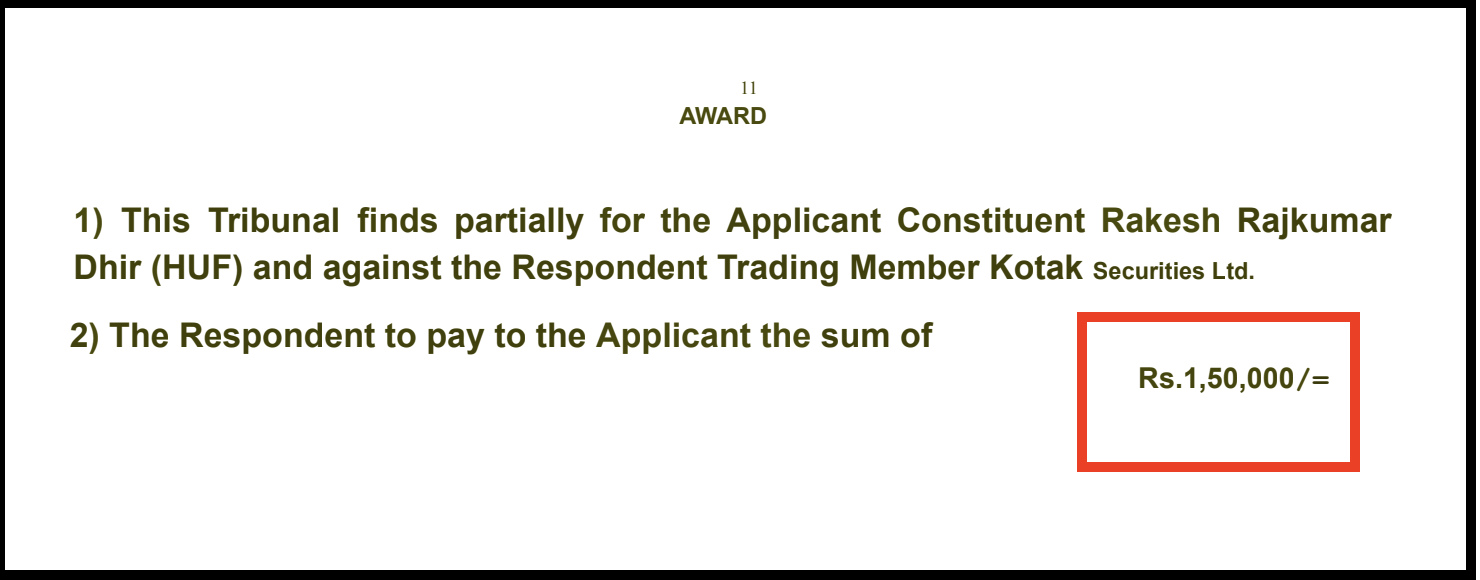
The tribunal called Kotak’s defence weak, even pathetic, and found its claim of receiving the file only that morning was patently false. It awarded ₹1,50,000 in litigation costs and asked the exchange to place the matter before SEBI directly.
A Penalty in a Case the Client Actually Lost
The third matter is the most curious of the three, because the investor lost her claim entirely.
She had instructed her shares moved to another demat account. Days later, her Kotak securities account handling issue became clear when she opened the mobile app and saw those same shares still sitting there. She sold them anyway, unaware they were already gone.
The tribunal held her accountable for that sale. But it examined the app regardless, and found Kotak’s own written statement admitted a system issue was behind the display error.
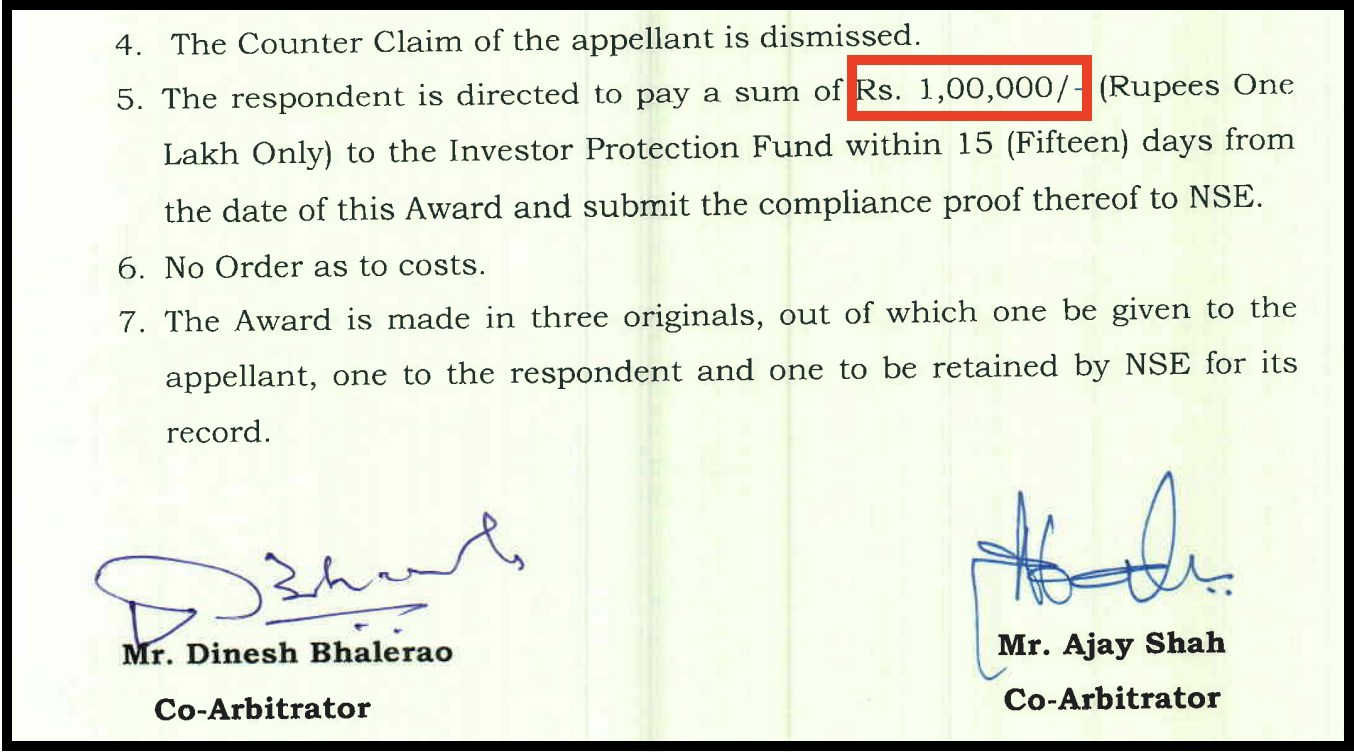
It ordered Kotak to pay ₹1,00,000 into the Investor Protection Fund, even while ruling against the client on her main claim.
What Decides These Kotak Securities Technical Glitch Claims
Reading all three together, the outcome turns on a small number of things.
Whether the order was accepted matters most. An order that entered the system and then failed is a strong claim. An order that never got in during an outage is weak.
Whether you asked for help and what you were told also counts. In the stop-loss case, the helpline gave no useful guidance at all.
Whether your number reflects reality, not hope, decides the amount. The ₹36 lakh claim above was rejected as notional, while the ₹10,720 claim was the actual, provable gap.
If your issue involves Kotak Neo not working during a critical moment, capture the order ID, timestamps, and screenshots the same day it happens.
Does This Sound Like Something You Have Lived Through?
Maybe your stop loss sat frozen on the screen while your losses grew silently in the background. You refreshed the app, hoping it would catch up. It never did.
Maybe you opened your holdings one morning and saw shares that had already left your account days earlier. You sold them anyway, trusting the screen in front of you. Only later did the truth surface.
Situations that often point to a valid claim:
- A stop loss or trigger order that never executed despite conditions being met
- An app or portal showing holdings that no longer actually existed
- A known system issue the broker had advance notice of and ignored
- Support calls that offered no real solution while your loss kept climbing
If any of this feels familiar, you already have the makings of a real grievance. Building it into a claim that actually holds up is a separate process, and the exact steps for that are covered in our guide on how to complaint against Kotak Securities.
Did an order fail on you and the loss keep growing while nobody helped?
We separate the loss the failure caused from the loss the market caused, and build the claim on the distinction tribunals actually apply.
Register with us for a free consultation.
Conclusion
The exemption clause in your account opening kit is real, and it will defeat a claim about a genuine outage or system crash. It will not defeat a claim about an order the system accepted and then failed to execute.
It did not stop a tribunal awarding the difference on a stop loss that never triggered and did not excuse a broker that had two full days to update its system and simply did not.
If a platform failure cost you money, the real question is whether the clause actually describes what happened to you.
Report. Recover. Stay Fraud Free.
It can be. In the reviewed award the buy leg executed and the stop loss leg did not, and the tribunal held the broker liable for the difference, citing a Delhi High Court judgment that a broker is responsible where orders are not executed due to an issue in its system. The client recovered ₹10,720 with 10 percent interest. No. The tribunal read the clause against the facts and found it covers equipment failure, link failure, outages and similar events, but not an order that the system accepted and then failed to execute. Where the clause does not describe what happened, it does not assist the broker. Generally no. One client claimed over ₹36 lakh on that basis and the tribunal rejected it as notional, since nothing guaranteed his shares would have sold at the price he wanted. He received ₹1,50,000 in costs instead, for the broker's failure to update its system. The appellate tribunal held the client accountable for selling shares she had already transferred out, but separately found the mobile app had been displaying holdings that were no longer there, which Kotak's own written statement attributed to a system issue. It held that providing a glitch free application was the broker's duty and ordered the penalty paid to the Investor Protection Fund.Frequently Asked Questions

 Add us as a preferred source on Google »

