

Quick Summary
In February 2024, a three member tribunal ordered Kotak Securities to pay a client ₹48,45,337. She had claimed ₹71 lakh for trades she said were placed without her permission. She did not win on that. Her records were incomplete, she had signed a ledger confirmation, and the tribunal held her partly responsible for her own inattention. She won on something she had not really focused on at all: Kotak had been charging her margin interest for two years without the written margin agreement SEBI requires. No agreement meant no right to charge. Every rupee of that interest came back, with interest on top.
Imagine losing a fight you were sure you would win, and then winning a different one you barely noticed you had.
That is exactly what happened here, and it is why Kotak Securities unauthorised trading arbitration cases deserve a much closer look than most investors give them.
Before we get into the numbers, it helps to understand why Kotak Securities complaints so often miss the strongest argument sitting right in front of them.
Kotak Securities Unauthorised Trading Arbitration: Where Most Claims Go Wrong
When trades appear in your account that you did not authorise, the instinct is to fight over the trades.
- “This one I did not place.”
- “That one I never approved.”
- “Who told you to sell?”
It is the obvious fight, and it is usually the hardest one to win. The broker holds the call recordings. You are arguing about conversations from months ago. Tribunals weigh your silence on contract notes against your objections, and often split the difference between both sides.
The Kotak record suggests a second line of attack that most investors never open. In the largest award, that second line was worth more than the trading claim itself.
Instead of asking whether each trade was authorised, ask what permission the broker had to run the arrangement at all.
What Happened in Kotak Securities’ ₹48 Lakh Case
The client opened her account in March 2018, moved most of her existing shareholding across from another broker, and relied heavily on an employee there for guidance. She was not confident with online platforms at all.
Within weeks, her account was running a debit balance funded by the broker, and it kept running. At points it reached ₹1.3 crore. Interest accrued at 24 percent a year, month after month.
She raised her first written objection in December 2018, disputing a sale of 1,500 shares. She kept objecting. The trading continued anyway. In 2019, she went to a commercial court and obtained an injunction. Kotak took the matter to the Calcutta High Court, which set the injunction aside and sent both sides to arbitration.
She then filed in the Bombay High Court, which told her to go to the arbitral tribunal instead.
She finally filed for arbitration in October 2023, claiming ₹71,88,870 in total.
Among the Kotak Securities NSE arbitration cases we reviewed, this one stands out because the winning argument had almost nothing to do with the trades themselves.
The Two Documents the Tribunal Asked For
Arbitration turned on directions the tribunal issued to both sides. Two of those directions decided the entire case.
The tribunal asked Kotak for proof of pre-trade order placement. Kotak could not provide it. What it filed instead were transcripts of calls made around the trades. The tribunal read them and found something the broker probably did not expect: the transcripts showed Kotak’s dealer suggesting which scrips to buy and sell, at what price, based on where the market was heading, with the client’s representative then agreeing.
That is not a client placing an order. The tribunal called it a blatant violation of the circulars on unauthorised trading, and added a line worth carrying into any dispute of this kind. Post-trade confirmation does not convert a post-trade into a pre-trade order placement.
The tribunal then asked Kotak for the margin trading agreement. This is the one that truly mattered.
SEBI’s master circular requires a trading member to enter into a written agreement with the client, on the lines of a model format, before providing any margin trading facility. It is not optional, and it is not something consent to individual trades can substitute for.
Kotak was asked in the first hearing. It did not produce one and was asked again in the second hearing, with a specific direction to file a copy showing the clauses on interest and pledging of shares. It still did not produce the document. Its final position was that the client’s recorded consent to trades proved the agreement existed somewhere.
The tribunal dismantled that in a single line: “Consent to trades cannot be considered proof of a written agreement, either as primary or secondary evidence under the Indian Evidence Act.“
How a Missing Document Became ₹48 Lakh
Once the agreement was found not to exist, the arithmetic did the rest of the work.
The tribunal went through the financial ledger month by month, from May 2018 to December 2019, adding up the interest Kotak had charged on margin funding. That came to ₹19,08,135.
Because the funding itself was unlawful without an agreement, and because lending funds and recovering interest on them is forbidden without one under the Securities Contracts Regulation Rules, the entire amount had to come back to her.
The tribunal then applied the same 24 percent Kotak had been charging her, running from August 2021, to arrive at ₹11,12,132 as interest on the wrongly recovered interest.
Then it added ₹18,25,069 as interest on the award itself, calculated at 24 percent over 919 days to the date of the award.
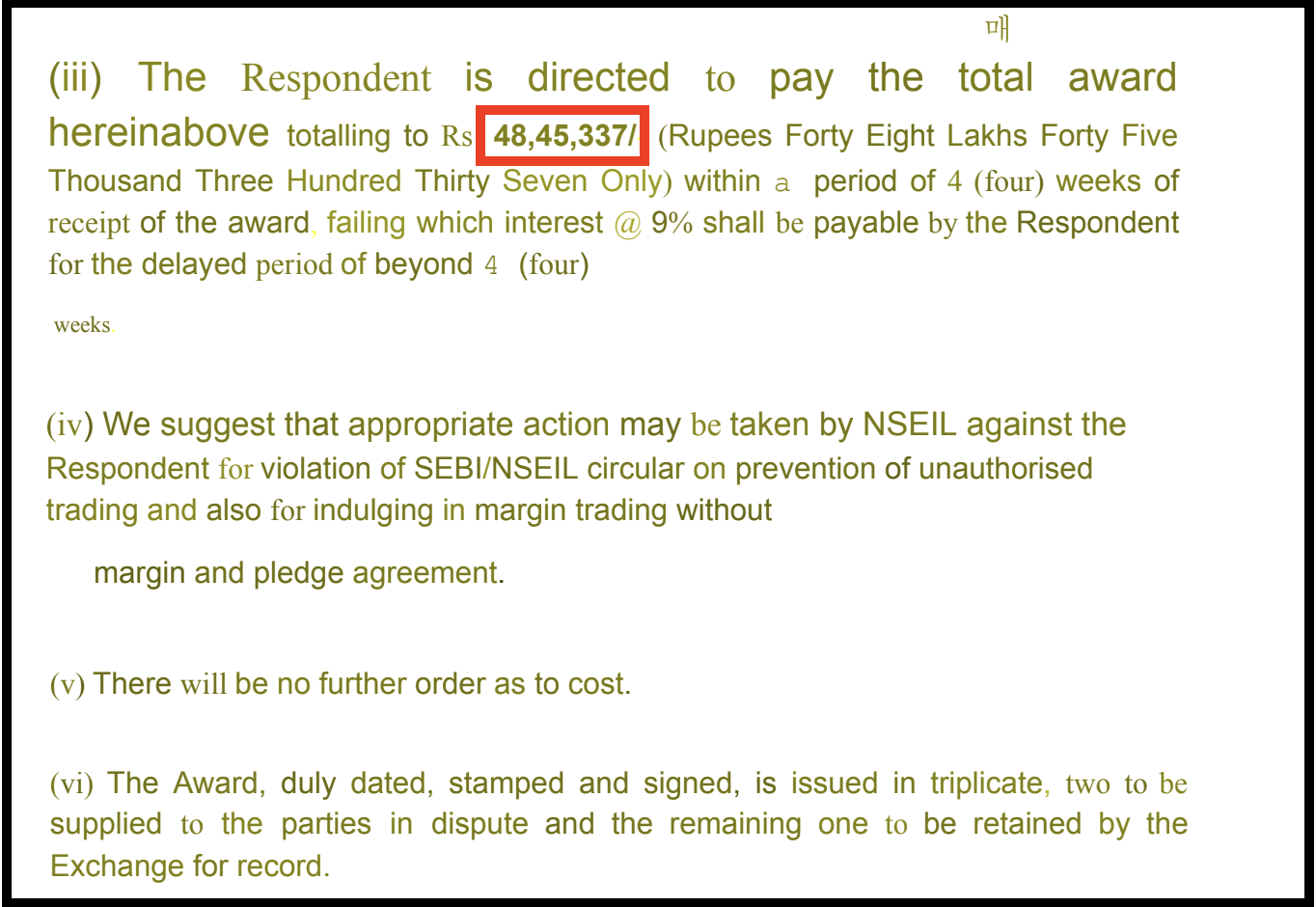
₹48,45,337 in total, payable within four weeks, with 9 percent running after that if Kotak delayed.
The tribunal also recommended the exchange take action against Kotak for the circular violations and for conducting margin trading without margin and pledge agreements.
What She Lost On, and Why It Is Worth Knowing?
This is not a clean sweep, and pretending otherwise would leave you unprepared for your own claim.
Her ₹64.78 lakh claim for shares traded without authorisation failed. She had valued the shares using prices from a date before they even reached her demat account, which the tribunal called grossly misleading.
The tribunal had also directed her to produce a transaction-wise loss calculation, but she did not do so. Instead of seeking monetary compensation, she asked for her shares to be replenished. The tribunal held that this was outside the relief it had the authority to grant.
Her conduct also counted against her in the end. She had signed a ledger confirmation and had received contract notes and margin statements and ignored them. She had left trading decisions to an employee without checking the outcomes. The tribunal invoked the doctrine of estoppel and held she had to bear roughly ₹22 lakh in delayed payment interest that she could not now reverse.
So the picture is mixed and honest. She lost the trading claim, lost the share replenishment claim, absorbed part of the interest, and still walked away with ₹48 lakh because of one missing document.
If you have been charged interest on a debit balance, the agreement behind it is worth asking about before anything else.
Register with us, and we will help you work out what to demand.
Five Hundred Kotak Securities Trades in Half an Hour
Unlike the Kotak Securities technical glitch arbitration cases, where the dispute centres on platform failures, this award involved unauthorised trading and the broker’s failure to detect highly abnormal activity.
A 67-year-old man held an account with a balance of around ₹3,000. He was not comfortable in English and not familiar with the internet. On 24 November 2022, roughly 500 trades ran through his account in about half an hour, involving the sale of more than fourteen lakh shares and generating over ₹13 lakh in brokerage.
That ₹13 lakh in brokerage is a clear case of Kotak Securities excess brokerage charges piling up unchecked.
He emailed the broker at 3:23 that afternoon reporting unauthorised trading. Trading was not stopped. More trades followed the very next day.
The tribunal’s reasoning here was refreshingly practical rather than purely legal. Around 500 trades in thirty minutes can only be executed by someone with real market knowledge and excellent computer skills. It was evident the claimant had not done this trading and that somebody else had.
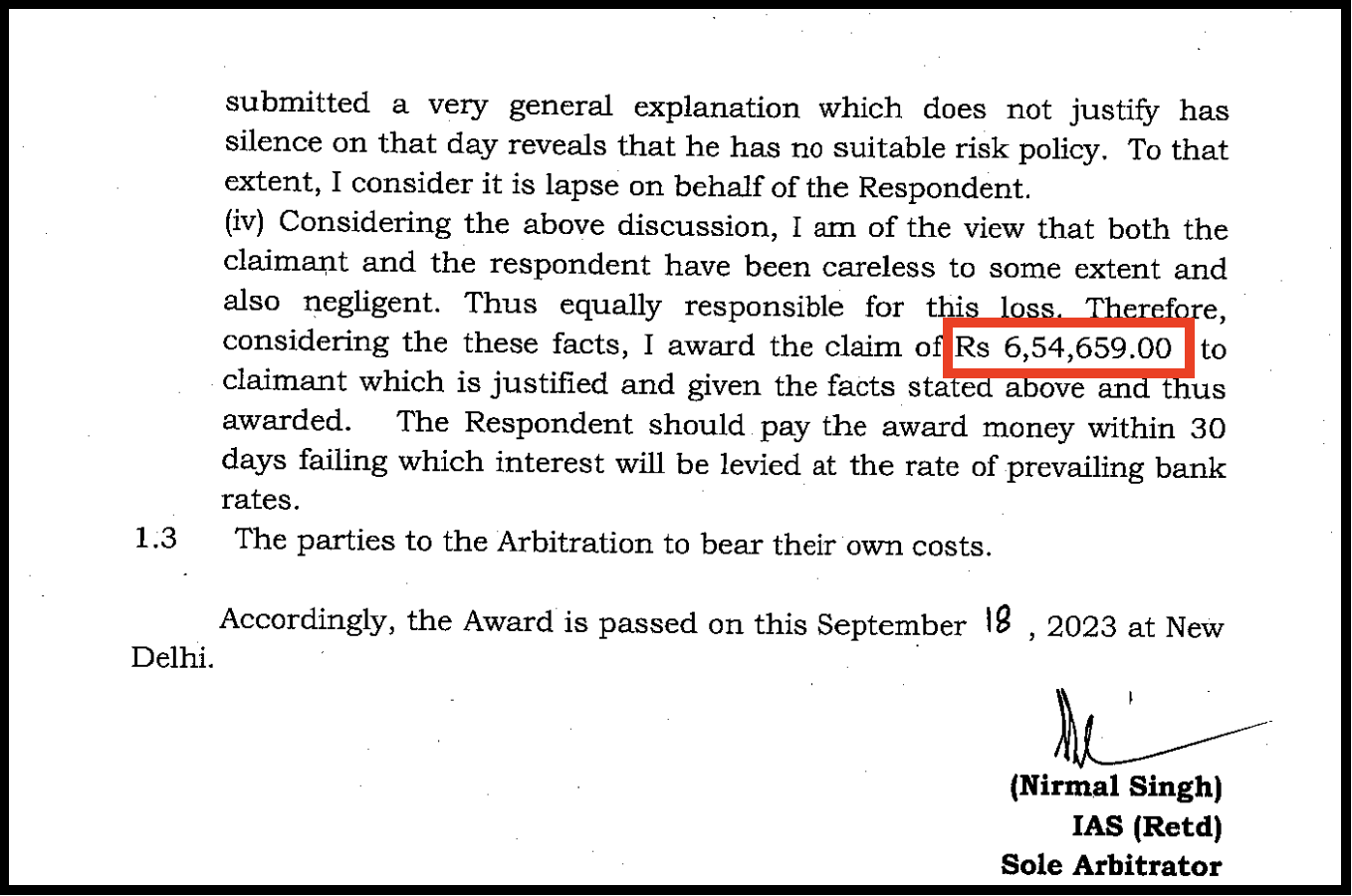
Then came the finding that applies to every account holder reading this. When trading that abnormal appears in a client’s account, the broker has a duty to notice it and act at once. Asked to explain why it had not, Kotak offered a general explanation the tribunal found inadequate, concluding the broker had no suitable risk policy in place at all.
He had shared his password with people he believed were broker staff, which the tribunal held against him. Liability was split evenly between both parties. He recovered ₹6,54,659.
This case is a reminder that Kotak Securities unauthorised trading does not always look like a single suspicious trade. Sometimes it looks like hundreds of them happening faster than any ordinary investor could manage.
Kotak Securities Unauthorised Trading: Your Action Checklist
Both cases were decided by what the tribunal directed the broker to produce, so demand these in order:
- The agreements first: Request the margin trading agreement and pledge agreement in writing. They either exist or they do not, and their absence outweighs most trading disputes.
- Pre-trade evidence, not confirmations: Ask specifically for proof you placed each order before execution, not contract notes or statements.
- Your full ledger: Pull it from day one, since the ₹19 lakh interest finding came from nearly two years of records, not just the disputed period.
- A transaction-wise calculation: Include date, scrip, quantity, buy and sell value, and profit or loss for every disputed trade.
- Written reports of anything suspicious: Password sharing or unexplained activity should be flagged to Kotak immediately, in writing.
- Escalation if the broker fails to respond: Move to the exchange grievance cell before filing for arbitration.
Knowing how to file a complaint against Kotak Securities, with dates and documents attached, is what separates a claim that gets dismissed from one that gets paid.
Conclusion
Two awards, two very different failures behind them.
In one, the broker charged margin interest without first obtaining the mandatory written agreement, and the tribunal ordered it to refund two years of interest charges with interest.
In the other, five hundred trades ran through an elderly man’s account in thirty minutes while the broker’s systems noticed nothing, and the tribunal found there was no risk policy worth the name.
Neither client won on the argument they started with. Both won on something the broker could not produce or could not explain. That is usually where these cases are decided.
Report. Recover. Stay Fraud Free.
It is the written agreement SEBI's master circular requires a broker to sign with a client before providing any margin trading facility. Without it, the tribunal held there was no lawful basis to charge interest on margin funding, and ordered nearly ₹19 lakh of interest returned along with interest on that sum. Only if the recordings actually show you placing it. In the reviewed case the transcripts showed the broker's dealer recommending which scrips to buy and sell, which the tribunal treated as evidence against the broker, holding that post trade confirmation does not convert a post trade into a pre trade order placement. Not automatically. The 67 year old client in the second award had shared his password and still recovered ₹6,54,659, because the broker failed to act on around 500 trades executed in half an hour and was found to have no suitable risk policy. Liability was split rather than denied. She valued the disputed shares using prices from a date before the shares reached her demat account, did not produce the transaction wise loss calculation the tribunal directed her to file, and asked for her shares to be replaced rather than compensated, which the tribunal held it could not order.Frequently Asked Questions


 Add us as a preferred source on Google »

