

Have you ever come across a stock market advisory that promised high daily returns, showed you a SEBI registration number, and made everything look completely above board, only for you to wonder if it was actually safe?
You are not alone. Every day, retail traders across India find themselves at that exact crossroads: a service that looks legitimate, makes confident promises, and has a registration to back it up.
The question is never really about the registration. The real question is: what happens after you pay?
If you have been searching for is Niftypro Trading Research safe, there is a good reason you ended up here. The website looks professional, the Telegram channel has plenty of followers, and the registration number is real.
But before any of that matters, the deeper question every trader eventually arrives at is should you trust Nifty Pro with your actual capital, and that question deserves a far more honest answer than a registration number alone can provide.
A SEBI registration is just the entry point. It authorises a firm to operate; it says nothing about whether they treat your capital with honesty and care.
In this blog, we break down Niftypro Trading Research’s background, the red flags documented by real investors, SEBI’s enforcement actions against the firm, a binding arbitration award won by an investor, and exactly what you can do if you have already been affected.
Is Niftypro Trading Research Safe or Not?
Niftypro Trading Research, run by Sameer Pande, holds an active SEBI Research Analyst registration number (INH000009649) and appears, at first glance, to operate like a standard research-based advisory service.
However, SEBI’s inspection covering May 2022 to January 2024 identified multiple regulatory concerns, including misleading marketing claims and profit-assurance-related practices.
So, is NiftyPro trading research safe or not?
To answer this honestly, we need to go beyond the registration certificate and look at what real clients experienced, what SEBI confirmed, and what the patterns actually reveal.
Here are the key red flags, drawn from real Nifty Pro user reviews and SEBI’s own documented findings, that every trader must read before spending a single rupee.
1. Early Profits Used to Build Trust
A user gave a “minus rating” and described a sequence that will feel familiar to many defrauded investors: Niftypro started by showing him profitable trades, built his confidence, and then switched to a pattern of consistent losses followed by daily demands for more money.
When he hesitated to pay, he was told he would be blocked from the service entirely.
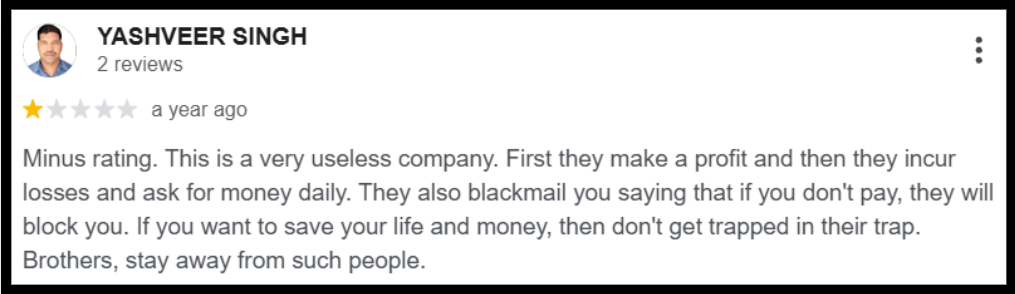
This aligns directly with the inducement violations SEBI confirmed in its inspection.
Generating early profits to establish trust and then leveraging that trust to push clients toward larger financial commitments is exactly the conduct SEBI’s PFUTP Regulations prohibit.
Threatening a client with service termination unless they pay more money contradicts every standard of fair dealing that a registered Research Analyst is required to uphold.
2. Small Demo Profits Used Before High-Fee Upselling
Another user describes one of the most detailed and structured accounts of how Niftypro operated. She was first shown a demo call with ₹1,000 in profit. Then she was asked to pay a ₹5,000 service fee.
After paying, the tips led to heavy capital losses, and immediately after, she received a demand for ₹25,000 more, framed as a “discounted 2-month fee.”
She lost ₹1 lakh in capital and paid ₹30,000 in fees, a total of ₹1.3 lakh gone in just two days.
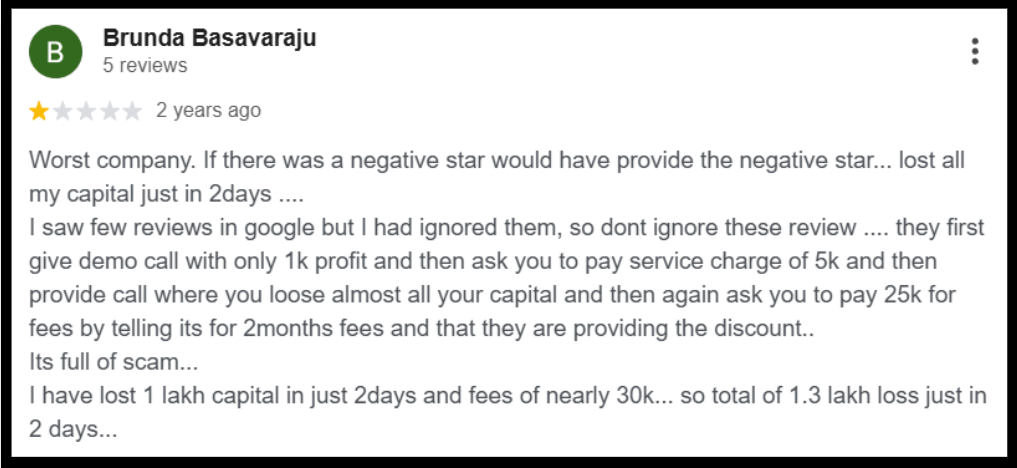
This is a textbook mis-selling sequence. A controlled demo win creates the initial hook. The fee payment locks the client in. Losses follow. And the upsell is presented as the path to recovering those losses.
3. Guaranteed Daily Profit Promises by Sales Representatives
SEBI’s inspection found that Niftypro’s sales staff were making specific, quantified income guarantees to potential clients during sales calls.
Representatives assured prospects that a capital of ₹50,000 would generate between ₹8,000 and ₹10,000 in daily profits, and that subscription fees could be fully recovered within just 2 to 3 trading days.
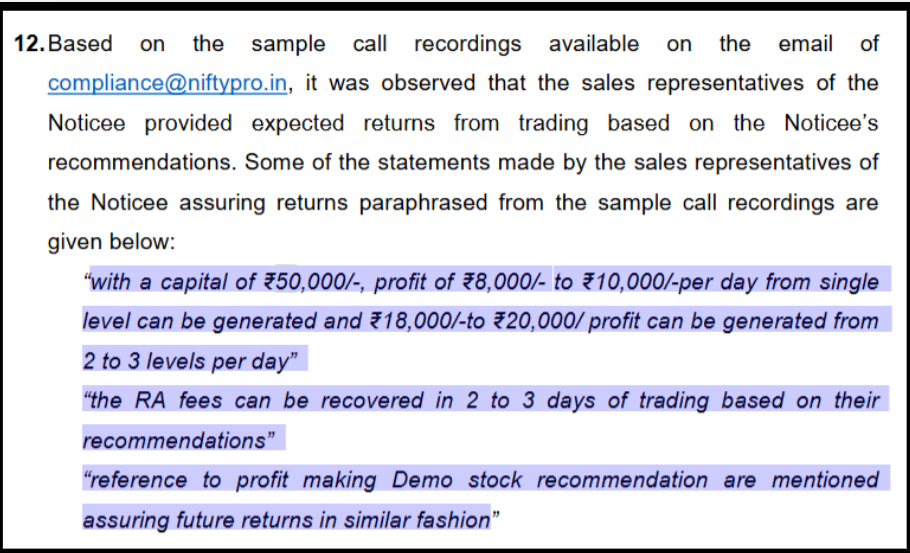
These were not vague encouragements; they were definitive profit promises designed to persuade investors to subscribe.
SEBI classified this as inducement, violating Regulations 3(a), (b), (c), and (d) and Regulations 4(1), 4(2)(k), (o), and (s) of the PFUTP Regulations, 2003, as well as Sections 12A(a), (b), and (c) of the SEBI Act, 1992.
4. Profit-Sharing Demand
One user describes exactly the illegal arrangement that SEBI formally penalised Niftypro for. He was given one profitable stock tip and then asked to share 50% of his profits with the firm.
He paid. The very next call led to a complete loss of his capital, amounting to ₹36,000.
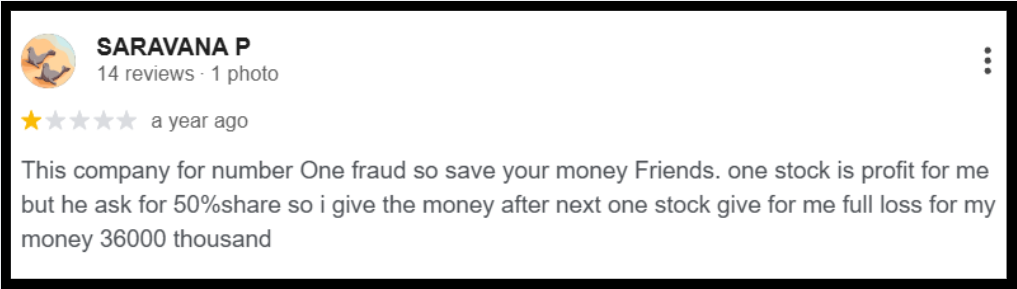
SEBI’s regulations categorically prohibit Research Analysts from entering into profit-sharing or performance-linked fee arrangements with clients.
This rule exists for a clear reason: if an analyst’s income depends on what the client earns, their advice stops being objective.
5. Claiming “90% Accuracy” in Intraday Calls
Niftypro’s website displayed a prominent claim: “We maintain up to 90% accuracy in intraday calls in all segments.”
SEBI’s Advertisement Circular (SEBI/HO/MIRSD/MIRSD-PoD-2/P/CIR/2023/51, April 2023) under Clause C(x) categorically prohibits Research Analysts from making any accuracy-based or performance-based representations in any marketing material.

Claiming a near-perfect accuracy rate creates an entirely unrealistic expectation.
It implies to investors that market outcomes can be reliably predicted at a 90% rate, which is misleading by definition, and a direct violation of the rules every registered RA must follow.
SEBI confirmed this violation and held it as a breach of the Advertisement Circular.
Taken together, these accounts describe the same experience from different investors.
Different amounts, different time periods, but an identical structure: a profitable start to build trust, losses once committed, financial pressure to pay more, and a firm that changes its position the moment accountability is demanded.
Also Read: Supreme Investrade WhatsApp fraud proof. What did the representatives actually promise clients on WhatsApp?
SEBI Actions Against Niftypro Trading Research
SEBI did not act on a single complaint.
It conducted a full thematic inspection covering 20 months of Niftypro’s operations, examined website content, Telegram posts, internal call recordings, lead generation sheets, and client communications.
Here is what each one found.
Niftypro SEBI Order
SEBI’s Adjudicating Officer examined the inspection findings and confirmed multiple violations across the SEBI (Research Analysts) Regulations, 2014, the PFUTP Regulations, 2003, and SEBI’s Advertisement Circular of April 2023.
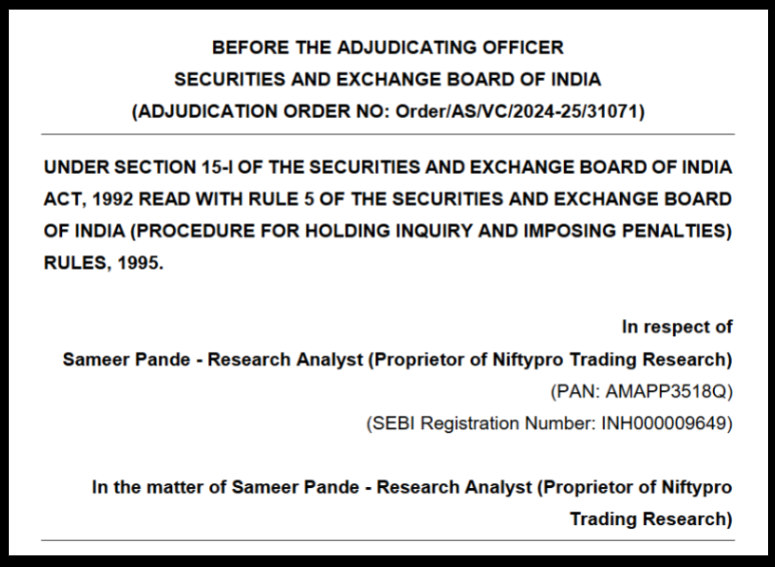
Violations confirmed in this order:
- Claiming “90% accuracy in intraday calls” on the website is a direct violation of Clause C(x) of SEBI’s Advertisement Circular, which prohibits any accuracy-based or performance-based claim in RA marketing material.
- Sales representatives guaranteeing that ₹50,000 in capital would generate ₹8,000 to ₹10,000 in daily profits and that subscription fees would be recovered within 2 to 3 trading days, constituting inducement under Regulations 3(a), (b), (c), (d) and 4(1), 4(2)(k), (o), (s) of the PFUTP Regulations, 2003, and Sections 12A(a), (b), (c) of the SEBI Act, 1992.
- Using superlative terms like “Best Market Tips” and “accurate” in promotional content violates Clauses 1, 2, 6, 7, and 8 of the Code of Conduct under Regulation 24(2) of the RA Regulations.
- Displaying client testimonials portraying consistent high returns alongside only a minimal footer disclaimer, violating Clause C of the SEBI Advertisement Circular, as the overall impression on the website was deceptive.
- Entering into a profit-sharing arrangement with a client, a structure expressly prohibited under SEBI regulations, as it compromises the objectivity and independence of research advice.
Penalty imposed: ₹2,00,000 under Section 15EB of the SEBI Act, 1992.
The Adjudicating Officer noted that as a registered RA, Sameer Pande had failed in his fiduciary duties to clients and had not complied with the Code of Conduct under the RA Regulations.
Niftypro Trading Research Arbitration Case
Beyond the regulatory orders, one investor took Niftypro all the way to formal arbitration and won.
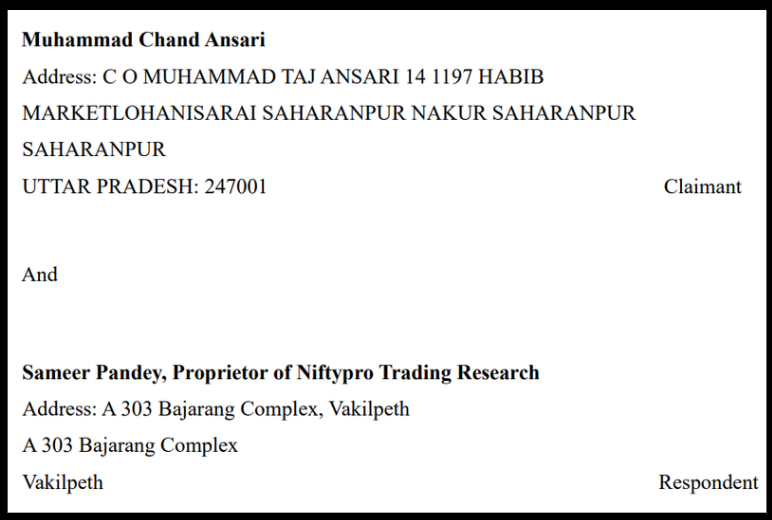
- Case Reference: Arbitration No. NSE-RA-2024-12-229923
- Arbitrator: Amar Sinha, Retired District Judge
- Forum: CORD, empanelled by NSE via SEBI’s SMART ODR framework
- Hearing Date: 24 March 2025 |
- Award Date: 29 April 2025
Muhammad Chand Ansari from Saharanpur was pitched a ₹1,00,000 monthly package he could not afford.
When he said so, Sameer Pande proposed a profit-sharing deal: 30% of profits for the firm, ₹55,000 payable upfront. Chand agreed and paid.
What followed were intraday calls with no stop-loss protection. His trades went consistently against him.
By the end, ₹4,65,000 of his savings had been wiped out. When he sought accountability, Niftypro changed its story, claiming the ₹55,000 had always been a standard non-refundable service fee, not a profit-sharing payment.
Arbitral Award: ₹4,65,000, to be paid within one month. Failure to pay attracts 15% annual interest until full recovery.
This case proves that even after a firm denies wrongdoing and presents a signed consent form as a defence, documented evidence and the right escalation path can produce a full, binding recovery.
How to Report Against Sameer Pande?
If you have already subscribed to Niftypro Trading Research and believe you were misled, here is exactly what you should do, in the right order.
Step 1: Preserve All Your Evidence Immediately
Save every payment receipt, bank transfer record, Telegram message, call recording, and screenshot of any tips or promises.
Do not delete anything. This evidence is the foundation of every step that follows.
Step 2: Send a Formal Written Complaint to the Firm
Write a clear, formal complaint to Niftypro Trading Research directly. Describe the specific conduct that harmed you and the resolution you are seeking.
Allow 7 to 10 working days for a written response. Keep complete records of everything you send and receive.
Step 3: File a Complaint in SCORES
If the firm does not respond adequately, escalate to SEBI’s investor grievance portal at scores.sebi.gov.in.
Select “Research Analyst” as the intermediary type, enter the registration number, describe the specific violation clearly, and attach all supporting documents.
Step 4: Register a Complaint with SMART ODR
If SCORES does not produce a satisfactory resolution, move to SEBI’s SMART ODR platform for structured dispute resolution, including conciliation and, if needed, arbitration.
Step 5: Share Market Arbitration
For disputes involving fee recovery or compensation for specific losses caused by advisory conduct, formal arbitration provides a binding outcome.
Need Help?
If you are unsure where to begin or how to build a case that gets results, you do not have to figure this out on your own.
Register with us, and we will assess your situation, organise your evidence, draft your complaint with the right regulatory language, and support you through every stage, from SCORES to arbitration if needed.
Conclusion
Is Niftypro Trading Research safe? The answer is not a simple yes or no, but the record laid out in this blog should give every trader serious reason to pause before subscribing.
Niftypro holds an active SEBI registration, but that registration now sits alongside two formal regulatory orders, a ₹2 lakh monetary penalty in December 2024 and a permanent regulatory censure in May 2025.
It also sits alongside a binding arbitration award of ₹4,65,000 won by an investor who was defrauded through an illegal profit-sharing arrangement.
Real client reviews describe a consistent, structured pattern: early profits to build trust, escalating losses once committed, financial pressure to keep paying, and a firm that denies all accountability the moment it is challenged.
Before subscribing to any research analyst, check their enforcement history on SEBI’s official website. It is free, public, and often the most revealing thing you will read.
Your capital deserves better than a confident sales call and a Telegram channel with a disclaimer in the footer.





 Add us as a preferred source on Google »

