
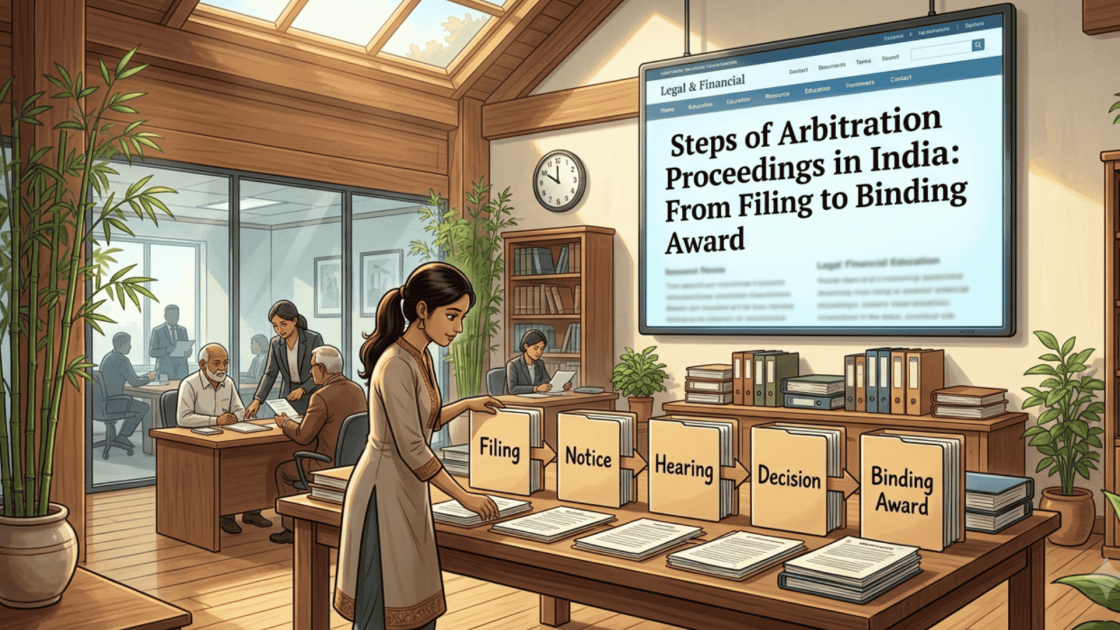
Quick Summary
Arbitration proceedings in India run through seven legal stages: filing, scrutiny, arbitrator appointment, the respondent’s reply, the hearing, the reasoned award, and the window to challenge it. The whole process runs under the Arbitration and Conciliation Act, 1996, and for stock market disputes, the exchange’s framework replaces the arbitration agreement a commercial case would need. Your claim must be filed within 3 years of the dispute under the Limitation Act, and if the other side skips the hearing, the case can proceed ex parte and still end in a binding award. This page walks you through each stage.
You have decided to take your broker or advisory firm to arbitration, and now the legal side of it feels bigger than the dispute itself.
Hearings, arbitrators, awards, Acts from 1996, it sounds like a courtroom drama you never wanted a role in.
Here is the truth: the proceedings run through seven defined stages, and none of them needs you to be a lawyer.
This page walks you through each stage as it will actually happen to you, so nothing in the process catches you off guard.
What Do Arbitration Proceedings Need Before They Start?
Three conditions open the door, and missing any one of them closes it.
You need a dispute with a registered market participant, a failed attempt at the earlier grievance stages, and a claim filed within time.
The grievance condition trips up the most investors, because arbitration is the last stage, not the first.
If your exchange complaint stage is still incomplete, our guide on how can I complain to NSE covers that stage from the first email to closure, and completing it is what opens the arbitration door.
The time condition is stricter than most people expect: the claim must be filed within 3 years from the date of the dispute under the Limitation Act, and a matter already filed in court on the same issue cannot come to arbitration.
And the dispute itself must be the kind arbitration accepts, a list we cover in full on our page: what matters can be referred to arbitration.
Conditions met?
Then here is exactly what happens next, stage by stage.
Arbitration Proceedings in India: Step by Step
The proceedings move in a fixed order, and no stage can be skipped or rushed, because protecting both sides equally is the whole purpose of arbitration.
Seven stages sit between your application and an enforceable decision, and here is the part that should relax you: only three of them need anything from you.
You file, you appear at the hearing, and you stay responsive in between.
The system runs the rest.
So go through each stage below as it will happen to you, and note the ones where your action decides the outcome:
Step 1: You File the Arbitration Application
Everything starts with a written application to the concerned stock exchange, with the arbitration fee paid.
The application carries your story in structured form: a summary of the dispute, the amount you claim, and every piece of evidence, contract notes, ledger statements, bank records, and communication.
Weak applications die here, not at the hearing.
The dispute may be genuine, but the application is what the system sees.
Step 2: The Exchange Checks and Registers Your Case
Before any arbitrator sees your file, the exchange goes through it: is the application complete, is the matter one arbitration can handle, are the documents attached.
If everything is in place, your case gets registered, and you receive a reference number that stays with it till the very end.
But if something is missing, or the matter turns out to be one arbitration cannot handle, the case can get closed before it even begins.
That situation, and what you can do about it, is covered on our page on the termination of arbitration proceedings.
So before you submit, go through your file once more like the exchange will: complete application, right kind of dispute, every document attached.
Step 3: An Arbitrator Is Appointed, and You Do Not Pick One
In commercial arbitration, parties negotiate arbitrators and sometimes end up in court over the appointment.
Your case skips all of that.
The exchange appoints arbitrators through an automated system, from a panel of trained professionals, retired judges, legal experts, market specialists, bound by SEBI’s code of conduct.
Smaller claims get a sole arbitrator, while larger claims go before a tribunal of three, with the threshold and exchange-specific rules covered on our page on NSE arbitration process.
Neither you nor the broker chooses the decision maker, and that is precisely what keeps the process neutral.
Step 4: The Respondent Must Answer
The broker or advisory firm is formally notified and must respond: a written reply, counter evidence if any, and confirmation of participation in the hearing.
While you wait for their reply, you do not have to sit in the dark.
Our guide on how to check arbitration case status shows where your case stands at any point.
Their silence does not save them, as you will see at the hearing stage.
Step 5: The Hearing Is Scheduled and Held
Both parties get the date, time, and mode of hearing, physical or virtual, with hearings typically scheduled within 30 days of the arbitrator’s appointment.
At the hearing, you present your case first, the respondent defends, and the arbitrator questions both sides and examines the documents.
And here is the rule that protects you if you show up prepared. If the other side fails to appear, the case can proceed ex parte, decided on the evidence available.
A broker cannot escape the proceedings by ignoring them.
What the hearing itself feels like from the inside, movement by movement, sits on our page: conduct of arbitration proceedings.
Preparing your file and worried one missing document will sink the whole case at the hearing?
We will build the application the way arbitrators read them, map every document to the violation it proves, and stand with you through each hearing.
Step 6: The Arbitrator Passes a Reasoned Award
After the hearings close, the arbitrator drafts the award, and the law demands it be a reasoned decision, not a bare yes or no.
The award is generally issued within 30 days of the final hearing, communicated to both parties, and it binds them both under the Arbitration and Conciliation Act, 1996.
That word binding is what makes the whole route worth it: this is not a recommendation the broker can shrug off.
Step 7: The Award Is Enforced, or Challenged on Narrow Grounds
The award is in your hand, and this final stage is about turning the paper into money.
A clock starts for the other side the moment the award is passed, and they now have exactly two options: pay you within the deadline, or challenge the award in court.
The challenge route is deliberately narrow. Courts accept only limited legal grounds, like a serious flaw in how the proceedings ran, and never simple disagreement with the outcome.
And before the broker can even file that challenge, money has to move in your direction of safety, not theirs.
For most investors, this stage ends quietly: the deadline arrives, the payment comes, and the case closes.
For the cases where it does not, the enforcement rules, the deposit the broker must make before challenging, and exactly what to do when payment never comes are covered on our page on the NSE arbitration award.
How Is This Different From Regular Commercial Arbitration?
Running the checklist on this one before rewriting: the section needs a context lead-in, and it has one repetition problem — “faster, cheaper” near the end re-states what the three differences just showed, and the fee detail brushes against Step 7’s territory. Here’s the section, context set, repetition removed, in speech:
How Is This Different From Regular Commercial Arbitration?
At some point, you or someone helping you will search about arbitration and land on pages full of arbitration agreements, court appointments under Section 11, and lawyer-driven proceedings between companies.
Reading those, you might panic and wonder if you have taken on more than you can handle.
You have not.
Those pages describe commercial arbitration between businesses, and your version as an investor differs in three ways that all work in your favour: the agreement, the arbitrator, and the cost.
- You never signed an arbitration agreement, and you do not need one: Companies arbitrate because their contract says so. Your right comes from the exchange and SEBI framework itself, which binds every registered market participant.
- You never approach a court to appoint an arbitrator: Commercial parties fight appointment battles under the Act. Your arbitrator arrives through the exchange’s automated panel system, no court needed.
- Your costs are fixed by slabs, not open-ended: Commercial arbitration costs run with lawyers and institutions. Your fee follows a published slab based on your claim amount.
The same 1996 Act stands behind both versions, which is why your award carries the same legal force as a company’s does.
Most matters conclude within four to six months of filing, and the stage-by-stage timeline sits on our guide: how long does arbitration decision take.
Conclusion
The proceedings that sounded intimidating at the top of this page are seven stages, each with a clear job: file, verify, appoint, reply, hear, decide, enforce.
The law behind them protects the prepared investor at every turn — the automated appointment keeps it neutral, the ex parte rule punishes absconding brokers, and the reasoned award requirement means you will always know why you won or lost.
Your part is simpler than the machinery: file in time, document everything, and show up.
The process does the rest.
Report. Recover. Stay Fraud Free.
Frequently Asked Questions
Three years from the date of the dispute, under the Limitation Act. But waiting anywhere near that long weakens evidence and can inflate fees, so treat the deadline as a backstop, not a plan.
No, the process is designed for parties to represent themselves. That said, brokers usually appear with professionals, so experienced representation levels the field, especially in structuring evidence and handling the hearing.
The case proceeds ex parte, meaning the arbitrator decides on the evidence available without them. Their absence does not stall your case, and awards passed ex parte bind them just the same.
Yes. Hearings run physically or virtually, and the filing, notifications, and status tracking all work online, which is why investors from any city can pursue a case without travelling to the exchange.
Both parties deposit fees as per the claim slab when the case begins, and the party that wins gets its deposit refunded. Delay in filing adds late fees, which is one more reason to move early.





 Add us as a preferred source on Google »

