
Quick Summary
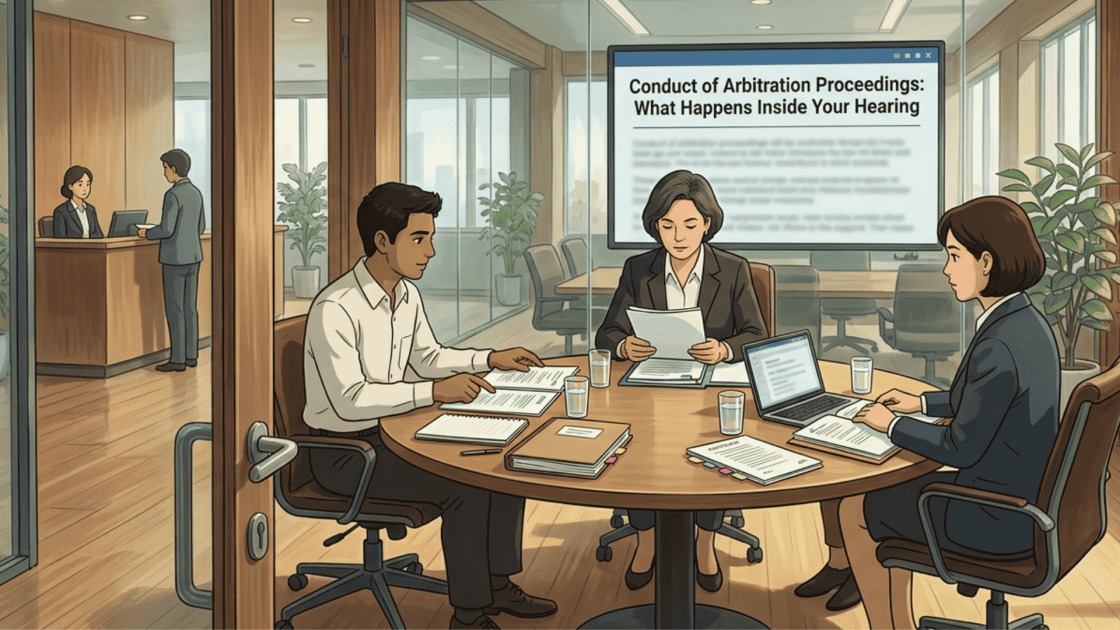
The conduct of arbitration proceedings covers how your case actually runs once it is admitted: the notices, the document exchange, and above all the hearing itself. Hearings are less formal than courtrooms but follow a fixed rhythm of six movements, from the arbitrator’s opening to both sides’ closing statements, held virtually or at exchange centres, and most matters finish in one or two sessions. If the other side stays absent, the case proceeds ex parte on the available evidence. This page walks you through the room before you enter it, so the day feels familiar instead of frightening.
Your hearing date just arrived by email, and suddenly this stopped being paperwork.
You are picturing a courtroom, with a judge’s bench, objections, cross-examinations, and you in the middle of it without a script.
Here is what nobody tells you: the room is nothing like that picture, and the whole session runs on a rhythm you can learn in ten minutes.
Reaching this stage of arbitration in share market disputes means the filing battles are behind you, and only the room remains.
This page walks you through the proceedings exactly as you will experience them, from the notices before the hearing to the moment the session closes.
What Does Conduct of Arbitration Proceedings Mean?
Somewhere between filing your case and getting your hearing date, you probably paused and wondered what actually happens in there.
Who talks to whom, who sees your documents, and who makes sure the broker’s side plays fair.
That entire in-between world is what the conduct of proceedings means.
Filing only tells the system what your dispute is.
The conduct is everything that follows, covering how the two sides communicate, how evidence moves between them, how the hearing runs, and how the decision is finally made.
The whole purpose of arbitration is fair justice at investor speed, so these rules exist to keep the process fair and time-bound for both sides equally, under SEBI’s framework.
And for you, all of it comes down to one comforting fact. Nothing in the proceedings is improvised.
Every notice, every deadline, and every hearing follows a set structure, which means knowing that structure is most of your preparation done.
One thing to check before any of this applies to you.
The hearing room only opens after the complaint route is completed, so if that stage is still pending, start with our guide on how to file complaint in NSE and come back to this page when your date arrives.
What Happens Before the Hearing Day?
Your case got admitted, and then the inbox went quiet. Days pass, sometimes weeks, and you start wondering if anyone is actually working on it.
They are.
This quiet stretch is the busiest part of the process, and four things are happening in it without needing you to appear anywhere.
The broker gets formally notified and time to reply. The arbitrator gets appointed through the exchange’s automated system.
Both sides submit their evidence, from contract notes and ledger statements to call records, everything the case will stand on.
And then the hearing gets scheduled, with the date, time, and mode sent to both parties.
Your only job through all of it is staying responsive. Whatever gets asked of you, send it on time, because your delays are the only ones you control.
The full sequence these events sit inside, from filing to the binding award, is mapped on our page: procedure of arbitration proceedings in India.
How Does the Arbitration Hearing Actually Run?
So the notices are done, the documents are in, and the calendar has a date on it.
This is the part everything else was building toward.
The night before a hearing, most investors sit with the same worry.
What if I get asked something I cannot answer? What if I miss my moment? What if I freeze in front of everyone?
Here is what dissolves that worry.
The session follows the same six movements, in the same order, every time, whether your hearing happens over video or at an exchange arbitration centre.
Nobody gets ambushed in this room, because the structure never changes.
Those six movements make one simple rhythm.
The arbitrator opens, you present, the broker replies, the questions come, and both sides close with final statements.
Walk through each movement in detail now, and on the day you will know exactly where you are and what comes next:
- The arbitrator opens. The process gets explained, and both parties are told how the session will run. Nothing starts without this.
- You present first. As the claimant, you walk through your story with your documents: what happened, what it cost you, and what proves it.
- The broker responds. Their side counters your claims and presents their own documentation.
- The questions come. The arbitrator questions both sides, not to trap anyone, but to understand the dispute properly. Straight answers serve you better than rehearsed speeches.
- An adjournment, only if truly needed. If genuine evidence gaps surface, a further session gets scheduled. This is the exception, not the pattern.
- Both sides close. Each party summarises its position in final statements, and the session ends.
Most matters finish in one or two sessions. Complex cases simply repeat the rhythm until the arbitrator has what the decision needs.
Hearing date on your calendar and rehearsing arguments in your head every night?
We will prepare you for exactly this room: which documents lead, what the arbitrator will ask, and how your story holds together under questions.
How Should You Conduct Yourself in the Hearing?
The arbitrator has seen hundreds of investors in your chair, and the ones who do well share habits anyone can copy.
Four of them cover nearly everything the room expects from you:
- Let your documents lead: Point to the record for every claim you make, because in this room, paper outweighs passion.
- Answer what is asked: When the arbitrator questions you, respond to that question directly and honestly, even when the answer feels imperfect.
- Stay respectful under provocation: The broker’s side may dismiss or irritate you. Composure reads as credibility, and the arbitrator notices both sides’ conduct.
- Never guess: If you do not know or do not remember, say so. A wrong guess discovered later damages everything true you said before it.
What If the Broker Simply Does Not Show Up?
You prepared for weeks, took the day off, and now a thought creeps in.
What if the other chair just stays empty? Can the broker kill your case by refusing to face it?
It happens more than you would expect, and the rules already have an answer waiting.
If a party stays absent despite proper notices, the arbitrator proceeds ex parte, hearing the case on the evidence available.
The absent side loses its chance to defend, not the present side’s chance to win.
So an empty chair across from you changes nothing about your day. You present as planned, the questions come as planned, and the decision follows the record.
And if circumstances end the case before any award at all, that is a different situation with its own rules, covered on our page on the termination of arbitration proceedings.
What Happens Once the Hearing Ends?
The closing statements finish, the screen goes dark or the room empties, and you walk out with the strangest feeling. After months of activity, there is suddenly nothing left for you to do.
That feeling is accurate, because the work has now moved entirely to the arbitrator’s desk.
The submissions get reviewed, and a written award follows, generally within 30 days of the final hearing, sent to both parties.
When it arrives, the document carries three things.
The outcome, the compensation directed, if any, and the reasoning behind the decision.
Read all three, because the reasoning tells you whether the matter is truly settled or worth taking further.
From your side, only the waiting remains, and most matters conclude within four to six months of filing overall.
Where each of those weeks goes, stage by stage, sits on our guide: how long does it take to get an arbitration decision?
Conclusion
The hearing that felt like a courtroom drama is six movements in a room built for people exactly like you.
You now know the order, your part in it, and the habits that make the arbitrator’s job of believing you easier.
Prepare your documents, learn the rhythm once, and walk in knowing what comes next.
The investors who do well in that room are rarely the best speakers. They are the ones who came knowing how the room works.
Report. Recover. Stay Fraud Free.
Frequently Asked Questions
Both modes run, and the notice tells you yours. Virtual hearings happen over video conference, while physical ones are held at exchange arbitration centres. The six movement structure stays identical either way, so preparation does not change.
No. Plain, honest language works better than legal vocabulary, because the arbitrator wants your account, not a performance. Present your documents, tell your story in order, and answer questions directly. That is the entire speaking requirement
Yes, you can appear with an authorised representative or professional support, and brokers usually do. Someone experienced beside you helps most during questioning, where knowing which document answers which question saves the moment.
The proceedings rely on your submitted documents, not your memory. If a point lives in your evidence, it is already before the arbitrator, and questioning gives you chances to return to it. The record protects you when nerves do not.
The appointed arbitrator conducts the proceedings from start to finish. Smaller claims go before a sole arbitrator while larger ones get a tribunal of three, all drawn from the exchange's panel of independent professionals through automated selection. Neither party has any hand in choosing them.





 Add us as a preferred source on Google »

